. 2006 May 9;103(19):7454-9.
doi: 10.1073/pnas.0600771103. Epub 2006 Apr 28.

Evolution of a cytoplasmic tripartite motif (TRIM) protein in cows that restricts retroviral infection

Affiliations

Evolution of a cytoplasmic tripartite motif (TRIM) protein in cows that restricts retroviral infection

Zhihai Si et al. Proc Natl Acad Sci U S A. .

Abstract

Primate tripartite motif 5alpha (TRIM5alpha) proteins mediate innate intracellular resistance to retroviruses. In humans, TRIM5 is located in a paralogous cluster that includes TRIM6, TRIM34, and TRIM22. Although TRIM6 and TRIM34 orthologs are found in other mammals, TRIM5 has to date been identified only in primates. Cow cells exhibit early blocks to infection by several retroviruses. We identify a cytoplasmic TRIM protein encoded by LOC505265 that is responsible for the restriction of infection by several lentiviruses and N-tropic murine leukemia virus in cow cells. Susceptibility of N-tropic murine leukemia virus to 505265-mediated restriction is determined primarily by residue 110 of the viral capsid protein. Phylogenetically, cow LOC505265 segregates with the TRIM5/TRIM6/TRIM34 group, but is not an ortholog of known TRIM genes. The B30.2/SPRY domain of 505265 exhibits long variable regions, a characteristic of the proteins encoded by this paralogous group, and shows evidence of positive selection. Apparently, cows have independently evolved a retroviral restriction factor from the same TRIM family that spawned TRIM5 in primates. Particular features of this subset of cytoplasmic TRIM proteins may be conducive to the convergent evolution of virus-restricting factors.


Conflict of interest statement

Conflict of interest statement: No conflicts declared.

Figures
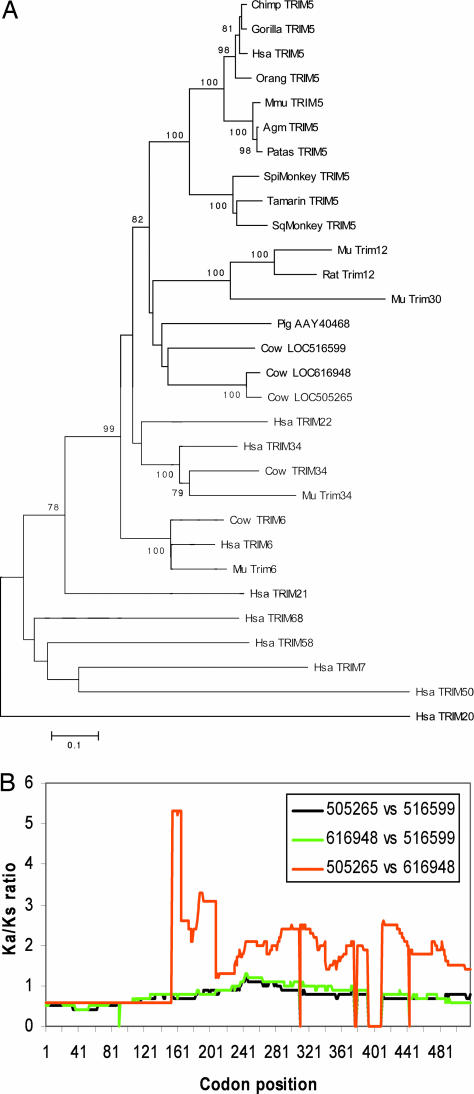
Fig. 1.
Fig. 1.
Identification of candidate bovine restrictions factors. (A) The predicted amino acid sequences of the proteins encoded by bovine LOC516599, LOC616948, LOC505265, LOC514492 (cow TRIM6) and LOC539820 (cow TRIM34) were aligned with those of other TRIM proteins by using clustal x (50). The alignment was used to build trees in mega3.1 by using neighbor joining, maximum parsimony, the Unweighted Pair Group Method with Authentic Mean (upgma), and maximum evolution methods with 1,000 bootstrap iterations. Values of 100 represent 99–100% concordance in the bootstrap analysis. The scale bar represents evolutionary distance in substitutions/amino acid residue. Hsa, Homo sapiens; Mmu, Macaca mulatta; Spi, spider monkey; Sq, squirrel monkey; Mu, mouse. (B) The plot shows the Ka/Ks ratios at various codon positions for pairwise comparisons of LOC516599, LOC616948, and LOC505265. The alignment is shown in Fig. 5. The Ka/Ks ratio across gaps in the alignment was arbitrarily set to 0. The Ka/Ks ratios, calculated as described (45), were estimated as rolling averages for a window of 200 codons.
Fig. 2.
Fig. 2.
Implication of bovine 505265 in retroviral restriction in MDBK cells. (AD) MDBK cells were mock-transfected or transfected with 100 pmol of siRNA directed against TRIM21 or siRNA 4. The cells were then incubated with increasing amounts of the indicated GFP-expressing viruses. Forty-eight hours later, GFP-positive cells were counted by fluorescence-activated cell sorting. The results shown are typical of those obtained in three independent experiments. (E) MDBK cells were transduced with the empty LPCX vector or LPCX vectors expressing cow LOC505265 or LOC616948 cDNAs with mutations that render them resistant to siRNA 4. Cells were then transfected with siRNA 4 and incubated with increasing amounts of the GFP-expressing N-MLV vector. GFP-positive cells were counted by fluorescence-activated cell sorting. The experiment was performed twice with similar results. (F) MDBK cells transduced with the empty LPCX vector or LPCX vectors expressing the mutant cDNAs (m505265 or m616948) described in E were lysed. Cell lysates were Western-blotted with an antibody directed against the hemagglutinin epitope tag at the C terminus of the protein.
Fig. 3.
Fig. 3.
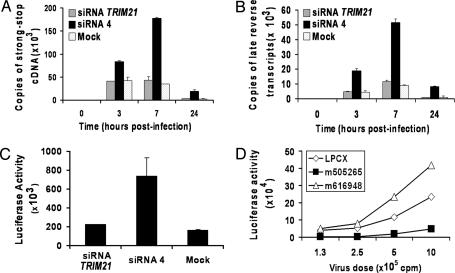
The block to HIV-1 infection in MDBK cells occurs before reverse transcription. (A and B) MDBK cells were mock-transfected or transfected with siRNA 4 or siRNA directed against TRIM21. Cells were then incubated with vesicular stomatitis virus G-pseudotyped, DNase-treated HIV-1-Luc virus. Extrachromosomal DNA was extracted at the indicated times and used to detect early, strong-stop (A) and late (B) reverse transcripts by quantitative PCR. Incubation of cells with control HIV-1-Luc viruses lacking envelope glycoproteins resulted in very low signals; these background signals were subtracted from those obtained with entry-competent HIV-1-Luc viruses. Error bars indicate the variation observed between two parallel infections assayed in duplicate. (C) A portion of the MDBK cells transfected as described above was incubated with 2 × 10⁶ reverse transcriptase-cpm of HIV-1-Luc viruses. Forty-eight hours later, luciferase activity was measured in the cell extracts. Error bars indicate the variation in luciferase activity between duplicate infections. Similar results were obtained in two independent experiments. (D) MDBK cells were transduced with the empty LPCX vector or LPCX vectors expressing LOC505265 or LOC616948 cDNAs with mutations that render them resistant to siRNA 4. The level of expression of the 505265 and 616948 proteins in these cells is shown in Fig. 2F. Cells were transfected with siRNA 4 and incubated with increasing amounts of vesicular stomatitis virus G-pseudotyped, HIV-1-Luc virus. Forty-eight hours later, luciferase was measured in the cell extracts. Similar results were obtained in two independent experiments.
Fig. 4.
Fig. 4.
Specific inhibition of retroviral infection by cow 505265. Cf2Th cells transduced with the empty LPCX vector or an LPCX vector expressing cow 505265 protein were incubated with various amounts of the indicated viruses expressing GFP. GFP-positive cells were counted by fluorescence-activated cell sorting. The data shown are representative of those obtained in three independent experiments.

References

    1. Arts E. J., Wainberg M. A. Adv. Virus Res. 1996;46:97–163. - PubMed
    1. Whitcomb J. M., Hughes S. H. Annu. Rev. Cell Biol. 1992;8:275–306. - PubMed
    1. Cowan S., Hatziioannou T., Cunningham T., Muesing M. A., Gottlinger H. G., Bieniasz P. D. Proc. Natl. Acad. Sci. USA. 2002;99:11914–11919. - PMC - PubMed
    1. Hatziioannou T., Cowan S., Von Schwedler U. K., Sundquist W. I., Bieniasz P. D. J. Virol. 2004;78:6005–6012. - PMC - PubMed
    1. Owens C. M., Yang P. C., Gottlinger H., Sodroski J. J. Virol. 2003;77:726–731. - PMC - PubMed

Publication types

Substances

Associated data

LinkOut - more resources