


Determinants that control the specific interactions between TAB1 and p38alpha
- PMID: 16648477
- PMCID: PMC1489000
- DOI: 10.1128/MCB.26.10.3824-3834.2006
Determinants that control the specific interactions between TAB1 and p38alpha
Abstract
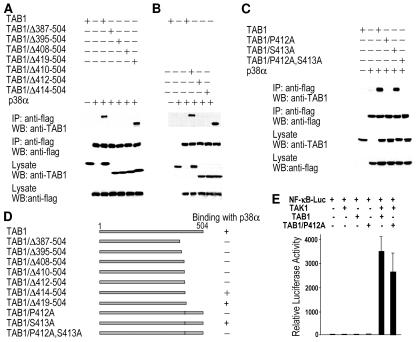
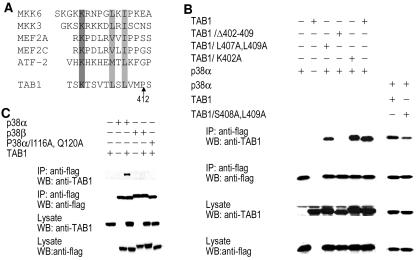
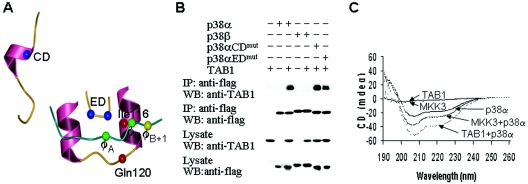
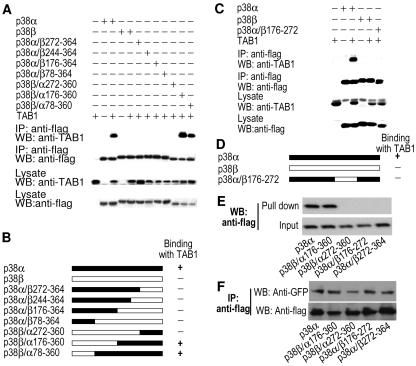
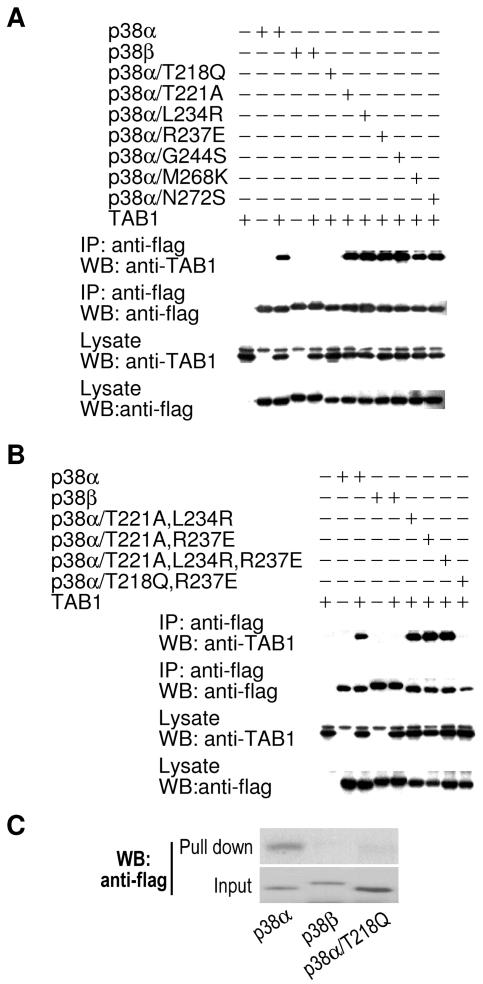
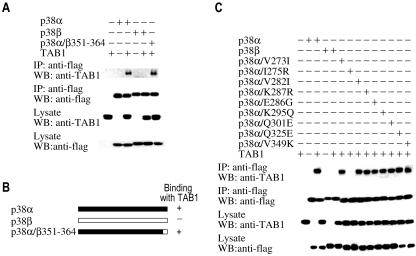
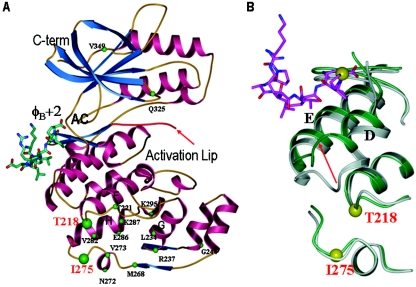
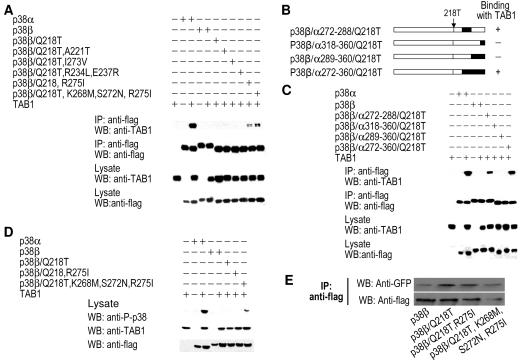
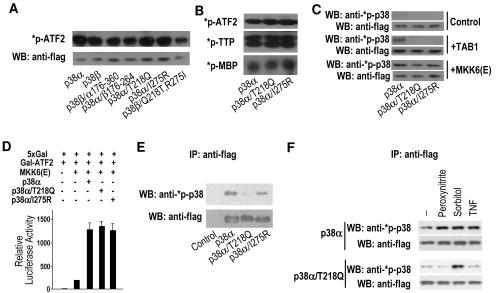
Previous studies have revealed that transforming growth factor-beta-activated protein kinase 1 (TAB1) interacts with p38alpha and induces p38alpha autophosphorylation. Here, we examine the sequence requirements in TAB1 and p38alpha that drive their interaction. Deletion and point mutations in TAB1 reveal that a proline residue in the C terminus of TAB1 (Pro412) is necessary for its interaction with p38alpha. Furthermore, a cryptic D-domain-like docking site was identified adjacent to the N terminus of Pro412, putting Pro412 in the phi(B)+3 position of the docking site. Through mutational analysis, we found that the previously identified hydrophobic docking groove in p38alpha is involved in this interaction, whereas the CD domain and ED domain are not. Furthermore, chimeric analysis with p38beta (which does not bind to TAB1) revealed a previously unidentified locus of p38alpha comprising Thr218 and Ile275 that is essential for specific binding of p38alpha to TAB1. Converting either of these residues to the corresponding amino acid of p38beta abolishes p38alpha interaction with TAB1. These p38alpha mutants still can be fully activated by p38alpha upstream activating kinase mitogen-activated protein kinase kinase 6, but their basal activity and activation in response to some extracellular stimuli are reduced. Adjacent to Thr218 and Ile275 is a site where large conformational changes occur in the presence of docking-site peptides derived from p38alpha substrates and activators. This suggests that TAB1-induced autophosphorylation of p38alpha results from conformational changes that are similar but unique to those seen in p38alpha interactions with its substrates and activating kinases.
Figures
References
-
- Anderson, N. G., J. L. Maller, N. K. Tonks, and T. W. Sturgill. 1990. Requirement for integration of signals from two distinct phosphorylation pathways for activation of MAP kinase. Nature 343:651-653. - PubMed
-
- Barsyte-Lovejoy, D., A. Galanis, and A. D. Sharrocks. 2002. Specificity determinants in MAPK signaling to transcription factors. J. Biol. Chem. 277:9896-9903. - PubMed
-
- Bell, M., R. Capone, I. Pashtan, A. Levitzki, and D. Engelberg. 2001. Isolation of hyperactive mutants of the MAPK p38/Hog1 that are independent of MAPK kinase activation. J. Biol. Chem. 276:25351-25358. - PubMed
-
- Brunner, D., N. Oellers, J. Szabad, W. H. Biggs III, S. L. Zipursky, and E. Hafen. 1994. A gain-of-function mutation in Drosophila MAP kinase activates multiple receptor tyrosine kinase signaling pathways. Cell 76:875-888. - PubMed
-
- Chang, C. I., B. E. Xu, R. Akella, M. H. Cobb, and E. J. Goldsmith. 2002. Crystal structures of MAP kinase p38 complexed to the docking sites on its nuclear substrate MEF2A and activator MKK3b. Mol. Cell 9:1241-1249. - PubMed
Publication types
MeSH terms
Substances
Grants and funding
LinkOut - more resources
Full Text Sources
Miscellaneous
