


The prevalence of hypovitaminosis D and secondary hyperparathyroidism in obese Black Americans
- PMID: 16649971
- PMCID: PMC1863008
- DOI: 10.1111/j.1365-2265.2006.02502.x
The prevalence of hypovitaminosis D and secondary hyperparathyroidism in obese Black Americans
Abstract
Context: Both obesity (body mass index, BMI > or = 30 kg/m2) and Black race are associated with a higher risk of vitamin D deficiency and secondary hyperparathyroidism. We hypothesized the risk of hypovitaminosis D would therefore be extraordinarily high in obese Black adults.
Objective: To study the effects of race and adiposity on 25-hydroxyvitamin D [25(OH)D] and parathyroid hormone (iPTH).
Design, setting and participants: Cross-sectional study of 379 Black and White adults from the Washington D.C. area. BMI ranged from 19.9 to 58.2 kg/m2.
Main outcome measures: Prevalence of hypovitaminosis D [25(OH)D < 37.5 nmol/l] and secondary hyperparathyroidism [25(OH)D < 37.5 nmol/l with iPTH > 4.2 pmol/l].
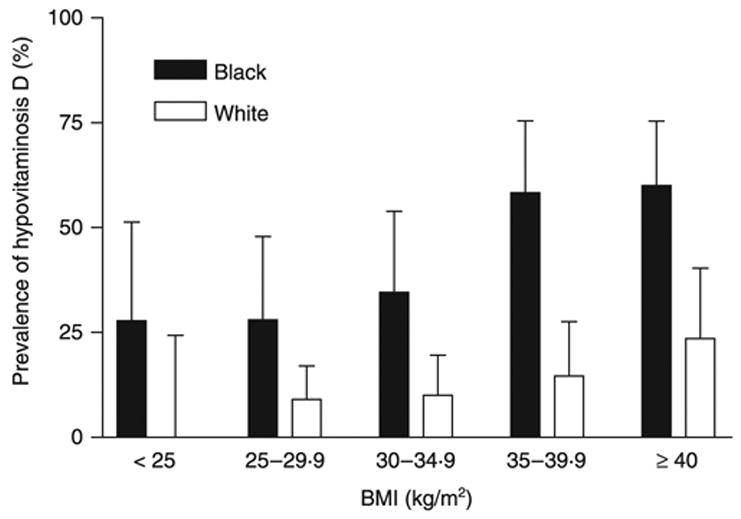
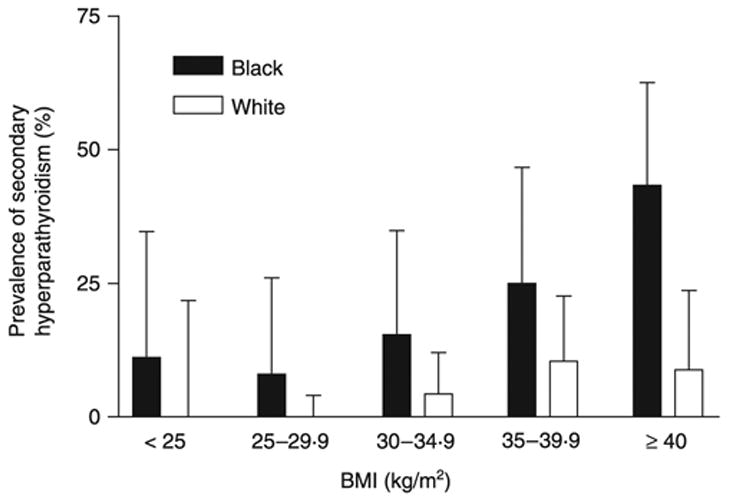
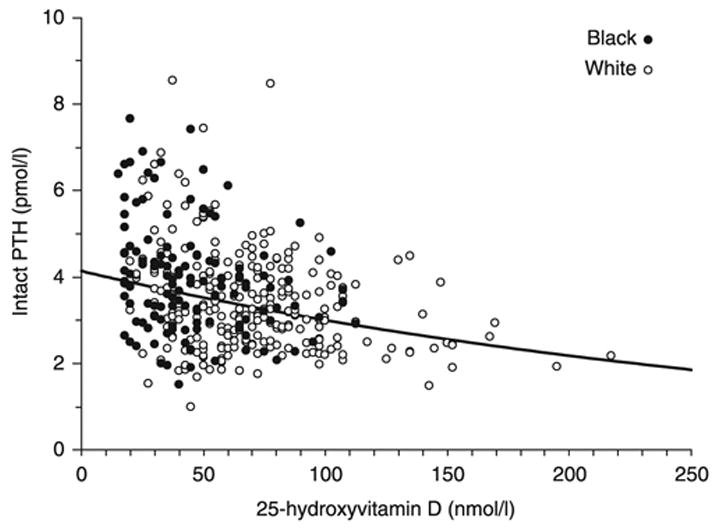
Results: Obese Black subjects had lower mean 25(OH)D, 40.3 (SD, 20.3) nmol/l, compared with obese Whites, 64.5 (29.7), P < 0.001, nonobese Blacks, 53.3 (26.0), P = 0.0025 and nonobese Whites, 78.0 (33.5), P < 0.001. The prevalence of hypovitaminosis D increased with increasing BMI, and was greater (P < 0.001) in Blacks than Whites within all BMI categories examined. Among subjects with BMI > or = 35 kg/m2, 59% of Blacks vs 18% of Whites had hypovitaminosis D (odds ratio 6.5, 95% confidence interval 3.0-14.2). iPTH was negatively correlated with 25(OH)D (r = -0.31, P < 0.0001), suggesting those with hypovitaminosis D had clinically important vitamin D deficiency with secondary hyperparathyroidism. For secondary hyperparathyroidism 35.2% of Blacks met the criteria, compared to 9.7% of Whites (OR 3.6, CI 1.5-98.8).
Conclusions: Obese Black Americans are at particularly high risk for vitamin D deficiency and secondary hyperparathyroidism. Physicians should consider routinely supplementing such patients with vitamin D or screening them for hypovitaminosis D.
Figures
References
-
- Compston JE, Vedi S, Ledger JE, Webb A, Gazet JC, Pilkington TR. Vitamin D status and bone histomorphometry in gross obesity. American Journal of Clinical Nutrition. 1981;34:2359–2363. - PubMed
-
- Zamboni G, Soffiati M, Giavarina D, Tato L. Mineral metabolism in obese children. Acta Paediatrica Scandinavica. 1988;77:741–746. - PubMed
-
- Arunabh S, Pollack S, Yeh J, Aloia JF. Body fat content and 25-hydroxyvitamin D levels in healthy women. Journal of Clinical Endocrinology and Metabolism. 2003;88:157–161. - PubMed
Publication types
MeSH terms
Substances
Grants and funding
LinkOut - more resources
Full Text Sources
Other Literature Sources
Medical
Miscellaneous
