. 2006 Apr;2(4):e34.
doi: 10.1371/journal.ppat.0020034. Epub 2006 Apr 28.

RNA interference analysis of Legionella in Drosophila cells: exploitation of early secretory apparatus dynamics

Affiliations

RNA interference analysis of Legionella in Drosophila cells: exploitation of early secretory apparatus dynamics

Marion S Dorer et al. PLoS Pathog. 2006 Apr.

Abstract

Legionella pneumophila translocates multiple bacterial effector proteins into host cells to direct formation of a replication vacuole for the bacterium. The emerging consensus is that formation of this compartment involves recruitment of membrane material that traffics between the endoplasmic reticulum (ER) and Golgi. To investigate this model, a targeted approach was used to knock down expression of proteins involved in membrane trafficking, using RNA interference in Drosophila cells. Surprisingly, few single knockdowns of ER-Golgi transport proteins decreased L. pneumophila replication. By analyzing double-stranded RNAs in pairs, combinations were identified that together caused defects in intracellular replication, consistent with the model that membrane traffic funnels into the replication vacuole from multiple sources. In particular, simultaneous depletion of the intermediate compartment and Golgi-tethering factor transport protein particle together with the ER SNARE protein Sec22 reduced replication efficiency, indicating that introduction of lesions at distinct sites in the secretory system reduces replication efficiency. In contrast to knockdowns in secretory traffic, which required multiple simultaneous hits, knockdown of single cytosolic components of ER-associated degradation, including Cdc48/p97 and associated cofactors, was sufficient to inhibit intracellular replication. The requirement for the Cdc48/p97 complex was conserved in mammalian cells, in which replication vacuoles showed intense recruitment of ubiquitinated proteins, the preferred substrates of Cdc48/p97. This complex promoted dislocation of both ubiquitinated proteins and bacterial effectors from the replication vacuole, consistent with the model that maintenance of high-level replication requires surveillance of the vacuole surface. This work demonstrates that L. pneumophila has the ability to gain access to multiple sites in the secretory system and provides the first evidence for a role of the Cdc48/p97 complex in promoting intracellular replication of pathogens and maintenance of replication vacuoles.


Conflict of interest statement

Competing interests. The authors have declared that no competing interests exist.

Figures

Figure 1
Figure 1. RNAi Targeting Multiple Secretory Components Decreases L. pneumophila Replication
dsRNA-treated Kc167 cells were incubated for 1 h with L. pneumophila at MOI = 1, washed, and incubated for 30 h prior to microscopic examination of replication vacuoles. The noted dsRNAs were added to Drosophila cells, and allowed to incubate with the cells prior to introduction of L. pneumophila, as described (see Materials and Methods). Untreated: no dsRNA added. The mean ± standard error is plotted.
Figure 2
Figure 2. RNAi Targeting Cdc48/p97 and Cofactors Decreases L. pneumophila Replication in Drosophila and Human Tissue-Culture Cells
(A) dsRNA treated Kc167 cells were incubated for 1 h with L. pneumophila at MOI = 1, washed, and incubated for 30 h prior to microscopic examination of replication vacuoles; mean ± standard error. (B) Drosophila Kc167 treated with dsRNA directed against Cdc48/p97, p47 or no dsRNA [30]. Cdc48/p97-treated cells (1 × 10⁶) were lysed in SDS-PAGE buffer, separated by SDS-PAGE electorphoresis, and subjected to Western blotting with anti-Cdc48/p97 [35] and antitubulin (Serotec) as a loading control. RNA from p47-treated cells was collected using trizol reagent (Invitrogen), cDNA was prepared using Superscript reverse transcriptase (Invitrogen) and 25 cycles of PCR were completed against either actin or p47. (C) HEK 293 cells were silenced for p47 or Cdc48/p97 [39], incubated with L. pneumophila at MOI = 2, and washed and incubated for 11 h prior to microscopic examination of replication vacuoles. (D) HEK 293 cells were silenced for Cdc48/p97 or p47 [39] and subjected to Western blotting with anti-p97 or anti-p47. Antitubulin (Serotec) served as a loading control. (E) Network of genes that interact with Cdc48/p97. Lines are color coded and weighted according to predicted confidence score for each interaction [36]. (F) RNAi of Cdc48/p97 cofactors as in (A), except only the mature (11+ bacteria) vacuoles were plotted.
Figure 3
Figure 3. Cdc48/p97 Localizes to the L. pneumophila Vacuole
(A) Mouse BMDMs were incubated with L. pneumophila for 1 h at MOI = 1, fixed, and immunostained for human Cdc48/p97 and L. pneumophila. Inset is an enlargement of bacterium in panel. Cdc48/p97 associated with 63% ± 11% vacuoles harboring wild-type bacteria and 1.3% ± 1% dotA bacteria. (B) Kc167 cells were incubated with L. pneumophila for 1 h at MOI = 1; replication vacuoles were isolated, fixed, and immunostained with antibodies against Drosophila Cdc48/p97 (Ter94) [35] and L. pneumophila. Cdc48/p97 associated with 77% ± 6.9% vacuoles harboring wild-type bacteria and 1.3% ± 0.3% dotA bacteria.
Figure 4
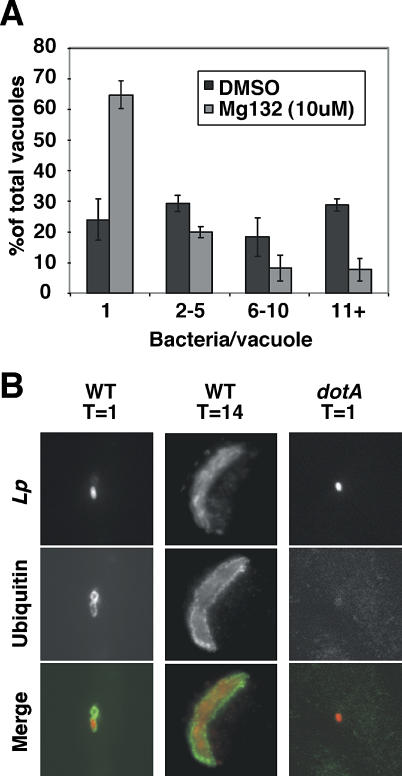
Figure 4. The Proteasome Promotes L. pneumophila Replication and Translocation of Bacterial Effectors causes Ubiquitination of the LCV
(A) Mouse BMDMs were pretreated for 1 h with proteasome inhibitor MG-132 or DMSO, incubated with L. pneumophila for 1 h at MOI = 1, washed, and incubated for 14 h. Infectious centers assay was performed as described. (B) Mouse BMDMs were incubated with L. pneumophila for 1 h at MOI = 1, fixed at the indicated time, and immunostained with antipolyubiquitin and anti–L. pneumophila.
Figure 5
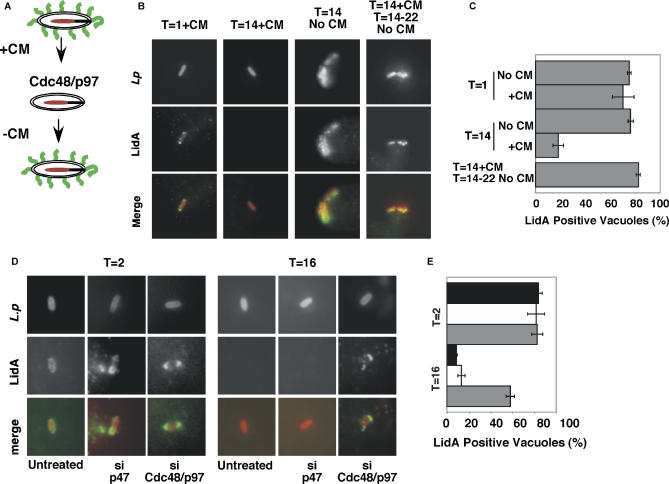
Figure 5. Cdc48/p97 Removes Translocated Effectors from the Replication Vacuole
(A) Cdc48/p97 mediates the removal of LidA (green) from the LCV (red) during incubation with CM. (B) Mouse BMDMs were incubated with L. pneumophila at MOI = 1 for 1 h in CM, washed, and fixed, or further incubated in CM as indicated. Cells were immunostained with anti-LidA and anti–L. pneumophila. (C) Quantification of LidA-positive vacuoles from (B), showing mean of three replicates ± standard error; at least 100 cells counted per replicate. (D) HEK 293 cells were silenced for Cdc48/p97 or p47 and incubated with wild-type L. pneumophila at MOI = 5 for 2 h in CM, washed, and fixed, or further incubated in CM for 16 h. Intact cells were immunostained for LidA and L. pneumophila. (E) Quantification of LidA-positive vacuoles from (D). Untreated (black), si p47 (white), si Cdc48/p97 (gray). Mean of three replicates ± standard error; at least 100 cells counted per replicate.
Figure 6
Figure 6. Cdc48/p97 Removes Polyubiquitinated Proteins from the Replication Vacuole
(A) HEK 293 cells were silenced for Cdc48/p97 or p47 and incubated with wild-type L. pneumophila at MOI = 5 for 2 hours in CM, washed, and fixed, or further incubated in CM for 16 h. Intact cells were immunostained for polyubiquitinated proteins and L. pneumophila. (B) Quantification of polyubiquitin positive vacuoles from (A). Untreated (black), si p47 (white), si Cdc48/p97 (gray). Mean of three replicates ± standard error; at least 100 cells counted per replicate.
Figure 7
Figure 7. Model for Functional Redundancy
The LCV captures secretory vesicles from multiple pathways. Sec22, TRAPP, and Arf1 promote vesicle movement through the IC, and the LCV captures membrane moving from the ER through the IC (white arrows). Alternatively, Sec22 and TRAPP may dock and tether vesicles on the LCV (filled arrows). In either case, Legionella replication is decreased when both pathways are disrupted.

References

    1. Segal G, Shuman HA. Intracellular multiplication and human macrophage killing by Legionella pneumophila are inhibited by conjugal components of IncQ plasmid RSF1010. Mol Microbiol. 1998;30:197–208. - PubMed
    1. Vogel JP, Andrews HL, Wong SK, Isberg RR. Conjugative transfer by the virulence system of Legionella pneumophila . Science. 1998;279:873–876. - PubMed
    1. Nagai H, Kagan JC, Zhu X, Kahn RA, Roy CR. A bacterial guanine nucleotide exchange factor activates ARF on Legionella phagosomes. Science. 2002;295:679–682. - PubMed
    1. Luo ZQ, Isberg RR. Multiple substrates of the Legionella pneumophila Dot/Icm system identified by interbacterial protein transfer. Proc Natl Acad Sci U S A. 2004;101:841–846. - PMC - PubMed
    1. Conover GM, Derre I, Vogel JP, Isberg RR. The Legionella pneumophila LidA protein: A translocated substrate of the Dot/Icm system associated with maintenance of bacterial integrity. Molecular Microbiology. 2003;48:305–321. - PubMed

Publication types

MeSH terms