Paroxetine: population pharmacokinetic analysis in late-life depression using sparse concentration sampling
- PMID: 16669849
- PMCID: PMC1885048
- DOI: 10.1111/j.1365-2125.2006.02629.x
Paroxetine: population pharmacokinetic analysis in late-life depression using sparse concentration sampling
Abstract
Aim: To develop a population pharmacokinetic (PK) model using sparse sampling of long-term treatment with paroxetine in elderly depressed subjects, incorporating CYP2D6 genotype as well as other covariates.
Methods: Elderly subjects (age>or=70 years) with nonpsychotic, nonbipolar major depressive disorder from the inpatient and outpatient clinic were treated with paroxetine in a 5-year clinical trial investigating 'Maintenance Therapies in Late-Life Depression' (MTLD-2). Plasma concentrations were collected during regular visits. CYP2D6 genotype was determined using polymerase chain reaction (PCR) for each individual. A nonlinear mixed-effects model was developed with NONMEM for these subjects who received 10-40 mg day-1 of paroxetine during treatment. One- and two-compartment models with linear and nonlinear elimination (Michaelis-Menten) were evaluated. PK parameters as well as interindividual and residual variability were estimated. The effects of age, weight, sex, race and CYP2D6 genotypes on the pharmacokinetics of paroxetine were evaluated.
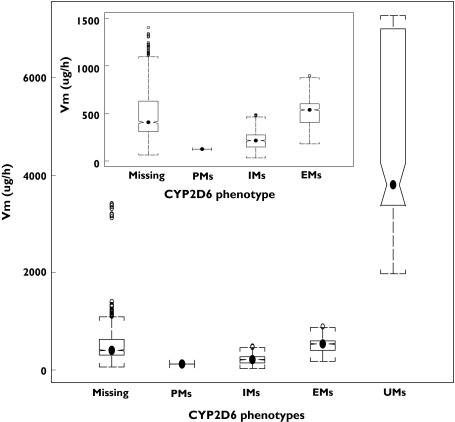
Results: One hundred and seventy-one subjects with a mean age of 77 years (range 69-95) and a mean weight of 72.0 kg (range 32.9-137.0) were enrolled in the MTLD-2 clinical trial. A total of 1970 paroxetine concentrations were available for population PK analyses. Approximately 10 samples were taken per subject. A two-compartment nonlinear PK model with additive and proportional error provided the best base model for description of the data. Weight and CYP2D6 polymorphisms were found to have a significant effect on maximal velocity (Vm), whereas sex had an effect on volume of distribution of the central compartment. The Vm estimates in each of the CYP2D6 phenotypic groups were: 125 microg h-1 in poor metabolizer (n=1), 182 microg h-1 in intermediate metabolizers (n=28), 454 microg h-1 in extensive metabolizers (n=36) and 3670 microg h-1 in ultra-rapid metabolizers (n=5).
Conclusions: The population PK model adequately described paroxetine data in this elderly depressed population. The data indicate that female and male subjects with different CYP2D6 polymorphisms have different elimination rates and therefore may need to be dosed differently based on metabolizer genotype.
Figures
References
-
- Wagstaff AJ, Cheer SM, Matheson AJ, Ormrod D, Goa KL. Paroxetine: an update of its use in psychiatric disorders in adults. Drugs. 2002;62:655–703. - PubMed
-
- Pollock BG, Ferrell RE, Mulsant BH, Mazumdar S, Miller M, Sweet RA, Davis S, Kirshner MA, Houck PR, Stack JA, Reynolds CF, Kupfer DJ. Allelic variation in the serotonin transporter promoter affects onset of paroxetine treatment response in late-life depression. Neuropsychopharmacology. 2000;23:587–90. - PubMed
-
- Reis M, Lundmark J, Bengtsson F. Therapeutic drug monitoring of racemic citalopram: a 5-year experience in Sweden, 1992–1997. Ther Drug Monit. 2003;25:183–91. - PubMed
-
- Feng Y, Pollock B, Roose S, Kirshner M, Lotrich F, Kupfer D, Bies R. Mixed effects pharmacokinetic modeling of an age effect on citalopram disposition. AAPS Pharmsci. 2003;5 Abstract M1063.
-
- Kaye CM, Haddock RE, Langley PF, Mellows G, Tasker TC, Zussman BD, Greb WH. A review of the metabolism and pharmacokinetics of paroxetine in man. Acta Psychiatr Scand Suppl. 1989;350:60–75. - PubMed
Publication types
MeSH terms
Substances
Grants and funding
- MH30915/MH/NIMH NIH HHS/United States
- K24 MH065416/MH/NIMH NIH HHS/United States
- P41 EB001975/EB/NIBIB NIH HHS/United States
- P30 MH071944/MH/NIMH NIH HHS/United States
- R37 MH43832/MH/NIMH NIH HHS/United States
- P30 MH52247/MH/NIMH NIH HHS/United States
- P41 EB001975-06/EB/NIBIB NIH HHS/United States
- P30 MH71944/MH/NIMH NIH HHS/United States
- R01 MH064173/MH/NIMH NIH HHS/United States
- MH55756/MH/NIMH NIH HHS/United States
- R37 MH043832/MH/NIMH NIH HHS/United States
- P30 MH052247/MH/NIMH NIH HHS/United States
- P30 MH030915/MH/NIMH NIH HHS/United States
- R01 MH37869/MH/NIMH NIH HHS/United States
- MH65416/MH/NIMH NIH HHS/United States
- R01 MH037869/MH/NIMH NIH HHS/United States
- MH64173/MH/NIMH NIH HHS/United States
LinkOut - more resources
Full Text Sources
Molecular Biology Databases