


doi: 10.1172/JCI28508.
The IL-23/IL-17 axis in inflammation
Affiliations
- PMID: 16670765
- PMCID: PMC1451213
- DOI: 10.1172/JCI28508
Item in Clipboard
The IL-23/IL-17 axis in inflammation
J Clin Invest.
2006 May.
Abstract
IL-23 induces the differentiation of naive CD4(+) T cells into highly pathogenic helper T cells (Th17/Th(IL-17)) that produce IL-17, IL-17F, IL-6, and TNF-alpha, but not IFN-gamma and IL-4. Two studies in this issue of the JCI demonstrate that blocking IL-23 or its downstream factors IL-17 and IL-6, but not the IL-12/IFN-gamma pathways, can significantly suppress disease development in animal models of inflammatory bowel disease and MS (see the related articles beginning on pages 1310 and 1317). These studies suggest that the IL-23/IL-17 pathway may be a novel therapeutic target for the treatment of chronic inflammatory diseases.
Figures
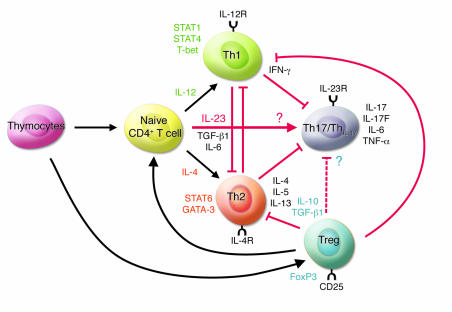
IL-23 induces the differentiation of naive CD4+ T cells into IL-17–producing helper T cells (Th17/ThIL-17) via mechanisms that are distinct from the Th1 and Th2 differentiation pathways. The transcriptional factors critical for the development of Th1 (STAT1, STAT4, and T-bet) and Th2 (STAT6) cells are not required for the induction of Th17/ThIL-17 cells. The transcriptional factor(s) essential for the development of Th17/ThIL-17 cells remain unknown. IFN-γ and IL-4 antagonize each other in the differentiation of Th1 and Th2 cells and the promotion of their function. IFN-γ also suppresses the differentiation of Th17/ThIL-17 cells by reducing IL-23R expression on CD4+ T cells. IL-4 also inhibits the development of Th17/ThIL-17 cells. It is not known, however, whether Th17/ThIL-17 cells inhibit the development of Th1 and Th2 cells. Tregs, an immune-modulating subset of CD4+ T cells, suppress the differentiation and effector function of Th1 and Th2 cells. Recent studies suggest that Treg-derived TGF-β induces the differentiation of Th17/ThIL-17 cells from naive CD4+ T cells in the presence of IL-6 in vitro (26). However, the precise effect(s) of Tregs on Th17/ThIL-17 cells are as yet unknown.
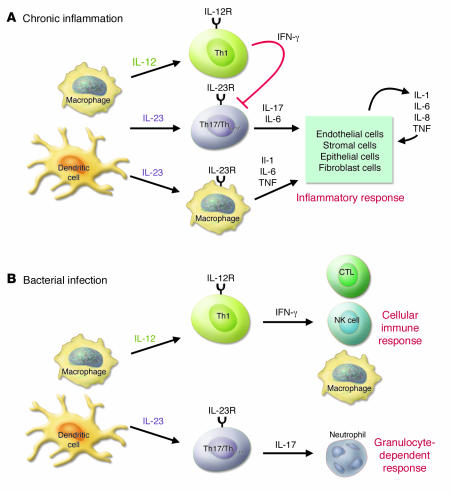
The IL-23/IL-17 axis plays an important role in the development of chronic inflammation and in host defenses against bacterial infection. (A) In chronic inflammation, antigen-stimulated dendritic cells and macrophages produce IL-23, which promotes the development of Th17/ThIL-17 cells. Th17/ThIL-17 cells produce IL-17, which enhances T cell priming and triggers potent inflammatory responses by inducing the production of a variety of inflammatory mediators. IL-23 also acts on dendritic cells and macrophages in an autocrine/paracrine manner to stimulate the generation of proinflammatory cytokines, such as IL-1, IL-6, and TNF-α. IL-12–stimulated Th1 cells produce IFN-γ and suppress the differentiation of Th17/ThIL-17 cells. Th1 cells may play an immunoregulatory, not a pathogenic, role in the development of chronic inflammation. (B) Upon bacterial infection, IL-23 is rapidly produced by activated macrophages and dendritic cells at the site of infection. IL-23 then activates local resident Th17/ThIL-17 cells and other IL-17–producing cells, such as CD8+ T cells and γδ T cells. Production of IL-17 by these cells induces G-CSF production from stromal cells. The IL-23/IL-17/G-CSF pathway augments neutrophil recruitment to the infection site, contributing to extracellular bacterial clearance. IL-23 also increases the production of IL-1, IL-6, and TNF-α in an autocrine/paracrine manner. In contrast, Th1 cells produce IFN-γ and stimulate CD8+ cytotoxic T lympocytes, NK cells, and macrophages. IFN-γ enhances antigen presentation by inducing expression of MHC molecules and activates cells to produce cytolytic molecules, including perforin and granzyme, which promote the elimination of intracellular bacteria.
Comment on
- J Clin Invest. 116:1310.
References
-
- Infante-Duarte C., Horton H.F., Byrne M.C., Kamradt T. Microbial lipopeptides induce the production of IL-17 in Th cells. J. Immunol. 2000;165:6107–6115. - PubMed
-
- Harrington L.E., et al. Interleukin 17-producing CD4+ effector T cells develop via a lineage distinct from the T helper type 1 and 2 lineages. Nat. Immunol. 2005;6:1123–1132. - PubMed
-
- Kolls J.K., Linden A. Interleukin-17 family members and inflammation. Immunity. 2004;21:467–476. - PubMed
MeSH terms
Substances
LinkOut - more resources
Full Text Sources
Other Literature Sources
Research Materials
