Comparative Study
. 2006 Aug 15;398(1):135-44.
doi: 10.1042/BJ20060313.

Direct comparison of nick-joining activity of the nucleic acid ligases from bacteriophage T4

Affiliations
Comparative Study

Direct comparison of nick-joining activity of the nucleic acid ligases from bacteriophage T4

Desmond R Bullard et al. Biochem J. .

Abstract

The genome of bacteriophage T4 encodes three polynucleotide ligases, which seal the backbone of nucleic acids during infection of host bacteria. The T4Dnl (T4 DNA ligase) and two RNA ligases [T4Rnl1 (T4 RNA ligase 1) and T4Rnl2] join a diverse array of substrates, including nicks that are present in double-stranded nucleic acids, albeit with different efficiencies. To unravel the biochemical and functional relationship between these proteins, a systematic analysis of their substrate specificity was performed using recombinant proteins. The ability of each protein to ligate 20 bp double-stranded oligonucleotides containing a single-strand break was determined. Between 4 and 37 degrees C, all proteins ligated substrates containing various combinations of DNA and RNA. The RNA ligases ligated a more diverse set of substrates than T4Dnl and, generally, T4Rnl1 had 50-1000-fold lower activity than T4Rnl2. In assays using identical conditions, optimal ligation of all substrates was at pH 8 for T4Dnl and T4Rnl1 and pH 7 for T4Rnl2, demonstrating that the protein dictates the pH optimum for ligation. All proteins ligated a substrate containing DNA as the unbroken strand, with the nucleotides at the nick of the broken strand being RNA at the 3'-hydroxy group and DNA at the 5'-phosphate. Since this RNA-DNA hybrid was joined at a similar maximal rate by T4Dnl and T4Rnl2 at 37 degrees C, we consider the possibility that this could be an unexpected physiological substrate used during some pathways of 'DNA repair'.


Figures
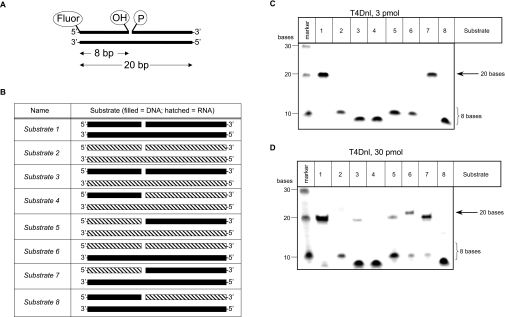
Figure 1
Figure 1. Ligation activity of T4Dnl on a range of substrates
The nick-joining activity of T4Dnl was tested on 20 bp double-stranded substrates containing differing fragments of DNA and RNA. (A) Overview of substrates used in assays of in vitro nucleic acid ligation activity. The diagram illustrates the position of the 5′- and 3′-ends, the fluorescein reporter group (Fluor) and the phosphate (P) and hydroxy (OH) groups at the nick. Note that, if ligation occurs, the size of the nucleic acid attached to fluorescein increases from 8 to 20 bases. (B) Schematic diagram of the substrates used in the ligation assay, indicating the position of the 5′- and 3′-ends and with DNA and RNA being represented by filled and hatched boxes respectively. (C, D) In vitro ligation assays performed at 37°C for 30 min with the various substrates (45 pmol) and indicated amounts of protein. The marker contained a mixture of fluorescein-labelled oligonucleotides of the specified size.
Figure 2
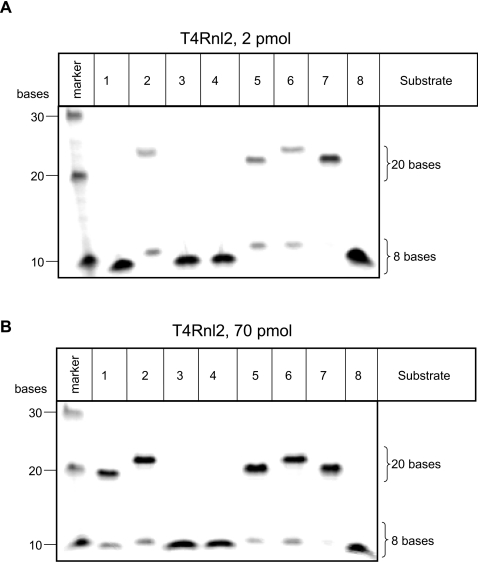
Figure 2. Ligation activity of T4Rnl2 on a range of substrates
The nick-joining activity of T4Rnl2 was tested on 20 bp double-stranded substrates containing differing fragments of DNA and RNA (see Figures 1A and 1B for details). (A, B) In vitro ligation assays performed at 37°C for 30 min with the various substrates (45 pmol) and indicated amounts of protein. The marker contained a mixture of fluorescein-labelled oligonucleotides of the specified size.
Figure 3
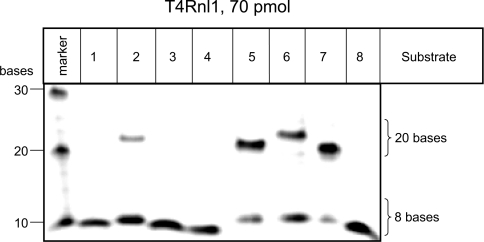
Figure 3. Ligation activity of T4Rnl1 on a range of substrates
The nick-joining activity of T4Rnl1 was tested on 20 bp double-stranded substrates containing differing fragments of DNA and RNA (see Figures 1A and 1B for details). In vitro ligation assays performed at 37°C for 30 min with the various substrates (45 pmol) and indicated amount of protein. The marker contained a mixture of fluorescein-labelled oligonucleotides of the specified size.
Figure 4
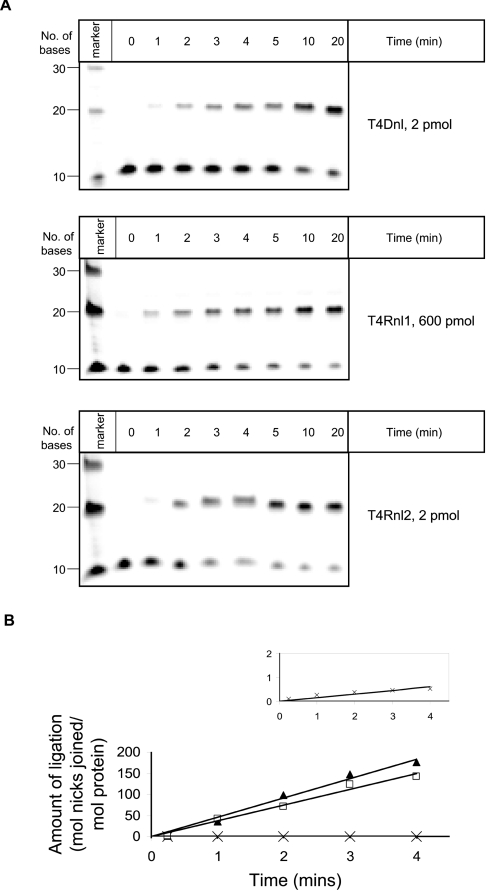
Figure 4. Determination of the rates of ligation of different substrates by T4Dnl, T4Rnl1 and T4Rnl2
(A) In vitro ligation assays performed for various times at 37 °C with substrate 7 (540 pmol) and indicated amounts of protein. The marker contained a mixture of fluorescein-labelled oligonucleotides of the specified size. (B) The extent of nick joining in the experiment shown in (A) was quantified for T4Dnl (open square), T4Rnl1 (cross) and T4Rnl2 (closed triangle). The inset shows an enlarged plot of the results with T4Rnl1. Initial rates of nick joining were calculated from triplicate experiments and are recorded in Table 1. For clarity, error bars are not included in the graphs, but the S.D. of the measurements are included in Table 1.
Figure 5
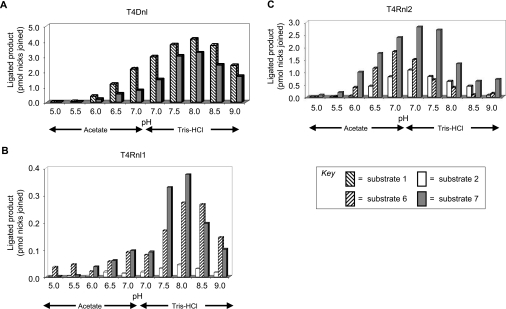
Figure 5. Effect of pH on nick-joining activity of T4 nucleic acid ligases
Nicked 20 bp substrates were used in assays of the in vitro ligation activity of each enzyme at various pH values. The buffer used for all reactions was identical except that it contained Tris-acetate (pH 4–7) or Tris/HCl (pH 7–9). Quantification of the extent of nick joining is presented for those substrates giving significant ligation with T4Dnl (A), T4Rnl1 (B) and T4Rnl2 (C). Shading of the bars relates to specific substrates as indicated in the key. See Figures 1(A) and 1(B) for details of substrates.

References

    1. Miller E. S., Kutter E., Mosig G., Arisaka F., Kunisawa T., Ruger W. Bacteriophage T4 genome. Microbiol. Mol. Biol. Rev. 2003;67:86–156. - PMC - PubMed
    1. Lehman I. R. DNA ligase: structure, mechanism, and function. Science. 1974;186:790–797. - PubMed
    1. Shuman S., Schwer B. RNA capping enzyme and DNA ligase: a superfamily of covalent nucleotidyl transferases. Mol. Microbiol. 1995;17:405–410. - PubMed
    1. Wilkinson A., Day J., Bowater R. Bacterial DNA ligases. Mol. Microbiol. 2001;40:1241–1248. - PubMed
    1. Doherty A. J., Suh S. W. Structural and mechanistic conservation in DNA ligases. Nucleic Acids Res. 2000;28:4051–4058. - PMC - PubMed

Publication types