


Conversion of trypsin to a functional threonine protease
- PMID: 16672242
- PMCID: PMC2242550
- DOI: 10.1110/ps.062179006
Conversion of trypsin to a functional threonine protease
Abstract
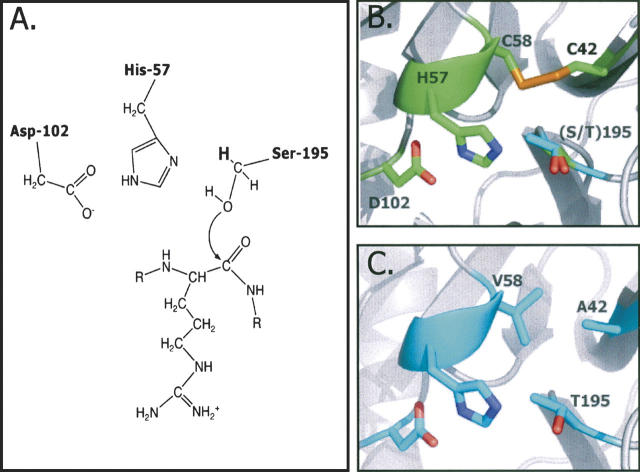
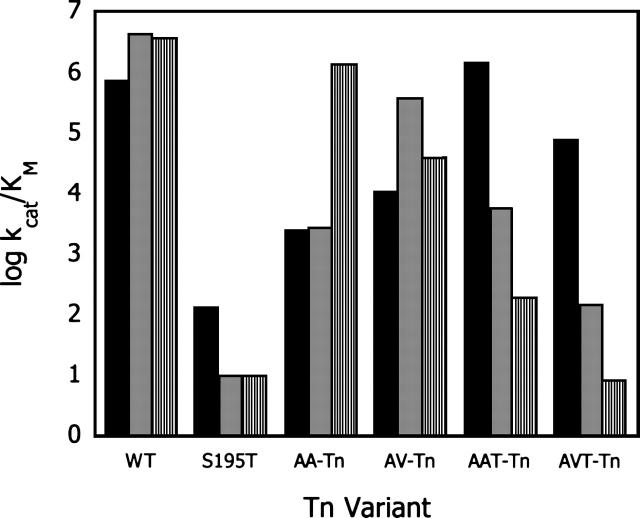
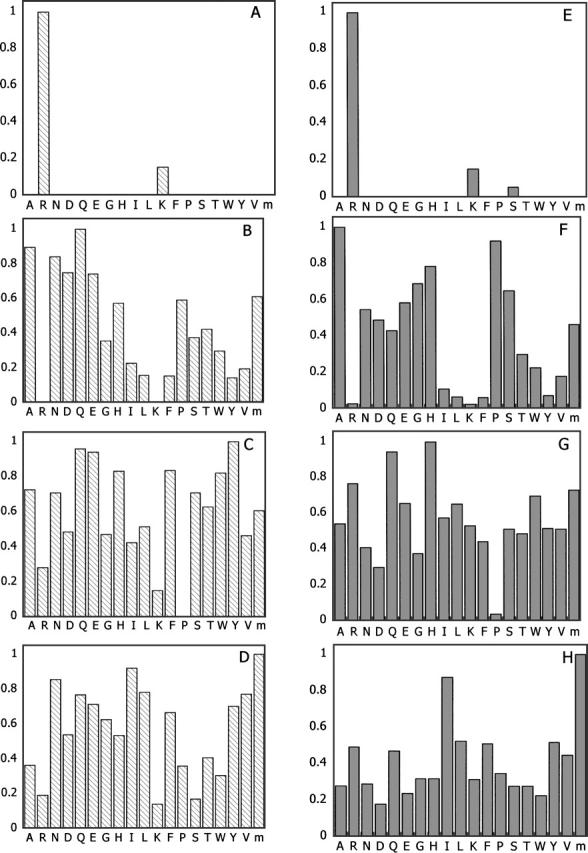
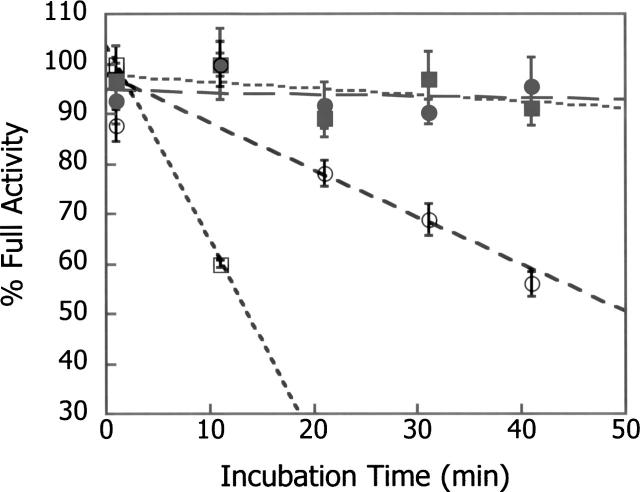
The hydroxyl group of a serine residue at position 195 acts as a nucleophile in the catalytic mechanism of the serine proteases. However, the chemically similar residue, threonine, is rarely used in similar functional context. Our structural modeling suggests that the Ser 195 --> Thr trypsin variant is inactive due to negative steric interaction between the methyl group on the beta-carbon of Thr 195 and the disulfide bridge formed by cysteines 42 and 58. By simultaneously truncating residues 42 and 58 and substituting Ser 195 with threonine, we have successfully converted the classic serine protease trypsin to a functional threonine protease. Substitution of residue 42 with alanine and residue 58 with alanine or valine in the presence of threonine 195 results in trypsin variants that are 10(2) -10(4) -fold less active than wild type in kcat/KM but >10(6)-fold more active than the Ser 195 --> Thr single variant. The substitutions do not alter the substrate specificity of the enzyme in the P1'- P4' positions. Removal of the disulfide bridge decreases the overall thermostability of the enzyme, but it is partially rescued by the presence of threonine at position 195.
Figures
References
-
- Baumeister W. and Lupas A. 1997. The proteasome Curr. Opin. Struct. Biol. 7 273–278. - PubMed
-
- Betzel C., Gourinath S., Kumar P., Kaur P., Perbandt M., Eschenburg S., Singh T.P. 2001. Structure of a serine protease proteinase K from Tritirachium album limber at 0.98 Å resolution Biochemistry 40 3080–3088. - PubMed
-
- Bode W., Turk D., Karshikov A. 1992. The refined 1.9-Å X-ray crystal structure of D-Phe-Pro-Arg chloromethylketone-inhibited human α-thrombin: Structure analysis, overall structure, electrostatic properties, detailed active-site geometry, and structure–function relationships Protein Sci. 1 426–471. - PMC - PubMed
-
- Brannigan J.A., Dodson G., Duggleby H.J., Moody P.C., Smith J.L., Tomchick D.R., Murzin A.G. 1995. A protein catalytic framework with an N-terminal nucleophile is capable of self-activation Nature 378 416–419. - PubMed
Publication types
MeSH terms
Substances
Grants and funding
LinkOut - more resources
Full Text Sources
