


Human papillomavirus type 16 integration in cervical carcinoma in situ and in invasive cervical cancer
- PMID: 16672403
- PMCID: PMC1479176
- DOI: 10.1128/JCM.44.5.1755-1762.2006
Human papillomavirus type 16 integration in cervical carcinoma in situ and in invasive cervical cancer
Abstract
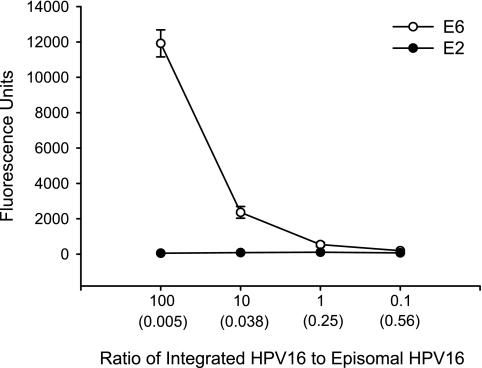
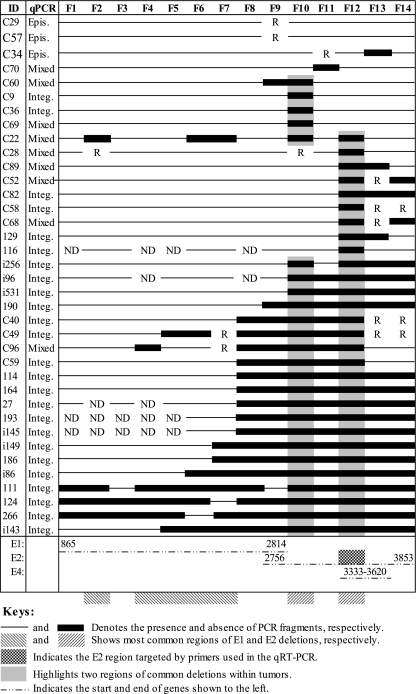
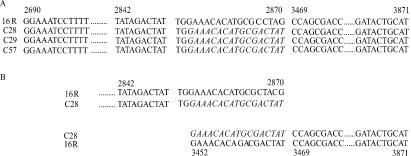
Integration of human papillomavirus type 16 (HPV-16) into the host DNA has been proposed as a potential marker of cervical neoplastic progression. In this study, a quantitative real-time PCR (qRT-PCR) was used to examine the physical status of HPV-16 in 126 cervical carcinoma in situ and 92 invasive cervical cancers. Based on criteria applied to results from this qRT-PCR assay, HPV-16 was characterized in carcinoma in situ cases as episomal (61.9%), mixed (i.e., episomal and integrated; 29.4%), and integrated (8.7%) forms. In invasive cervical cancer samples, HPV-16 was similarly characterized as episomal (39.1%), mixed (45.7%), and integrated (15.2%) forms. The difference in the frequency of integrated or episomal status estimated for carcinoma in situ and invasive cervical cancer cases was statistically significant (P = 0.003). Extensive mapping analysis of HPV-16 E1 and E2 genes in 37 selected tumors demonstrated deletions in both E1 and E2 genes with the maximum number of losses (78.4%) observed within the HPV-16 E2 hinge region. Specifically, deletions within the E2 hinge region were detected most often between nucleotides (nt) 3243 and 3539. The capacity to detect low-frequency HPV-16 integration events was highly limited due to the common presence and abundance of HPV episomal forms. HPV-16 E2 expressed from intact episomes may act in trans to regulate integrated genome expression of E6 and E7.
Figures
References
-
- Arias-Pulido, H., N. Joste, and C. Wheeler. 2004. Loss of heterozygosity on chromosome 6 in HPV-16 positive cervical carcinomas carrying the DRB1*1501-DQB1*0602 haplotype. Genes Chromosomes Cancer 40:277-284. - PubMed
-
- Berumen, J., E. Unger, L. Casas, and P. Figueroa. 1995. Amplification of human papillomavirus types 16 and 18 in invasive cervical cancer. Hum. Pathol. 26:676-681. - PubMed
-
- Daniel, B., A. Rangarajan, G. Mukherjee, E. Vallikad, and S. Krishna. 1997. The link between integration and expression of human papillomavirus type 16 genomes and cellular changes in the evolution of cervical intraepithelial neoplastic lesions. J. Gen. Virol. 78:1095-1101. - PubMed
-
- Fink, L., W. Seeger, L. Ermert, J. Hanze, U. Stahl, F. Grimminger, W. Kummer, and R. M. Bohle. 1998. Real-time quantitative RT-PCR after laser-assisted cell picking. Nat. Med. 4:1329-1333. - PubMed
Publication types
MeSH terms
Substances
Grants and funding
LinkOut - more resources
Full Text Sources
Other Literature Sources
Medical
Research Materials
