


Evaluation of a novel highly sensitive, broad-spectrum PCR-reverse hybridization assay for detection and identification of beta-papillomavirus DNA
- PMID: 16672409
- PMCID: PMC1479195
- DOI: 10.1128/JCM.44.5.1792-1800.2006
Evaluation of a novel highly sensitive, broad-spectrum PCR-reverse hybridization assay for detection and identification of beta-papillomavirus DNA
Abstract
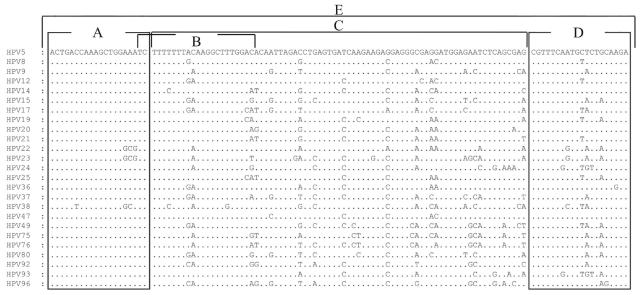
Human papillomavirus can be detected by amplification of viral DNA. A novel one-step PCR (PM-PCR) was evaluated for amplification of a 117-bp fragment from the E1 region. It permitted ultrasensitive detection of all 25 known human papillomavirus genotypes from the beta-papillomavirus genus. The intra- and intertypic sequence variations of the 77-bp interprimer region were studied. Genotype-specific probes as well as general probes were selected for the 25 established beta-papillomavirus types, and a reverse hybridization assay (RHA) was developed (PM-PCR RHA method). The analytical sensitivity of the PM-PCR RHA method was 10 to 100 viral genomes. The one-step PM-PCR turned out to be more sensitive than the previously described nested MaHa-PCR for beta-papillomavirus detection. The PM-PCR RHA method was able to detect and identify beta-papillomavirus types in frozen patient material as well as in poorly amplifiable material such as formalin-fixed, paraffin-embedded skin biopsy specimens. Inter- and intralaboratory variability experiments showed that the reproducibility of the assay was very high. In conclusion, the one-step PM-PCR together with the RHA allows extremely sensitive, specific, and reproducible detection of beta-papillomavirus DNA as well as reliable identification of beta-papillomavirus genotypes in both fresh and paraffin-embedded patient material.
Figures


References
-
- Altschul, S. F., W. Gish, W. Miller, E. W. Myers, and D. J. Lipman. 1990. Basic local alignment search tool. J. Mol. Biol. 215:403-410. - PubMed
-
- Berkhout, R. J., L. M. Tieben, H. L. Smits, J. N. Bouwes Bavinck, B. J. Vermeer, and J. ter Schegget. 1995. Nested PCR approach for detection and typing of epidermodysplasia verruciformis-associated human papillomavirus types in cutaneous cancers from renal transplant recipients. J. Clin. Microbiol. 33:690-695. - PMC - PubMed
-
- Boxman, I. L., R. J. Berkhout, L. H. Mulder, M. C. Wolkers, J. N. Bouwes Bavinck, B. J. Vermeer, and J. ter Schegget. 1997. Detection of human papillomavirus DNA in plucked hairs from renal transplant recipients and healthy volunteers. J. Investig. Dermatol. 108:712-715. - PubMed
Publication types
MeSH terms
Substances
LinkOut - more resources
Full Text Sources
Other Literature Sources
