


Diversity and seasonal dynamics of Actinobacteria populations in four lakes in northeastern Germany
- PMID: 16672495
- PMCID: PMC1472390
- DOI: 10.1128/AEM.72.5.3489-3497.2006
Diversity and seasonal dynamics of Actinobacteria populations in four lakes in northeastern Germany
Abstract
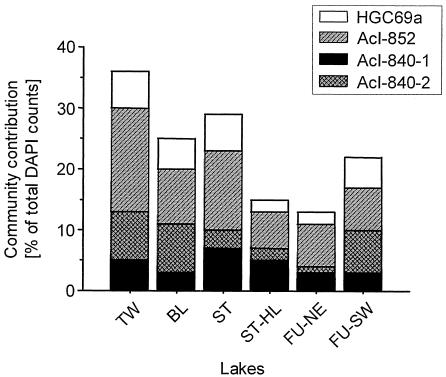
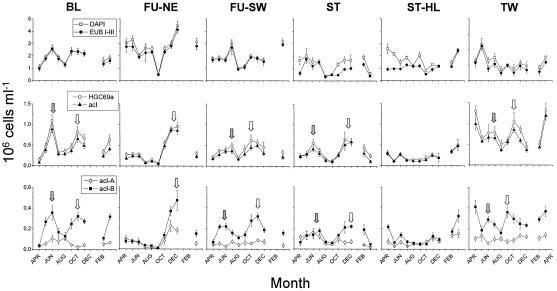
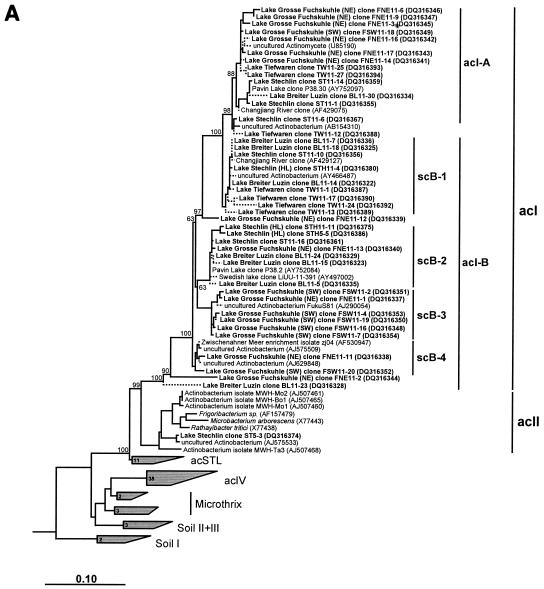
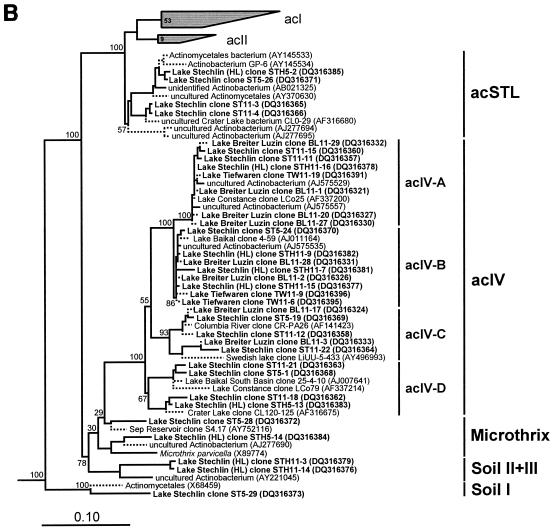
The phylogenetic diversity and seasonal dynamics of freshwater Actinobacteria populations in four limnologically different lakes of the Mecklenburg-Brandenburg Lake District (northeastern Germany) were investigated. Fluorescence in situ hybridization was used to determine the seasonal abundances and dynamics of total Actinobacteria (probe HGC69a) and the three actinobacterial subclusters acI, acI-A, and acI-B (probes AcI-852, AcI-840-1, and AcI-840-2). Seasonal means of total Actinobacteria abundances in the epilimnia of the lakes varied from 13 to 36%, with maximum values of 30 to 58%, of all DAPI (4',6'-diamidino-2-phenylindole)-stained cells. Around 80% of total Actinobacteria belonged to the acI cluster. The two subclusters acI-A and acI-B accounted for 60 to 91% of the acI cluster and showed seasonal means of 49% (acI-B) and 23% (acI-A) in relation to the acI cluster. Total Actinobacteria and members of the clusters acI and acI-B showed distinct seasonal changes in their absolute abundances, with maxima in late spring and fall/winter. In eight clone libraries constructed from the lakes, a total of 76 actinobacterial 16S rRNA gene sequences were identified from a total of 177 clones. The majority of the Actinobacteria sequences belonged to the acI and acIV cluster. Several new clusters and subclusters were found (acSTL, scB1-4, and acIVA-D). The majority of all obtained 16S rRNA gene sequences are distinct from those of already-cultured freshwater Actinobacteria.
Figures
References
-
- Bahr, M., J. E. Hobbie, and M. L. Sogin. 1999. Bacterial diversity in an arctic lake—a freshwater SAR11 cluster. Aquat. Microb. Ecol. 11:271-277.
-
- Bergström, A.-K., and M. Jansson. 2000. Bacterioplankton production in humic lake Örträsket in relation to input of bacterial cells and input of allochthonous organic carbon. Microb. Ecol. 39:101-115. - PubMed
-
- Bittl, T., and H. D. Babenzien. 1996. Microbial activities in an artificially divided acidic lake. Arch. Hydrobiol. Adv. Limnol. 48:113-121.
Publication types
MeSH terms
Substances
Associated data
- Actions
- Actions
- Actions
- Actions
- Actions
- Actions
- Actions
- Actions
- Actions
- Actions
- Actions
- Actions
- Actions
- Actions
- Actions
- Actions
- Actions
- Actions
- Actions
- Actions
- Actions
- Actions
- Actions
- Actions
- Actions
- Actions
- Actions
- Actions
- Actions
- Actions
- Actions
- Actions
- Actions
- Actions
- Actions
- Actions
- Actions
- Actions
- Actions
- Actions
- Actions
- Actions
- Actions
- Actions
- Actions
- Actions
- Actions
- Actions
- Actions
- Actions
- Actions
- Actions
- Actions
- Actions
- Actions
- Actions
- Actions
- Actions
- Actions
- Actions
- Actions
- Actions
- Actions
- Actions
- Actions
- Actions
- Actions
- Actions
- Actions
- Actions
- Actions
- Actions
- Actions
- Actions
- Actions
- Actions
LinkOut - more resources
Full Text Sources
Molecular Biology Databases
