. 2006 May;188(10):3654-63.
doi: 10.1128/JB.188.10.3654-3663.2006.

Flavonoid-inducible modifications to rhamnan O antigens are necessary for Rhizobium sp. strain NGR234-legume symbioses

Affiliations

Flavonoid-inducible modifications to rhamnan O antigens are necessary for Rhizobium sp. strain NGR234-legume symbioses

W J Broughton et al. J Bacteriol. 2006 May.

Abstract

Rhizobium sp. strain NGR234 produces a flavonoid-inducible rhamnose-rich lipopolysaccharide (LPS) that is important for the nodulation of legumes. Many of the genes encoding the rhamnan part of the molecule lie between 87 degrees and 110 degrees of pNGR234a, the symbiotic plasmid of NGR234. Computational methods suggest that 5 of the 12 open reading frames (ORFs) within this arc are involved in synthesis (and subsequent polymerization) of L-rhamnose. Two others probably play roles in the transport of carbohydrates. To evaluate the function of these ORFs, we mutated a number of them and tested the ability of the mutants to nodulate a variety of legumes. At the same time, changes in the production of surface polysaccharides (particularly the rhamnan O antigen) were examined. Deletion of rmlB to wbgA and mutation in fixF abolished rhamnan synthesis. Mutation of y4gM (a member of the ATP-binding cassette transporter family) did not abolish production of the rhamnose-rich LPS but, unexpectedly, the mutant displayed a symbiotic phenotype very similar to that of strains unable to produce the rhamnan O antigen (NGRDeltarmlB-wbgA and NGROmegafixF). At least two flavonoid-inducible regulatory pathways are involved in synthesis of the rhamnan O antigen. Mutation of either pathway reduces rhamnan production. Coordination of rhamnan synthesis with rhizobial release from infection threads is thus part of the symbiotic interaction.


Figures
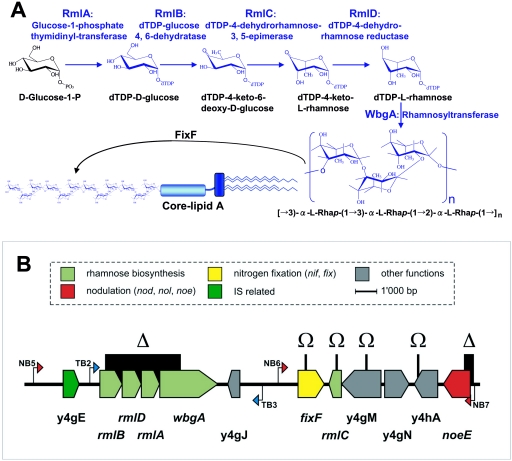
FIG. 1.
FIG. 1.
A. Proposed synthetic pathway of rhamnose and its possible adjunction to the LPS core by enzymes encoded within the 87°-110° locus. The putative roles of the RmlA to -D enzymes in the synthesis of dTDP-l-rhamnose from d-glucose-1-phosphate are shown. A predicted glycosyl transferase, WbgA, could be responsible for the polymerization of the newly synthesized rhamnose residues. FixF is thought to function in the export or attachment of the rhamnose-rich O antigen across the bacterial membrane or onto lipid A core molecules. B. Genetic map of the 87°-110° locus of Rhizobium sp. strain NGR234. Genes are drawn as arrows matching the sense of transcription and are colored according to their proposed function. nod boxes and tts boxes are represented by red and blue arrows, respectively. The positions of the various mutations are shown above the genes as either omega cassette insertions (Ω) or deletions followed by omega cassette insertions (Δ).
FIG. 2.
FIG. 2.
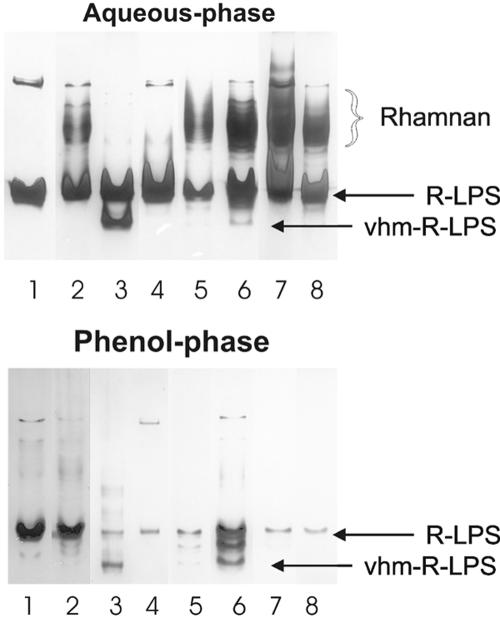
PAGE analyses of rhamnan-containing LPSs present in the aqueous or phenol phase of hot phenol-water extracts of Rhizobium sp. strain NGR234 (and various mutants thereof). The gels were silver stained for LPS. Lanes contain extracts from the following sources: 1, noninduced wild-type NGR234 (grown in the absence of apigenin); 2, apigenin-induced (IND) NGR234; 3, IND NGRΔrmlB-wbgA; 4, IND NGRΩfixF; 5, IND NGRΩrmlC; 6, IND NGRΩgM; 7, IND NGRΩhA; 8, IND NGRΩnoeE. The position of the rhamnan O antigen produced by induced NGR234 and certain derivatives is indicated. The position of the R-LPS produced by all the strains and present in both phases is also marked. Finally the vhm-R-LPS produced by certain mutants is indicated.
FIG. 3.
FIG. 3.
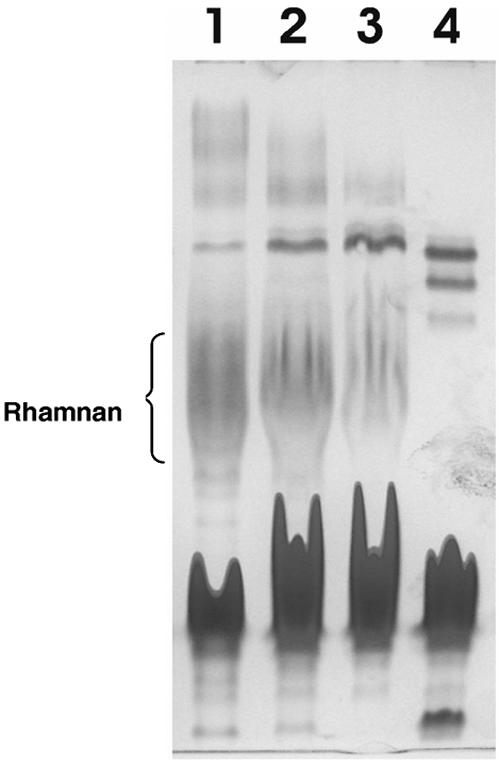
PAGE analyses of rhamnan-containing LPSs present in the aqueous phases of hot phenol-water extracts of Rhizobium sp. strain NGR234 and regulatory mutants involved in transcriptional control of rhamnan production. All cultures were induced with apigenin. Lanes contain extracts from the following sources: 1, wild-type NGR234; 2, NGRsyrM2::uidA; 3, NGRΩnodD2; 4, NGRΩttsI. The position of the rhamnan-containg LPS is indicated in lanes 1 to 3. The gels were silver stained for LPS.
FIG. 4.
FIG. 4.
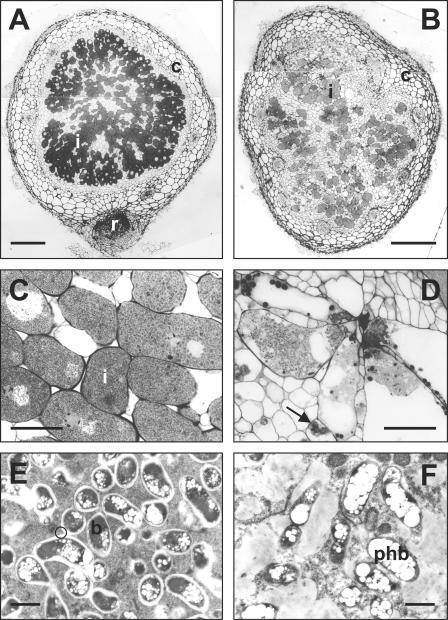
Structures of Vigna unguiculata nodules formed by Rhizobium sp. strain NGR234 (A, C, and E) and the y4gM mutant NGRΩgM (B, D, and F). (A and B) Low-magnification light micrographs of whole nodules. Magnification, ×35. Bar, 200 μm. (C and D) High-magnification light micrographs of nodule sections. Magnification, ×312. Bar, 32 μm. (E and F) Electron micrographs of bacteroidal tissue. Magnification, ×8,650. Bar, 2 μm. Abbreviations: b, bacteroids; c, nodule cortex; i, infected cells; phb, polyhydroxybutyrate; r, roots. The black arrow points to an amyloplast containing starch granules, and the black circle indicates peribacteroid membranes.

References

    1. Allaway, D., L. Cavalca, S. Saini, P. Hocking, E. M. Lodwig, M. E. Leonard, and P. S. Poole. 2000. Identification of a putative LPS-associated cation exporter from Rhizobium leguminosarum bv. viciae. FEMS Microbiol. Lett. 186:47-53. - PubMed
    1. Altschul, S. F., W. Gish, W. Miller, E. W. Myers, and D. J. Lipman. 1990. Basic local alignment search tool. J. Mol. Biol. 215:403-410. - PubMed
    1. Broughton, W. J., S. Jabbouri, and X. Perret. 2000. Keys to symbiotic harmony. J. Bacteriol. 182:5641-5652. - PMC - PubMed
    1. Broughton, W. J., C.-H. Wong, A. Lewin, U. Samrey, H. Myint, H. Meyer, z. A., D. N. Dowling, and R. Simon. 1986. Identification of Rhizobium plasmid sequences involved in recognition of Psophocarpus, Vigna, and other legumes. J. Cell Biol. 102:1173-1182. - PMC - PubMed
    1. Campbell, G. R. O., B. L. Reuhs, and G. C. Walker. 2002. Chronic intracellular infection of alfalfa nodules by Sinorhizobium meliloti requires correct lipopolysaccharide core. Proc. Natl. Acad. Sci. USA 99:3938-3943. - PMC - PubMed

Publication types

LinkOut - more resources