Comparative Study
. 2006 May 3;26(18):4908-16.
doi: 10.1523/JNEUROSCI.0476-06.2006.

Estrogen receptors alpha and beta differentially regulate the transcriptional activity of the Urocortin gene

Affiliations
Comparative Study

Estrogen receptors alpha and beta differentially regulate the transcriptional activity of the Urocortin gene

Paola Haeger et al. J Neurosci. .

Abstract

Urocortin (Ucn), a highly conserved metazoan gene, is related to stress and feeding, behaviors with significant gender differences. We investigated whether estrogens regulate the expression of the Ucn gene using transient transfection in PC12 cells with the human Ucn (hUcn) promoter coupled to luciferase and either alpha or beta estrogen receptors (ERalpha or ERbeta, respectively). The results demonstrate that estradiol (E2) increases the activity of the hUcn promoter via ERalpha, and decreases hUcn promoter activity through ERbeta. Deletions of the hUcn promoter show that the increase in promoter activity mediated by E2-ERalpha depends on a promoter region containing a half-estrogen response element and an Sp1 site, and the decrease mediated by E2-ERbeta depends on a proximal promoter region containing a cAMP response element. Ucn and ERs coexist in neurons of rat hypothalamic nuclei, giving anatomical support for a direct effect of estrogen receptors on the Ucn gene. By in situ hybridization, we observed that cycling female rats have a higher number of cells expressing Ucn mRNA than males in the paraventricular nucleus of the hypothalamus (PVN) and the septum. Both of these brain nuclei are related to stress behaviors and express moderate levels of Ucn. Furthermore, Ucn mRNA was significantly decreased in the PVN and increased in the septum 30 d after ovariectomy. Acute E2 administration to ovariectomized rats significantly increased Ucn mRNA expression in the PVN and septum. In conclusion, our in vitro and in vivo evidence suggests that estrogens exert a direct and differential transcriptional regulation of the Ucn gene.


Figures
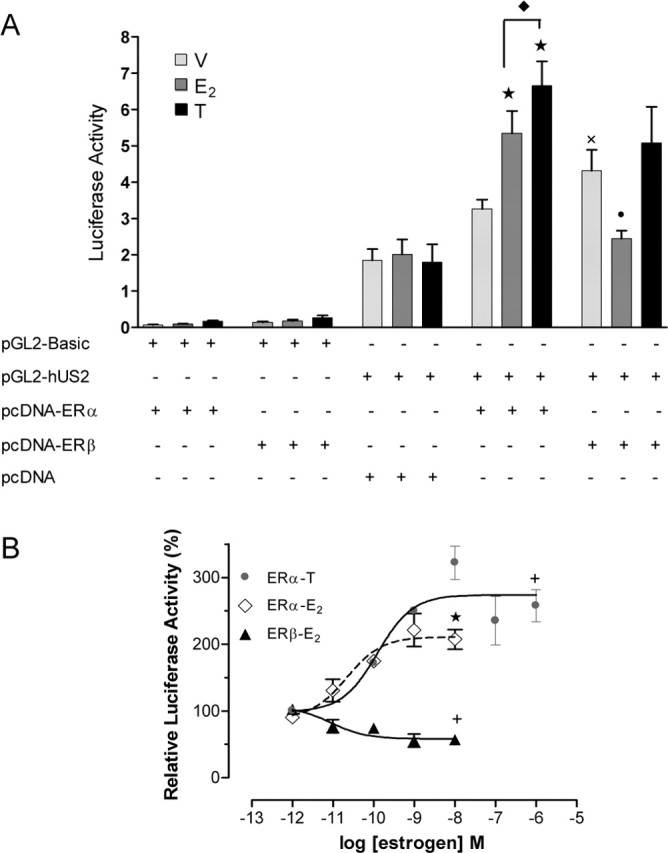
Figure 1.
Figure 1.
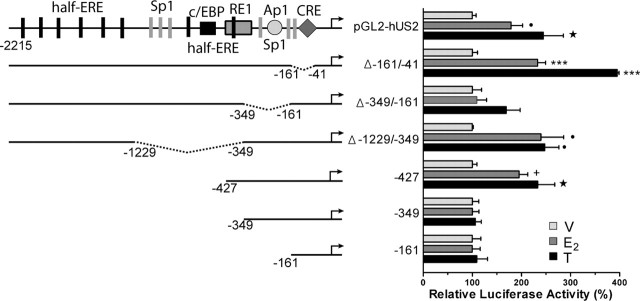
Activation of ERα increases and activation of ERβ decreases the activity of the hUcn promoter. A, Effect of E2 and tamoxifen (T) on the activity of the hUcn promoter through ERα (pcDNA-ERα) or ERβ (pcDNA-ERβ) or when cotransfected with the empty vector (pcDNA). Luciferase activity corresponds to light units of firefly luciferase quantified 24 h after cells were treated with 10 nm E2, 1000 nm T, or vehicle (V; ethanol) and normalized to renilla luciferase light units. B, Dose–response effect of E2 and T through ERα and of E2 through ERβ, on the activity of the hUcn promoter. Relative luciferase activity corresponds to the luciferase activity relative to vehicle (100%). Values are the mean ± SEM of three independent experiments. Statistical analysis by ANOVA followed by Newman–Keuls (A) or Dunn (B) post hoc tests gave the following significances: ★, p < 0.001, ✚, p < 0.01, and •, p < 0.05, compared with respective vehicle control; ×, p < 0.01, compared with pcDNA/pGL2-hUS2; ♦, p < 0.05, compared between them.
Figure 2.
Figure 2.
Activation of ERα by E2 and T increases the activity of the hUcn promoter through a promoter region containing half-ERE, Sp1, and Ap1 sites. PC12 cells were cotransfected with the hUcn promoter (pGL2-hUS2) or deleted mutants and pcDNA-ERα. The results are expressed relative to vehicle (100%). Luciferase activity corresponds to light units of firefly luciferase normalized to renilla luciferase light units. Values are the mean ± SEM of two to three independent experiments. Statistical analysis by ANOVA followed by Dunn post hoc test gave the following significances: ★, p < 0.001; ✚, p < 0.01; and • p < 0.05, compared with respective vehicle control. Analysis by Mann–Whitney U test gave the following significance: ★★★, p < 0.001, compared with respective vehicle control.
Figure 3.
Figure 3.
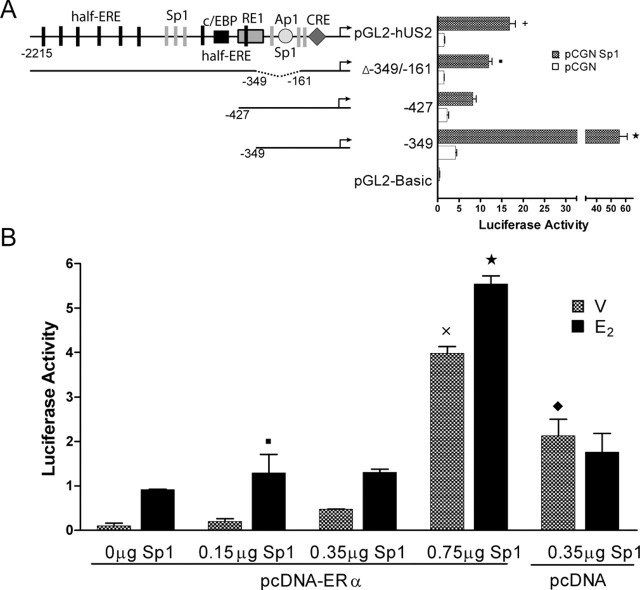
Sp1 overexpression increases the activity of the Ucn promoter. A, PC12 cells were cotransfected with pGL2-hUS2 or deleted mutants of the hUcn promoter, or the empty reporter vector (pGL2-Basic) (0.75 μg), and the Sp1 expression vector (Sp1) or the respective empty vector (pCGN) (0.8 μg). Luciferase activity of pGL2-Basic plus pCGN was 0.081 ± 0.006 and of pGL2-Basic plus Sp1 was 0.406 ± 0.059. B, PC12 cells were cotransfected with pGL2-hUS2 (0.5 μg) and Sp1 and pcDNA-ERα (0.35 μg) expression vectors. PC12 cells were cotransfected with PGL2-hUS2 and pcDNA-ERα and increasing amounts of Sp1 expression vector (0.15, 0.35, and 0.75 μg). Transfected cells were treated for 24 h with 10 nm E2 or vehicle (V; ethanol). Luciferase activity corresponds to light units of firefly luciferase normalized to total protein. Statistical analysis by ANOVA followed by Newman–Keuls post hoc test gave the following significances: (in A) ★, p < 0.001, ✚, p < 0.01, and ▪, p < 0.05 compared with the empty vector; (in B) ★, p < 0.001 and ▪, p < 0.05 compared with respective vehicle control; ×, p < 0.001, compared with 0.15 and 0.35 μg Sp1/pcDNA-ERα treated to vehicle; ♦, p < 0.01, compared with 0.35 Sp1/pcDNA-ERα.
Figure 4.
Figure 4.
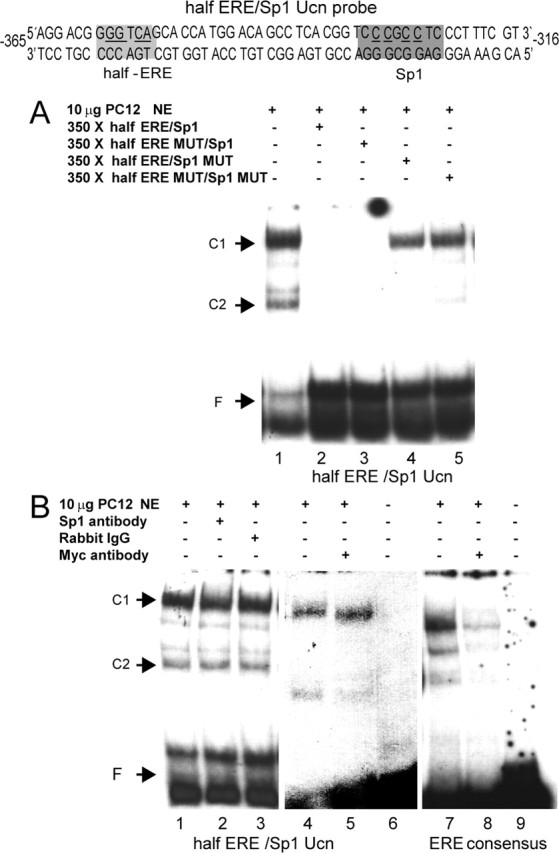
EMSA with PC12 nuclear extracts. A radiolabeled probe corresponding to the hUcn promoter containing the most proximal half-ERE and medial Sp1 site (halfERE/Sp1 Ucn probe) was used in a gel mobility assay. Ten micrograms of a nuclear extract of PC12 cells transfected with pcDNAERα (A, B, left) or with pcDNAERα-Myc (B, middle and right) was incubated in the different conditions depicted in the figure. C1 and C2 correspond to two retarded DNA/protein complexes. F corresponds to the free probe. Results in A and B are representative of three and two independent experiments, respectively.
Figure 5.
Figure 5.
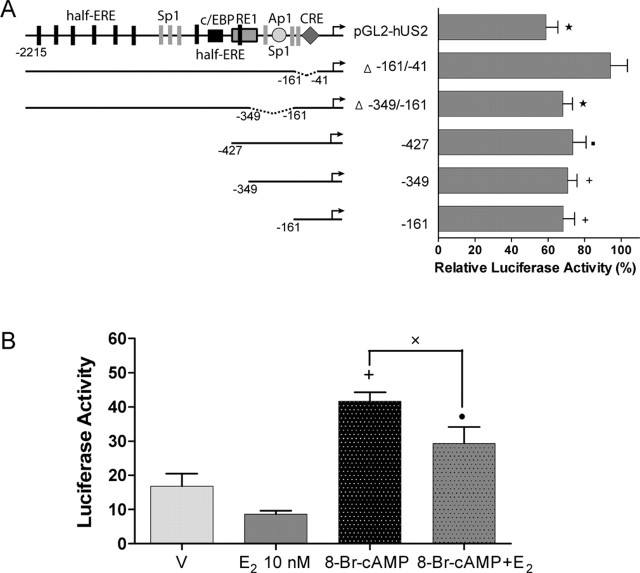
Activation of ERβ by E2 represses the activity of the hUcn promoter through the region containing a CRE site. A, PC12 cells were cotransfected with PGL2-hUS2 or deleted mutants of the hUcn promoter and pcDNA-ERβ. The results are expressed relative to vehicle (100%). Luciferase activity corresponds to light units of firefly luciferase normalized to renilla luciferase light units. B, PC12 cells were cotransfected with the −161 promoter and pcDNA-ERβ and treated for 24 h with 10 nm E2 and/or 0.5 mm 8-Br-cAMP. Vehicle (V) in B corresponds to ethanol plus DMSO used to E2 and 8-Br-cAMP, respectively. All of the treatment conditions have the same concentration of each vehicle. Luciferase activity corresponds to light units of firefly luciferase normalized to total protein. Values are the mean ± SEM of two to three independent experiments. Statistical analysis by ANOVA followed by Dunn post hoc test gave the following significances: ★, p < 0.001, ✚, p < 0.01, and •, p < 0.05, compared with respective vehicle control; ×, p < 0.05, compared between them.
Figure 6.
Figure 6.
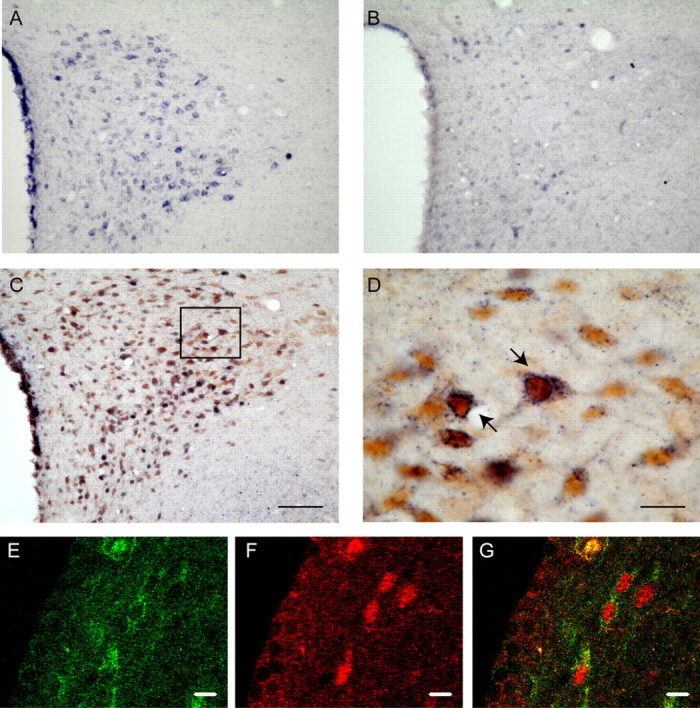
Ucn coexists with ERβ in cells of the rat PVN and with ERα in the periventricular nucleus of the hypothalamus. A, ISH for Ucn mRNA (dark blue staining) in a coronal tissue section at the level of the PVN in the presence of the U2 probe. B, Negative ISH control at the same level of the PVN using a scramble probe shows background staining. C, D, Coexistence of Ucn mRNA with ERβ immunoreactivity (brown staining). D, Higher magnification of the frame depicted in C. Confocal immunofluorescence detection of Ucn (E, green) and ERα (F, red) in the periventricular nucleus of the hypothalamus is shown. G, Merge of E and F. Scale bars: D–G, 10 μm; (in C) A–C, 100 μm.
Figure 7.
Figure 7.
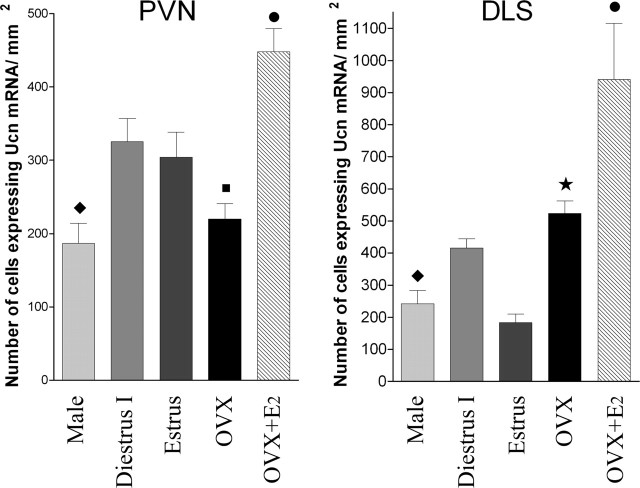
In situ expression of Ucn mRNA in different endocrine status in the PVN and DLS of the rat brain. Coronal tissue sections were processed for ISH using the U1 DIG-labeled probe. Values correspond to the mean ± SEM of three to seven independent experiments. Analysis by one-way ANOVA showed a significant difference between experimental conditions in both areas studied (PVN: F = 14.17, R2 = 0.76, p < 0.0001; DLS: F = 8.65, R2 = 0.60, p < 0.0002). Newman–Keuls multiple comparison post hoc test gave the following significances: PVN, •, p < 0.05 compared with estrus, p < 0.01 compared with diestrus I, and p < 0.001 compared with male and OVX, ♦, p < 0.05 compared with diestrus I and estrus, ▪, p < 0.05 compared with diestrus I and estrus; DLS, ♦, p < 0.001 compared with diestrus I, and OVX, •, p < 0.01 compared with diestrus I, estrus, and OVX, and p < 0.001 compared with male, ★, p < 0.05 compared with diestrus I and p < 0.01 compared with OVX.

References

    1. Andres ME, Gysling K, Araneda S, Venegas A, Bustos G (1996). NMDA-NR1 receptor subunit mRNA expression in rat brain after 6-OH-dopamine induced lesions: a nonisotopic in situ hybridization study. J Neurosci Res 46:375–384. - PubMed
    1. Bale TL, Vale WW (2004). CRF and CRF receptors: role in stress responsivity and other behaviors. Annu Rev Pharmacol Toxicol 44:525–557. - PubMed
    1. Bao AM, Hestiantoro A, Van Someren EJ, Swaab DF, Zhou JN (2005). Colocalization of corticotropin-releasing hormone and oestrogen receptor-alpha in the paraventricular nucleus of the hypothalamus in mood disorders. Brain 128:1301–1313. - PubMed
    1. Bebchuk JM, Arfken CL, Dolan-Manji S, Murphy J, Hasanat K, Manji HK (2000). A preliminary investigation of a protein kinase C inhibitor in the treatment of acute mania. Arch Gen Psychiatry 57:95–97. - PubMed
    1. Bittencourt JC, Vaughan J, Arias C, Rissman RA, Vale WW, Sawchenko PE (1999). Urocortin expression in rat brain: evidence against a pervasive relationship of urocortin-containing projections with targets bearing type 2 CRF receptors. J Comp Neurol 415:285–312. - PubMed

Publication types

MeSH terms

LinkOut - more resources