


Reproduction, embryonic development, and maternal transfer of contaminants in the amphibian Gastrophryne carolinensis
- PMID: 16675417
- PMCID: PMC1459916
- DOI: 10.1289/ehp.8457
Reproduction, embryonic development, and maternal transfer of contaminants in the amphibian Gastrophryne carolinensis
Abstract
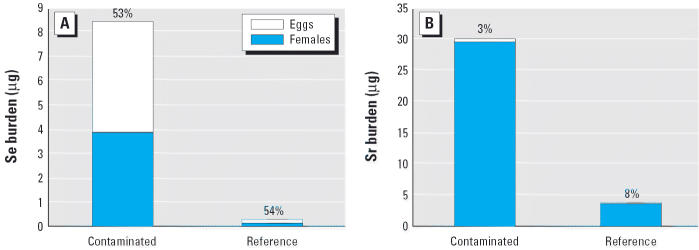
Although many amphibian populations around the world are declining at alarming rates, the cause of most declines remains unknown. Environmental contamination is one of several factors implicated in declines and may have particularly important effects on sensitive developmental stages. Despite the severe effects of maternal transfer of contaminants on early development in other vertebrate lineages, no studies have examined the effects of maternal transfer of contaminants on reproduction or development in amphibians. We examined maternal transfer of contaminants in eastern narrow-mouth toads (Gastrophryne carolinensis) collected from a reference site and near a coal-burning power plant. Adult toads inhabiting the industrial area transferred significant quantities of selenium and strontium to their eggs, but Se concentrations were most notable (up to 100 microg/g dry mass). Compared with the reference site, hatching success was reduced by 11% in clutches from the contaminated site. In surviving larvae, the frequency of developmental abnormalities and abnormal swimming was 55-58% higher in the contaminated site relative to the reference site. Craniofacial abnormalities were nearly an order of magnitude more prevalent in hatchlings from the contaminated site. When all developmental criteria were considered collectively, offspring from the contaminated site experienced 19% lower viability. Although there was no statistical relationship between the concentration of Se or Sr transferred to eggs and any measure of offspring viability, our study demonstrates that maternal transfer may be an important route of contaminant exposure in amphibians that has been overlooked.
Figures


References
-
- ASTM 1998. Standard Guide for Conducting the Frog Embryo Teratogenesis Assay-Xenopus (FETAX). E1439-98. Philadelphia:American Society For Testing and Materials.
-
- Bantle JA, Dumont JN, Finch R, Linder G. 1991. Atlas of Abnormalities: A Guide for the Performance of FETAX. Stillwater, OK:Oklahoma State Publications.
-
- Bryan L, Hopkins WA, Baionno JA, Jackson BP. Maternal transfer of contaminants to eggs in common grackles (Quiscalus quiscala) nesting on coal fly ash basins. Arch Environ Contam Toxicol. 2003;45:273–277. - PubMed
-
- Cherry DS, Guthrie RK, Rogers JH, Jr, Cairns J, Jr, Dixon KL. Responses of mosquitofish (Gambusia affinis) to ash effluent and thermal stress. Trans Am Fish Soc. 1976;105:686–694.
-
- Collins JP, Storfer A. Global amphibian declines: sorting the hypotheses. Divers Distrib. 2003;9:88–98.
Publication types
MeSH terms
Substances
LinkOut - more resources
Full Text Sources
Other Literature Sources
Research Materials