


Full-length and truncated neurokinin-1 receptor expression and function during monocyte/macrophage differentiation
- PMID: 16675550
- PMCID: PMC1457089
- DOI: 10.1073/pnas.0602563103
Full-length and truncated neurokinin-1 receptor expression and function during monocyte/macrophage differentiation
Abstract
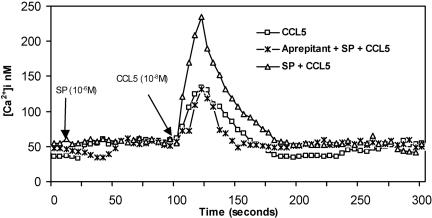
The substance P (SP)-preferring receptor neurokinin-1 receptor (NK-1R) has two forms: a full-length receptor consisting of 407 aa and a truncated receptor consisting of 311 aa. These two receptors differ in the length of the C terminus of NK-1R. We studied the undifferentiated and phorbol myristate acetate (PMA)-differentiated human monocyte/macrophage cell line THP-1 to investigate the expression and function of NK-1R. The expression of full-length and truncated NK-1R in this cell line was determined by using real-time PCR and immunofluorescence staining. Undifferentiated THP-1 cells expressed only truncated NK-1R. The differentiation of THP-1 cells with PMA to a macrophage-like phenotype resulted in the expression of full-length NK-1R, which was functionally accompanied by an SP (10(-6) M)-induced Ca2+ increase. In contrast, the addition of SP (10(-6) M) did not trigger Ca2+ response in undifferentiated THP-1 cells; however, SP did enhance the CCR5-preferring ligand RANTES (CCL5)-mediated Ca2+ increase. When a plasmid containing the full-length NK-1R was introduced into undifferentiated THP-1 cells, exposure to SP triggered Ca2+ increase, demonstrating that the full-length NK-1R is required for SP-induced Ca2+ increase. The NK-1R antagonist aprepitant (Emend, Merck) inhibited both the SP-induced Ca2+ increase in PMA-differentiated THP-1 cells and the SP priming effect on the CCL5-mediated Ca2+ increase, indicating that these effects are mediated through the full-length and truncated NK-1R, respectively. Taken together, these observations demonstrate that there are unique characteristics of NK-1R expression and NK-1R-mediated signaling between undifferentiated THP-1 cells and THP-1 cells differentiated to the macrophage phenotype.
Conflict of interest statement
Conflict of interest statement: No conflicts declared.
Figures


References
-
- Ho W. Z., Douglas S. D. J. Neuroimmunol. 2004;157:48–55. - PubMed
-
- Black I. B., Adler J. E., Dreyfus C. F., Jonakait G. M., Katz D. M., LaGamma E. F., Markey K. M. Science. 1984;225:1266–1270. - PubMed
-
- McGillis J. P., Mitsuhashi M., Payan D. G. Ann. N.Y. Acad. Sci. 1990;594:85–94. - PubMed
-
- Hartung H. P. Brain Behav. Immun. 1988;2:275–281. - PubMed
-
- Lieb K., Fiebich B. L., Berger M., Bauer J., Schulze-Osthoff K. J. Immunol. 1997;159:4952–4958. - PubMed
Publication types
MeSH terms
Substances
Grants and funding
LinkOut - more resources
Full Text Sources
Other Literature Sources
Medical
Miscellaneous
