. 2006 May 16;103(20):7571-6.
doi: 10.1073/pnas.0508312103. Epub 2006 May 4.

Farm-scale evaluation of the impacts of transgenic cotton on biodiversity, pesticide use, and yield

Affiliations

Farm-scale evaluation of the impacts of transgenic cotton on biodiversity, pesticide use, and yield

Manda G Cattaneo et al. Proc Natl Acad Sci U S A. .

Abstract

Higher yields and reduced pesticide impacts are needed to mitigate the effects of agricultural intensification. A 2-year farm-scale evaluation of 81 commercial fields in Arizona show that use of transgenic Bacillus thuringiensis (Bt) cotton reduced insecticide use, whereas transgenic cotton with Bt protein and herbicide resistance (BtHr) did not affect herbicide use. Transgenic cotton had higher yield than nontransgenic cotton for any given number of insecticide applications. However, nontransgenic, Bt and BtHr cotton had similar yields overall, largely because higher insecticide use with nontransgenic cotton improved control of key pests. Unlike Bt and BtHr cotton, insecticides reduced the diversity of nontarget insects. Several other agronomic and ecological factors also affected biodiversity. Nevertheless, pairwise comparisons of diversity of nontarget insects in cotton fields with diversity in adjacent noncultivated sites revealed similar effects of cultivation of transgenic and nontransgenic cotton on biodiversity. The results indicate that impacts of agricultural intensification can be reduced when replacement of broad-spectrum insecticides by narrow-spectrum Bt crops does not reduce control of pests not affected by Bt crops.


Conflict of interest statement

Conflict of interest statement: No conflicts declared.

Figures
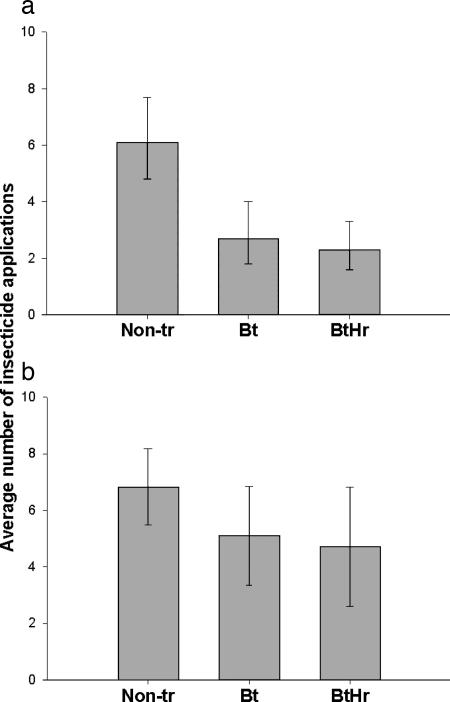
Fig. 1.
Fig. 1.
Average number of broad-spectrum insecticide applications in nonTr, Bt, and BtHr cotton (with 95% confidence intervals). The number of insecticide applications was significantly higher in nonTr than in transgenic cotton in 2002 (one-tailed contrast, t = 4.13, df = 72, P < 0.0001) (a) and in 2003 (one-tailed contrast, t = 1.99, df = 72, P = 0.025) (b). The number of insecticide applications was higher in 2003 than in 2002 (P = 0.058), although differences in insecticide applications among cotton types did not vary between years (P = 0.47).
Fig. 2.
Fig. 2.
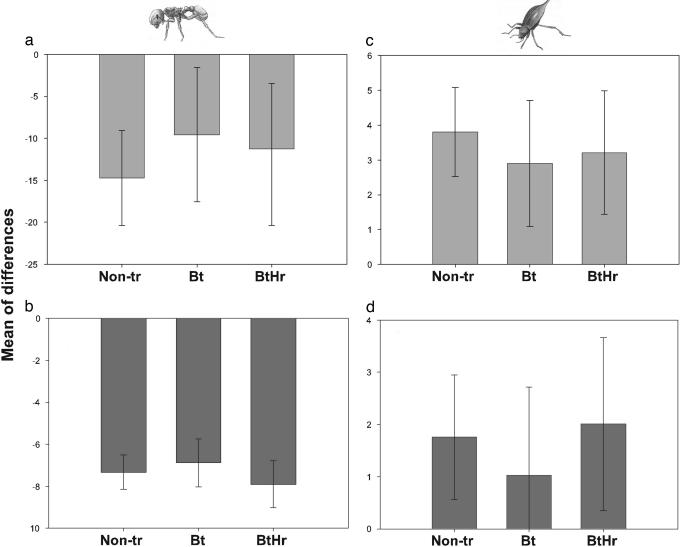
Mean of differences (with 95% confidence intervals) in ant and beetle density or species richness between noncultivated vegetation and adjacent cotton fields, for nonTr, Bt, and BtHr cotton. (a and b) Ant density (a) and ant species richness (b) declined significantly from noncultivated vegetation to cotton fields. (c and d) Beetle density (c) and beetle species richness (d) increased significantly from noncultivated vegetation to cotton fields, except for species richness in Bt cotton. For ants, the year did not affect overall changes in density (P = 0.99) or species richness (P = 0.39) from noncultivated vegetation to the cotton types, nor the differences among changes in density (P = 0.98) or species richness (P = 0.13) in the cotton types. Similarly for beetles, the year did not affect overall changes in density (P = 0.85) or species richness (P = 0.73) from noncultivated vegetation to the cotton types, nor the differences among changes in density (0.64) or species richness (P = 0.96) in the cotton types.
Fig. 3.
Fig. 3.
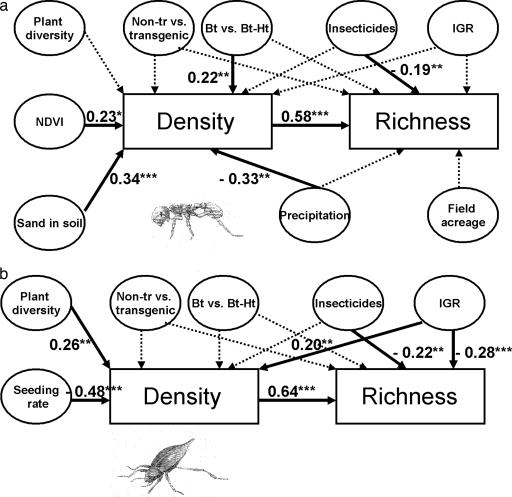
Path analyses evaluating the effects of nonTr and transgenic cotton on density and species richness of ants and beetles (see Materials and Methods for details). Path coefficients not significantly different from zero are represented by dotted arrows; significant path coefficients are represented by continuous arrows. ∗, P < 0.07; ∗∗, P < 0.05; ∗∗∗, P < 0.01. (a) For ants, variables included in the analysis were the orthogonal contrast between nonTr and the weighted average of Bt and BtHr cotton (nonTr vs. transgenic), the orthogonal contrast between Bt and BtHr cotton (Bt vs. BtHr), number of broad-spectrum insecticide applications before insect sampling (insecticides), whether a field was treated with an IGR before insect sampling (IGR), number of plant types in noncultivated sites (plant diversity), NDVI of noncultivated sites, percentage of sand in soil (sand in soil), accumulated precipitation before insect sampling (precipitation), and field acreage. The compound path coefficients linking species richness to Bt vs. BtHr, NDVI, sand in soil, and precipitation were 0.13 (revealing lower species richness in BtHr than Bt cotton), 0.13, 0.20, and −0.19, respectively. (b) For beetles, the first five variables considered for ants and seeding rate were included in the path analysis. The compound path coefficients linking species richness to plant diversity and seeding rate were 0.17 and −0.31, respectively. The total correlation between IGRs and species richness was −0.15.

References

    1. Tilman D., Fargione J., Wolff B., D’Antonio C., Dobson A., Howarth R., Schindler D., Schlesinger W. H., Simberloff D., Swackhamer D. Science. 2001;292:281–284. - PubMed
    1. Khush G. S. Nat. Rev. Genet. 2001;2:815–822. - PubMed
    1. Pimentel D. S., Raven P. H. Proc. Natl. Acad. Sci. USA. 2000;97:8198–8199. - PMC - PubMed
    1. Huang J., Rozelle S., Pray C., Wang Q. Science. 2002;295:674–677. - PubMed
    1. Hails R. S. Nature. 2002;418:685–688. - PubMed

Publication types