. 2006 Jul 15;91(2):411-20.
doi: 10.1529/biophysj.105.070532. Epub 2006 May 5.

Dynamics of DNA ejection from bacteriophage

Affiliations

Dynamics of DNA ejection from bacteriophage

Mandar M Inamdar et al. Biophys J. .

Abstract

The ejection of DNA from a bacterial virus (i.e., phage) into its host cell is a biologically important example of the translocation of a macromolecular chain along its length through a membrane. The simplest mechanism for this motion is diffusion, but in the case of phage ejection a significant driving force derives from the high degree of stress to which the DNA is subjected in the viral capsid. The translocation is further sped up by the ratcheting and entropic forces associated with proteins that bind to the viral DNA in the host cell cytoplasm. We formulate a generalized diffusion equation that includes these various pushing and pulling effects and make estimates of the corresponding speedups in the overall translocation process. Stress in the capsid is the dominant factor throughout early ejection, with the pull due to binding particles taking over at later stages. Confinement effects are also investigated, in the case where the phage injects its DNA into a volume comparable to the capsid size. Our results suggest a series of in vitro experiments involving the ejection of DNA into vesicles filled with varying amounts of binding proteins from phage whose state of stress is controlled by ambient salt conditions or by tuning genome length.


Figures
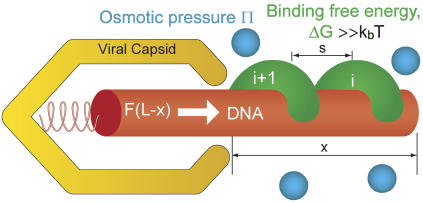
FIGURE 1
FIGURE 1
Schematic showing the various physical effects that assist bare diffusion in the process of phage DNA ejection. The DNA cross-section is not shown to scale: its diameter is 2–3 nm, as compared with a capsid radius that is 10 times larger. The spring denotes schematically the stored energy density resulting in a force F acting along the length Lx of chain remaining in the capsid. The small spheres denote particles giving rise to an external (cytoplasmic) osmotic pressure Πosmotic, and the green particles labeled i and i + 1 are successive binding particles. (The schematic and the model were inspired by Fig. 10.10 in (17).)
FIGURE 2
FIGURE 2
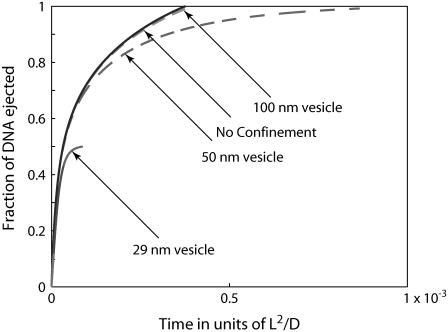
Ejection time for phage-λ injecting its genome into vesicles of radius 29, 50, and 100 nm. The capsid radius of the phage is 29 nm. It can be seen that the amount of DNA injection increases as the ratio of the vesicle radius to the capsid radius increases. On the timescale depicted here, there will be essentially no ejection due to pure diffusion (which takes place instead at times of order 1, in units of L2/D).
FIGURE 3
FIGURE 3
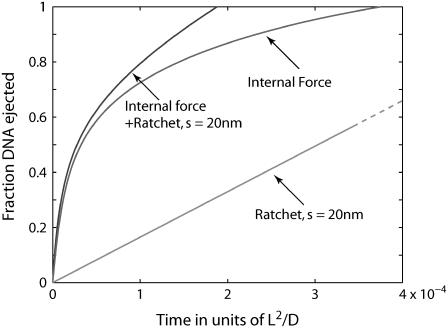
The fraction of DNA injected in phage λ as a function of time (in units of L2/D) in the presence of binding particles that form a ratchet. The DNA injection purely due to the internal force is used as a benchmark, and the spacing between the binding sites s = 20 nm. It can be seen that the ratchet reduces the translocation time. The time required to internalize the genome solely by the ratcheting mechanism (see lower, straight line) is approximately twice the time taken for the purely internal force-driven mechanism.
FIGURE 4
FIGURE 4
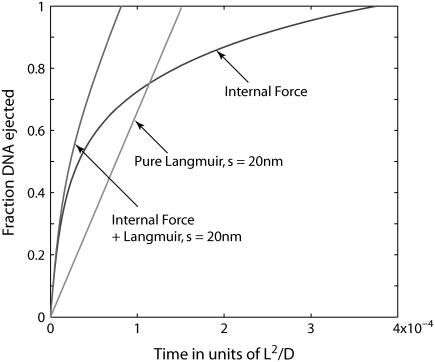
The fraction of DNA injected in phage λ in the presence of binding proteins that bind reversibly, as a function of time (in units of L2/D.) The presence of reversible binding proteins results in a pulling Langmuir force (see text). This pulling force significantly enhances the DNA ejection rate over that of the purely force-driven mechanism, by almost a factor of 10.
FIGURE 5
FIGURE 5
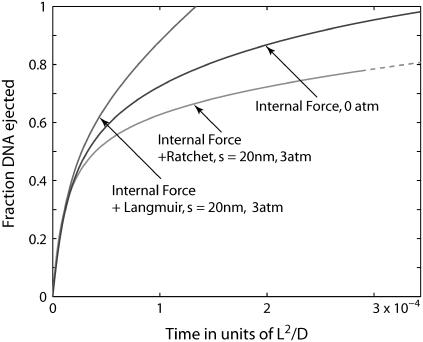
The fraction of DNA injected in phage λ as a function of time (in units of L2/D) for the case in which there is a resistive force due to osmotic pressure. We compare the roles of the Langmuir force and the ratchet effect in ejecting the phage DNA against osmotic pressure. The spacing s is taken to be 20 nm and the osmotic pressure in the cell is ∼3 atm. It can be seen that the Langmuir force easily pulls the DNA against this pressure. The DNA translocation by the Brownian ratchet requires a much longer time, but it still succeeds in pulling out the genome at timescales not much longer than the ejection by internal force alone with zero osmotic pressure.

References

    1. Molineux, I. J. 2001. No syringes please, ejection of phage T7 DNA from the virion is enzyme driven. Mol. Microbiol. 40:1–8. - PubMed
    1. Letellier, L., P. Boulanger, L. Plancon, P. Jacquot, and M. Santamaria. 2004. Main features of tailed phage, host recognition and DNA uptake. Front. Biosci. 9:1228–1239. - PubMed
    1. Gonzales-Huici, V., M. Salas, and J. Hermoso. 2004. The push-pull mechanism of bacteriophage φ29 DNA injection. Mol. Microbiol. 52:529–540. - PubMed
    1. Riemer, S. C., and V. A. Bloomfield. 1978. Packaging of DNA in bacteriophage heads: some considerations on energetics. Biopolymers. 17:785–794. - PubMed
    1. Odijk, T. 1998. Hexagonally packed DNA within bacteriophage T7 stabilized by curvature stress. Biophys. J. 75:1223–1227. - PMC - PubMed

Publication types

MeSH terms

LinkOut - more resources