


Treatment of non-alcoholic fatty liver disease
- PMID: 16679470
- PMCID: PMC2563793
- DOI: 10.1136/pgmj.2005.042200
Treatment of non-alcoholic fatty liver disease
Abstract
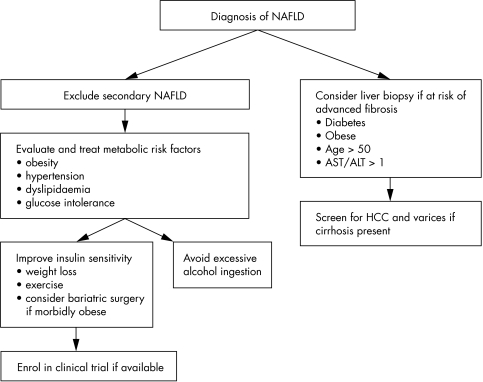
Non-alcoholic fatty liver disease (NAFLD) is common and may progress to cirrhosis and its complications. The pathogenesis of steatosis and cellular injury is thought to be related mostly to insulin resistance and oxidative stress. Therefore, management entails identification and treatment of metabolic risk factors, improving insulin sensitivity, and increasing antioxidant defences in the liver. Weight loss and exercise improve insulin sensitivity. Bariatric surgery may improve liver histology in patients with morbid obesity. Insulin sensitising drugs showed promise in pilot trials as have a number of hepatoprotective agents. Further randomised, well controlled trials are required to determine the efficacy of these drugs.
Conflict of interest statement
Conflicts of interest: none declared.
References
-
- Browning J, Szczepaniak L, Dobbins R.et al Prevalence of hepatic steatosis in an urban population in the United States: impact of ethnicity. Hepatology 2004401387–1395. - PubMed
-
- Nomura H, Kashiwagi S, Hayashi J.et al Prevalence of fatty liver in a general population of Okinawa, Japan. Jpn J Med 198827142–149. - PubMed
-
- Angulo P. Nonalcoholic fatty liver disease. N Engl J Med 20023461221–1231. - PubMed
-
- Day C P, James O F. Steatohepatitis: a tale of two “hits”? Gastroenterology 1998114842–845. - PubMed
Publication types
MeSH terms
Substances
LinkOut - more resources
Full Text Sources
Other Literature Sources
Medical
