


Sex-specific influences of vasopressin on human social communication
- PMID: 16682649
- PMCID: PMC1472540
- DOI: 10.1073/pnas.0600406103
Sex-specific influences of vasopressin on human social communication
Abstract
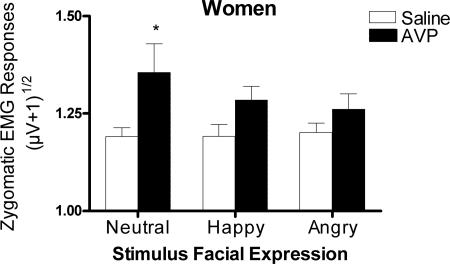
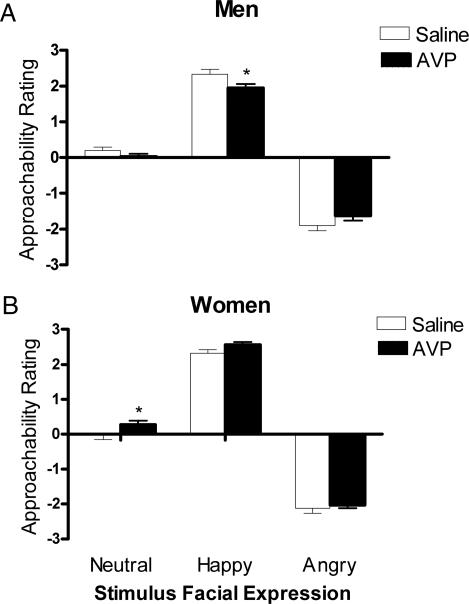
Arginine vasopressin (AVP) and related peptides affect social behaviors in numerous species, but AVP influences on human social functions have not yet been established. Here, we describe how intranasal AVP administration differentially affects social communication in men and women, and we propose a mechanism through which it may exert those influences. In men, AVP stimulates agonistic facial motor patterns in response to the faces of unfamiliar men and decreases perceptions of the friendliness of those faces. In contrast, in women, AVP stimulates affiliative facial motor patterns in response to the faces of unfamiliar women and increases perceptions of the friendliness of those faces. AVP also affected autonomic responsiveness to threatening faces and increased anxiety, which may underlie both communication patterns by promoting different social strategies in stressful contexts in men and women.
Conflict of interest statement
Conflict of interest statement: No conflicts declared.
Figures



References
-
- Goodson J. L., Bass A. H. Brain Res. Brain Res. Rev. 2001;35:246–265. - PubMed
-
- Coccaro E. F., Kavoussi R. J., Hauger R. L., Cooper T. B., Ferris C. F. Arch. Gen. Psychiatry. 1998;55:708–714. - PubMed
-
- Insel T. R., Winslow J. T., Wang Z., Young L. J. Adv. Exp. Med. Biol. 1998;449:215–224. - PubMed
-
- Young L. J., Wang Z., Insel T. R. Trends Neurosci. 1998;21:71–75. - PubMed
-
- Insel T. R., O’Brien D. J., Leckman J. F. Biol. Psychiatry. 1999;45:145–157. - PubMed
Publication types
MeSH terms
Substances
Grants and funding
LinkOut - more resources
Full Text Sources
Medical
Miscellaneous
