Review
. 2006 Apr;2(4):e64.
doi: 10.1371/journal.pgen.0020064.

Balancing selection and its effects on sequences in nearby genome regions

Affiliations
Review

Balancing selection and its effects on sequences in nearby genome regions

Deborah Charlesworth. PLoS Genet. 2006 Apr.

Abstract

Our understanding of balancing selection is currently becoming greatly clarified by new sequence data being gathered from genes in which polymorphisms are known to be maintained by selection. The data can be interpreted in conjunction with results from population genetics models that include recombination between selected sites and nearby neutral marker variants. This understanding is making possible tests for balancing selection using molecular evolutionary approaches. Such tests do not necessarily require knowledge of the functional types of the different alleles at a locus, but such information, as well as information about the geographic distribution of alleles and markers near the genes, can potentially help towards understanding what form of balancing selection is acting, and how long alleles have been maintained.


Conflict of interest statement

Competing interests. The author has declared that no competing interests exist.

Figures
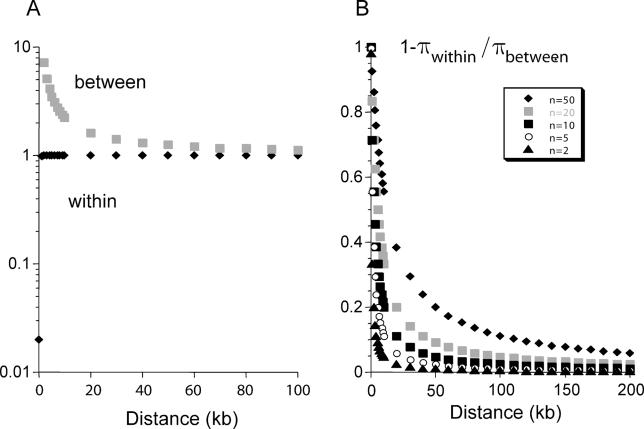
Figure 1
Figure 1. Sequence Diversity Expected at Neutral Sites at Different Distances from a Site under Balancing Selection
The figure shows the dependence of diversity at neutral sites in a gene on the number of different alleles maintained (n values) and the distance from the selected sites. A recombination rate of 1 cM/Mb is assumed, which is appropriate for humans, but much lower than the estimated rate for A. thaliana or maize. The example calculated is based on equations in the Appendix of [12], which are appropriate for selection at loci, such as MHC, where homozygous genotypes can be formed (e.g., a system with heterozygous advantage in which homozygotes are viable); note, however, that heterozygous advantage is unlikely to maintain very large allele numbers [35,82]. In the example shown, the turnover rate of alleles at the selected locus (or site) is assumed to be 10−7. (A) Shows predicted nucleotide diversity (π) between and within haplotypes of allelic classes (defined as having different alleles at the selected site or sites) for the case when 50 different alleles are maintained. (B) Shows the proportion of the overall diversity that is between allelic classes (analogous to FST in a subdivided population), showing differentiation between the haplotypes across several kb when there are many alleles, even when recombination occurs.
Figure 2
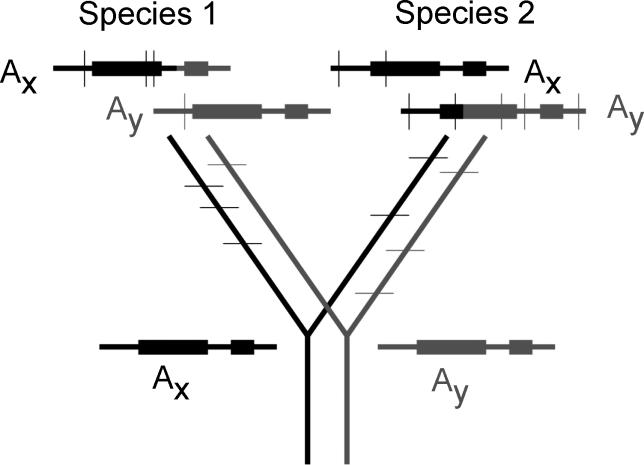
Figure 2. Lineages at a Locus under Long-Term Balancing Selection
Two haplotypes with different alleles, Ax and Ay, which diverged before the common ancestor of two species (1 and 2), are denoted by black and grey lines and boxes, respectively (denoting genes). Variants in the regions in and around the selected locus will remain associated with the haplotype in which they arose until recombination occurs with a different haplotype, even after the species become isolated. Species–specific differences (shown as thin horizontal lines in the tree and vertical lines in the haplotypes) will also accumulate. Recombination between different haplotypes (indicated by mixed black–grey haplotypes) will mean that sites close to the selected sites will be most differentiated between alleles (see Figure 1).
Figure 3
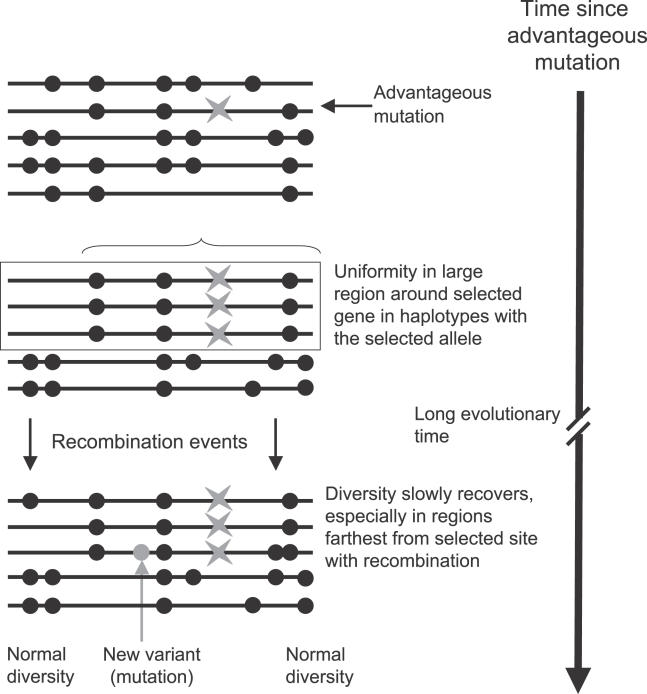
Figure 3. Haplotypes in a Genome Region after Spread of an Advantageous Mutation That Establishes a Balanced Polymorphism
An advantageous mutation (denoted by the star) arises and quickly spreads to a high frequency. Variants (black dots) in the region of genome around the selected site will be carried to high frequency in the haplotypes with the mutation, and recombination subsequently introduces variants from the rest of the population, especially at sites distant from the selected site. Mutations may also occur. Note that the hitchhiking does not contribute to differentiation between haplotypes, since the variants were present before the selective event.

References

    1. Levene H. Genetic equilibrium when more than one niche is available. Am Nat. 1953;87:331–333.
    1. Gillespie JH. A general model to account for enzyme variation in natural populations. V. The SAS/CFF model. Theor Popul Biol. 1978;14:1–45. - PubMed
    1. Gouyon PH, Vichot F, Damme Jv. Nuclear-cytoplasmic male sterility: Single point equilibria versus limit cycles. Am Nat. 1991;137:498–514.
    1. Seger J. Dynamics of some simple host–parasite models with more than two genotypes in each species. Philos Trans R Soc Lond B Biol Sci. 1988;319:541–555. - PubMed
    1. Frank SA. Coevolutionary genetics of plants and pathogens. Evol Ecol. 1993;7:45–75.

Publication types