


Promoter mutations that increase amyloid precursor-protein expression are associated with Alzheimer disease
- PMID: 16685645
- PMCID: PMC1474091
- DOI: 10.1086/504044
Promoter mutations that increase amyloid precursor-protein expression are associated with Alzheimer disease
Abstract
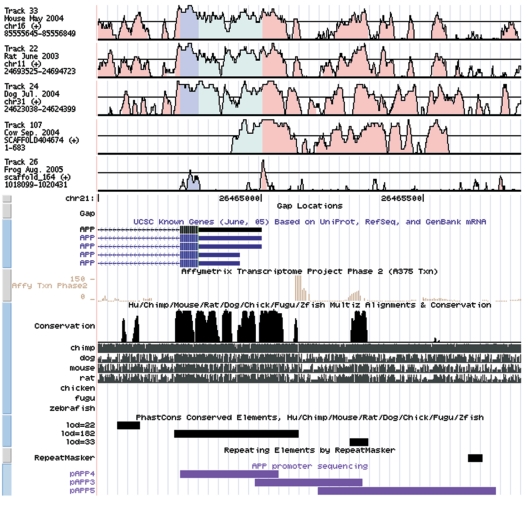
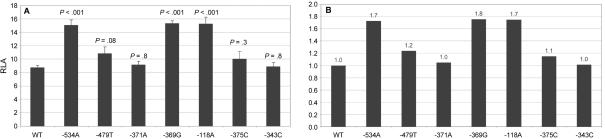
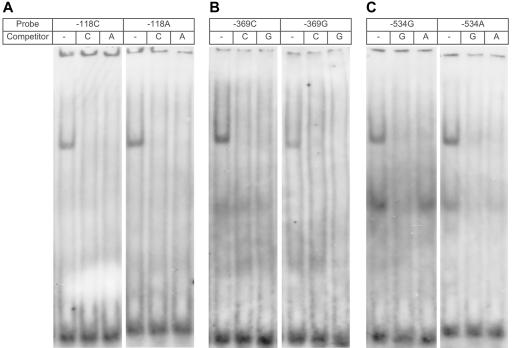
Genetic variations in promoter sequences that alter gene expression play a prominent role in increasing susceptibility to complex diseases. Also, expression levels of APP are essentially regulated by its core promoter and 5' upstream regulatory region and correlate with amyloid beta levels in Alzheimer disease (AD) brains. Here, we systematically sequenced the proximal promoter (-766/+204) and two functional distal regions (-2634/-2159 and -2096/-1563) of APP in two independent AD series with onset ages < or =70 years (Belgian sample, n=180; Dutch sample, n=111) and identified eight novel sequence variants. Three mutations (-118C-->A, -369C-->G, and -534G-->A) identified only in patients with AD showed, in vitro, a nearly twofold neuron-specific increase in APP transcriptional activity, similar to what is expected from triplication of APP in Down syndrome. These mutations either abolished (AP-2 and HES-1) or created (Oct1) transcription-factor binding sites involved in the development and differentiation of neuronal systems. Also, two of these clustered in the 200-bp region (-540/-340) of the APP promoter that showed the highest degree of species conservation. The present study provides evidence that APP-promoter mutations that significantly increase APP expression levels are associated with AD.
Figures
References
Web Resources
-
- Alzheimer Disease & Frontotemporal Dementia Mutation Database, http://www.molgen.ua.ac.be/ADMutations/
-
- GenBank, http://www.ncbi.nlm.nih.gov/Genbank/ (for APP [accession number D87675.1])
-
- Genetic Service Facility, http://www.vibgeneticservicefacility.be/
-
- International HapMap Project, http://www.hapmap.org/
-
- Online Mendelian Inheritance in Man (OMIM), http://www.ncbi.nlm.nih.gov/Omim/ (for AD, APP, PSEN1, PSEN2, MAPT, PRNP, PD, NR4A2, SNCA, and PARK2)
References
-
- Suzuki N, Cheung TT, Cai X-D, Odaka A, Otvos L Jr, Eckman C, Golde TE, Younkin SG (1994) An increased percentage of long amyloid β protein secreted by familial amyloid β protein precursor (βAPP717) mutants. Science 264:1336–1340 - PubMed
-
- Scheuner D, Eckman C, Jensen M, Song X, Citron M, Suzuki N, Bird TD, Hardy J, Hutton M, Kukull W, Larson E, Levy-Lahad E, Viitanen M, Peskind E, Poorkaj P, Schellenberg G, Tanzi R, Wasco W, Lannfelt L, Selkoe D, Younkin S (1996) Secreted amyloid β-protein similar to that in the senile plaques of Alzheimer’s disease is increased in vivo by the presenilin 1 and 2 and APP mutations linked to familial Alzheimer’s disease. Nat Med 2:864–870 10.1038/nm0896-864 - DOI - PubMed
-
- Citron M, Westaway D, Xia W, Carlson G, Diehl T, Levesque G, Johnson-Wood K, Lee M, Seubert P, Davis A, Kholodenko D, Motter R, Sherrington R, Perry B, Yao H, Strome R, Lieberburg I, Rommens J, Kim S, Schenk D, Fraser P, St George H, Selkoe DJ (1997) Mutant presenilins of Alzheimer’s disease increase production of 42-residue amyloid beta-protein in both transfected cells and transgenic mice. Nat Med 3:67–72 10.1038/nm0197-67 - DOI - PubMed
-
- Burdick D, Soreghan B, Kwon M, Kosmoski J, Knauer M, Henschen A, Yates J, Cotman C, Glabe C (1992) Assembly and aggregation properties of synthetic Alzheimer’s A4/beta amyloid peptide analogs. J Biol Chem 267:546–554 - PubMed
Publication types
MeSH terms
Substances
LinkOut - more resources
Full Text Sources
Other Literature Sources
Medical
Research Materials
