


Brief report: Coronary heart disease events associated with hormone therapy in younger and older women. A meta-analysis
- PMID: 16686814
- PMCID: PMC1484709
- DOI: 10.1111/j.1525-1497.2006.00389.x
Brief report: Coronary heart disease events associated with hormone therapy in younger and older women. A meta-analysis
Erratum in
- J Gen Intern Med. 2008 Oct;23(10):1728
Abstract
Objective: To assess the effect of hormone therapy (HT) on coronary heart disease (CHD) events in younger and older postmenopausal women.
Design: A comprehensive database search identified randomized-controlled trials of HT of at least 6 months' duration that reported CHD events, defined as myocardial infarction or cardiac death.
Measurements: The pooled odds ratios (ORs) for CHD events were reported separately for younger and older women, defined as participants with mean time from menopause of less than or greater than 10 years, or mean age less than or greater than 60 years.
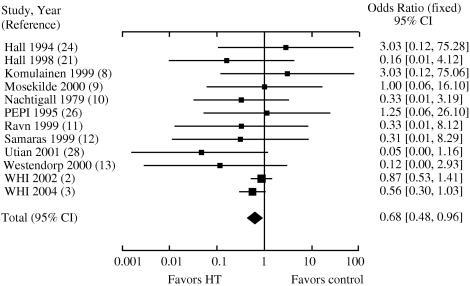
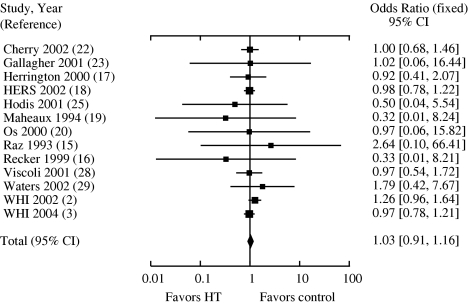
Main results: Pooled data from 23 trials, with 39,049 participants followed for 191,340 patient-years, showed that HT significantly reduced CHD events in younger women (OR 0.68 [confidence interval (C I), 0.48 to 0.96]), but not in older women (OR 1.03 [CI, 0.91 to 1.16]). Hormone therapy reduced events in younger women compared with older women (OR 0.66 [CI, 0.46 to 0.95]). In older women, HT increased events in the first year (OR 1.47 [CI, 1.12 to 1.92]), then reduced events after 2 years (OR 0.79 [CI, 0.67 to 0.93]).
Conclusions: Hormone therapy reduces the risk of CHD events in younger postmenopausal women. In older women, HT increases, then decreases risk over time.
Figures
References
-
- Grodstein F, Stampfer MJ, Manson JE, et al. Postmenopausal estrogen and progestin use and the risk of cardiovascular disease. N Engl J Med. 1996;335:453–61. - PubMed
-
- Rossouw JE, Anderson GL, Prentice RL, et al. Risks and benefits of estrogen plus progestin in healthy postmenopausal women: principal results From the Women's Health Initiative randomized controlled trial. JAMA. 2002;288:321–33. - PubMed
-
- Anderson GL, Limacher M, Assaf AR, et al. Effects of conjugated equine estrogen in postmenopausal women with hysterectomy: the Women's Health Initiative randomized controlled trial. JAMA. 2004;291:1701–12. - PubMed
-
- Mantel N, Haenszel W. Statistical aspects of the analysis of data from retrospective studies of disease. J Natl Cancer Inst. 1959;22:719–48. - PubMed
Publication types
MeSH terms
LinkOut - more resources
Full Text Sources
Other Literature Sources