Is hypertension a more frequent risk factor for deep than for lobar supratentorial intracerebral haemorrhage?
- PMID: 16690694
- PMCID: PMC2077396
- DOI: 10.1136/jnnp.2006.089292
Is hypertension a more frequent risk factor for deep than for lobar supratentorial intracerebral haemorrhage?
Abstract
Objective: To determine whether evidence from observational studies supports the widely held belief that hypertension is more commonly a risk factor for deep than for lobar supratentorial intracerebral haemorrhage.
Methods: Studies comparing the frequency of hypertension as a risk factor for deep versus lobar supratentorial intracerebral haemorrhage, excluding haemorrhages with identified secondary causes, were identified and subjected to a meta-analysis. The effects of predefined methodological quality criteria on the results were assessed and other sources of bias were considered.
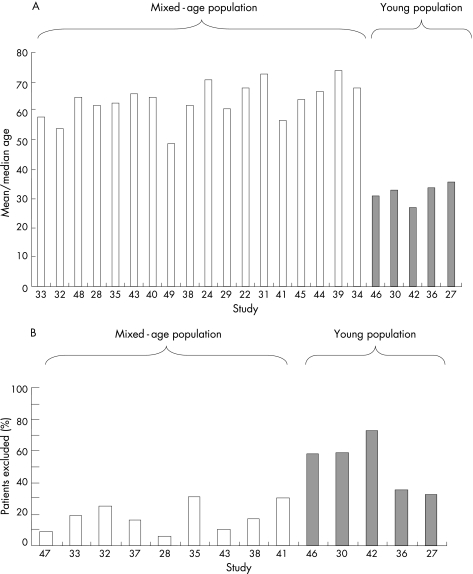
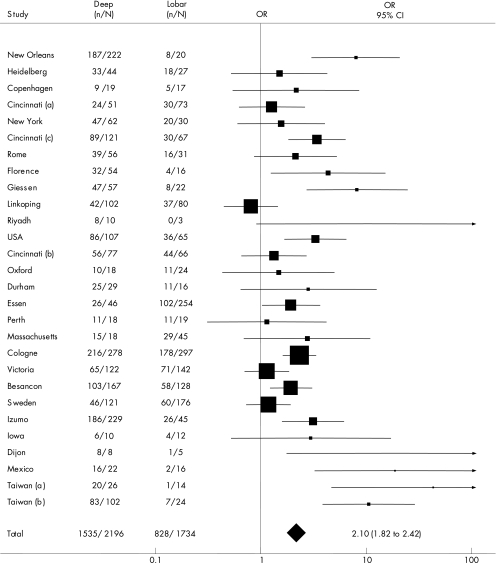
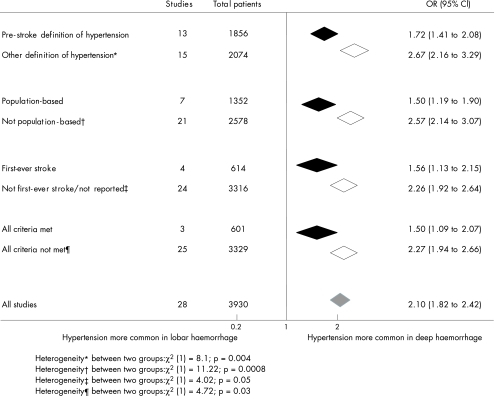
Results: The pooled result from all 28 included studies (about 4000 patients) found hypertension to be about twice as common in patients with deep as in those with lobar haemorrhage (odds ratio (OR) 2.10, 95% confidence interval (95% CI) 1.82 to 2.42), but there was significant heterogeneity between studies. The pooled OR was less extreme for studies that used a pre-stroke definition of hypertension, were population based or included first-ever strokes only. In the three studies meeting all criteria (601 patients), deep haemorrhage was associated with a smaller, statistically significant excess of hypertension (OR 1.50, 95% CI 1.09 to 2.07). The OR for studies confined to younger patients seemed to be more extreme (12.32, 95% CI 6.13 to 24.77), but none of these studies fulfilled our methodological quality criteria. Additional, unquantified sources of bias included uncertainty about whether those doctors reporting brain scans were blind to hypertension status, uncertain reliability of the classification of haemorrhage location and variable rates of investigation for secondary causes.
Conclusions: An excess of hypertension was found in patients with deep versus lobar intracerebral haemorrhages without an identified secondary cause, but this may be due to residual, unquantified methodological biases.
Conflict of interest statement
Competing interests: None.
Comment in
-
Differential effects of hypertension in the aetiology of major intracerebral haemorrhage subtypes.J Neurol Neurosurg Psychiatry. 2006 Nov;77(11):1206. doi: 10.1136/jnnp.2006.096495. Epub 2006 Jun 20. J Neurol Neurosurg Psychiatry. 2006. PMID: 16788008 Free PMC article.
References
-
- Warlow C, Dennis M, van Gijn J.et al What caused this intracerebral haemorrhage? In: Sandercock PAG, Hankey, GJ van Gijn J, et al eds. Stroke: a practical guide to management. 2nd edn. Oxford: Blackwell Sciences, 2001339–375.
-
- Thrift A, McNeil J, Forbes A.et al Risk factors for cerebral haemorrhage in the era of well‐controlled hypertension. Melbourne Risk Factor Study (MERFS) Group. Stroke 1996272020–2025. - PubMed
-
- Saloheimo P, Juvela S, Hillbom M. Use of aspirin, epistaxis, and untreated hypertension as risk factors for primary intracerebral haemorrhage in middle‐aged and elderly people. Stroke 200132399–404. - PubMed
-
- Eastern Stroke and Coronary Heart Disease Collaborative Research Group Blood pressure, cholesterol, and stroke in Eastern Asia. Lancet 19983521801–1807. - PubMed
-
- Juvela S, Hillbom M, Palomäki H. Risk factors for spontaneous intracerebral haemorrhage. Stroke 1995261558–1564. - PubMed
Publication types
MeSH terms
Grants and funding
LinkOut - more resources
Full Text Sources
Medical