


Analytic IMRT dose calculations utilizing Monte Carlo to predict MLC fluence modulation
- PMID: 16696458
- PMCID: PMC2621101
- DOI: 10.1118/1.2178449
Analytic IMRT dose calculations utilizing Monte Carlo to predict MLC fluence modulation
Abstract
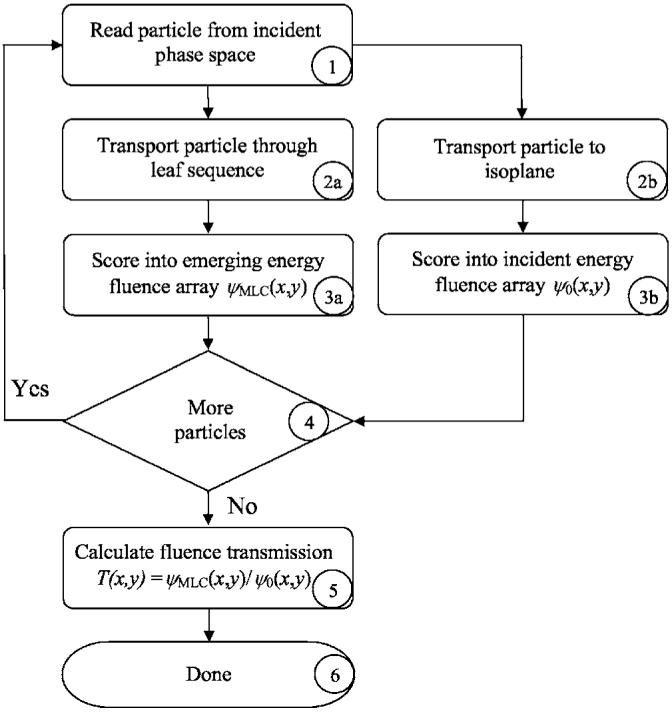
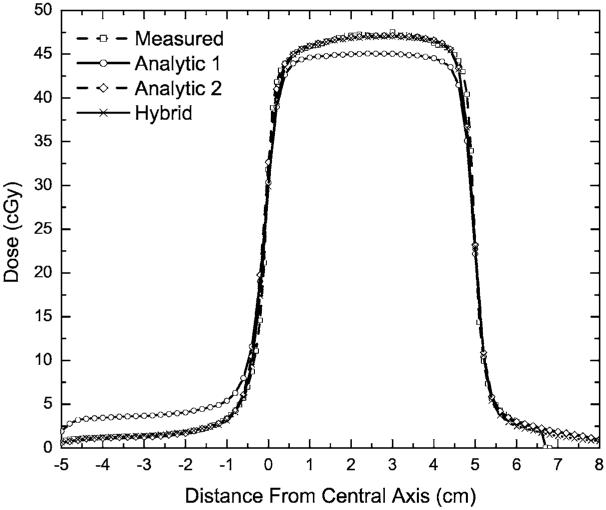
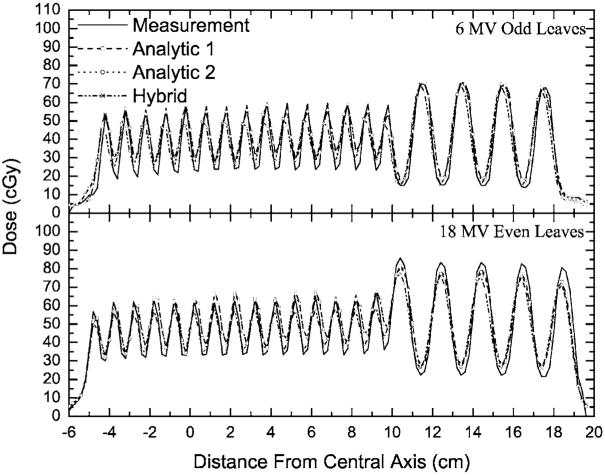
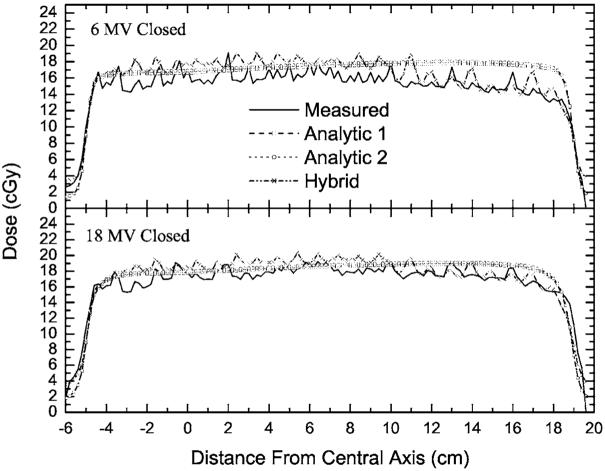
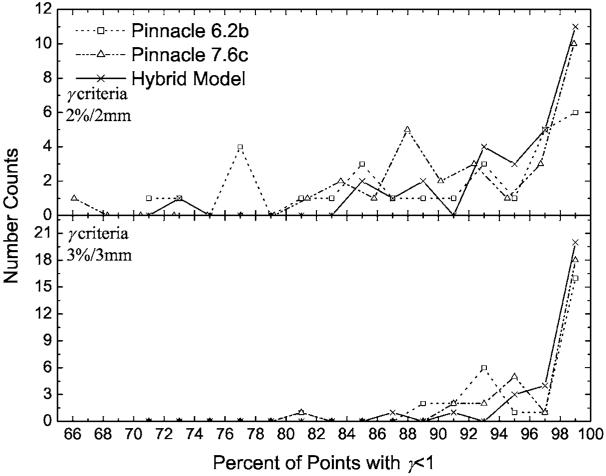
A hybrid dose-computation method is designed which accurately accounts for multileaf collimator (MLC)-induced intensity modulation in intensity modulated radiation therapy (IMRT) dose calculations. The method employs Monte Carlo (MC) modeling to determine the fluence modulation caused by the delivery of dynamic or multisegmental (step-and-shoot) MLC fields, and a conventional dose-computation algorithm to estimate the delivered dose to a phantom or a patient. Thus, it determines the IMRT fluence prediction accuracy achievable by analytic methods in the limit that the analytic method includes all details of the MLC leaf transport and scatter. The hybrid method is validated and benchmarked by comparison with in-phantom film dose measurements, as well as dose calculations from two in-house, and two commercial treatment planning system analytic fluence estimation methods. All computation methods utilize the same dose algorithm to calculate dose to a phantom, varying only in the estimation of the MLC modulation of the incident photon energy fluence. Gamma analysis, with respect to measured two-dimensional (2D) dose planes, is used to benchmark each algorithm's performance. The analyzed fields include static and dynamic test patterns, as well as fields from ten DMLC IMRT treatment plans (79 fields) and five SMLC treatment plans (29 fields). The test fields (fully closed MLC, picket fence, sliding windows of different size, and leaf-tip profiles) cover the extremes of MLC usage during IMRT, while the patient fields represent realistic clinical conditions. Of the methods tested, the hybrid method most accurately reproduces measurements. For the hybrid method, 79 of 79 DMLC field calculations have gamma < 1 (3%/3 mm) for more than 95% of the points (per field) while for SMLC fields, 27 of 29 pass the same criteria. The analytic energy fluence estimation methods show inferior pass rates, with 76 of 79 DMLC and 24 of 29 SMLC fields having more than 95% of the test points with gamma < or = 1 (3%/3 mm). Paired one-way ANOVA tests of the gamma analysis results found that the hybrid method better predicts measurements in terms of both the fraction of points with gamma < or = 1 and the average gamma for both 2%/2 mm and 3%/3 mm criteria. These results quantify the enhancement in accuracy in IMRT dose calculations when MC is used to model the MLC field modulation.
Figures
References
-
- Galvin JM, Ezzell G, Eisbrauch A, Yu C, Butler B, Xiao Y, Rosen I, Rosenman J, Sharpe M, Xing L, Xia P, Lomax T, Low DA, Palta J. Implementing IMRT in clinical practice: a joint document of the American Society for Therapeutic Radiology and Oncology and the American Association of Physicists in Medicine. Int. J. Radiat. Oncol., Biol., Phys. 2004;58(5):1616–34. - PubMed
-
- Low DA. Quality assurance of intensity-modulated radiotherapy. Semin. Radiat. Oncol. 2002;12(3):219–28. - PubMed
-
- CWG I. Intensity-modulated radiotherapy: current status and issues of interest. Int. J. Radiat. Oncol., Biol., Phys. 2001;51(4):880–914. - PubMed
-
- Chen Y, Boyer AL, Ma CM. Calculation of x-ray transmission through a multileaf collimator. Med. Phys. 2000;27(8):1717–26. - PubMed
-
- Chen Y, Hou Q, Galvin JM. A graph-searching method for MLC leaf sequencing under constraints. Med. Phys. 2004;31(6):1504–11. - PubMed
Publication types
MeSH terms
Grants and funding
LinkOut - more resources
Full Text Sources
Other Literature Sources
