


Signature whistle shape conveys identity information to bottlenose dolphins
- PMID: 16698937
- PMCID: PMC1472465
- DOI: 10.1073/pnas.0509918103
Signature whistle shape conveys identity information to bottlenose dolphins
Abstract
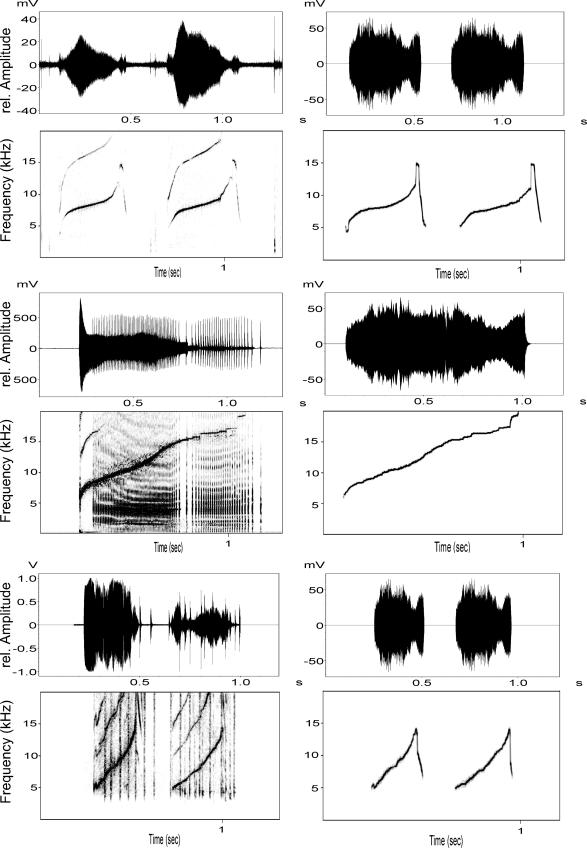
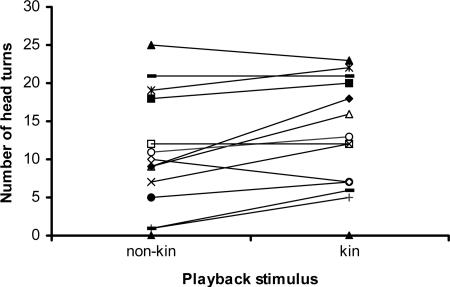
Bottlenose dolphins (Tursiops truncatus) develop individually distinctive signature whistles that they use to maintain group cohesion. Unlike the development of identification signals in most other species, signature whistle development is strongly influenced by vocal learning. This learning ability is maintained throughout life, and dolphins frequently copy each other's whistles in the wild. It has been hypothesized that signature whistles can be used as referential signals among conspecifics, because captive bottlenose dolphins can be trained to use novel, learned signals to label objects. For this labeling to occur, signature whistles would have to convey identity information independent of the caller's voice features. However, experimental proof for this hypothesis has been lacking. This study demonstrates that bottlenose dolphins extract identity information from signature whistles even after all voice features have been removed from the signal. Thus, dolphins are the only animals other than humans that have been shown to transmit identity information independent of the caller's voice or location.
Conflict of interest statement
Conflict of interest statement: No conflicts declared.
Figures
References
-
- Weary D. M., Krebs J. R. Anim. Behav. 1992;43:283–287.
-
- Rendall D., Rodman P. S., Emond R. E. Anim. Behav. 1996;51:1007–1015.
-
- Lind H., Dabelsteen T., McGregor P. K. Anim. Behav. 1996;52:667–671.
-
- Cheney D. L., Seyfarth R. M. Anim. Behav. 1988;36:477–486.
-
- Aubin T., Jouventin P. Proc. R. Soc. London Ser. B; 1998. pp. 1665–1673.
Publication types
MeSH terms
LinkOut - more resources
Full Text Sources
Other Literature Sources
