. 2006 May 12;34(9):2558-69.
doi: 10.1093/nar/gkl278. Print 2006.

Cloning and expression of new microRNAs from zebrafish

Affiliations

Cloning and expression of new microRNAs from zebrafish

Wigard P Kloosterman et al. Nucleic Acids Res. .

Abstract

MicroRNAs (miRNAs) play an important role in development and regulate the expression of many animal genes by post-transcriptional gene silencing. Here we describe the cloning and expression of new miRNAs from zebrafish. By high-throughput sequencing of small-RNA cDNA libraries from 5-day-old zebrafish larvae and adult zebrafish brain we found 139 known miRNAs and 66 new miRNAs. For 65 known miRNAs and for 11 new miRNAs we also cloned the miRNA star sequence. We analyzed the temporal and spatial expression patterns for 35 new miRNAs and for 32 known miRNAs in the zebrafish by whole mount in situ hybridization and northern blotting. Overall, 23 of the 35 new miRNAs and 30 of the 32 known miRNAs could be detected. We found that most miRNAs were expressed during later stages of development. Some were expressed ubiquitously, but many of the miRNAs were expressed in a tissue-specific manner. Most newly discovered miRNAs have low expression levels and are less conserved in other vertebrate species. Our cloning and expression analysis indicates that most abundant and conserved miRNAs in zebrafish are now known.


Figures
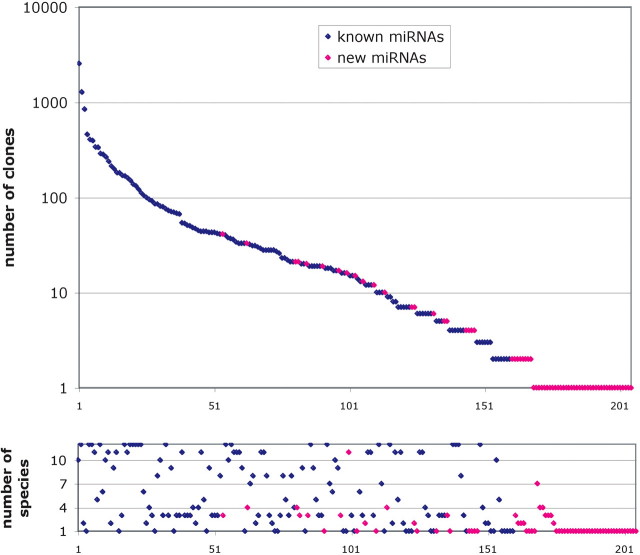
Figure 1
Figure 1
Cloning frequency and conservation for all miRNAs cloned from zebrafish small-RNA cDNA libraries. The upper panel depicts the cloning frequency for all small RNAs that were found in the two libraries and that passed our computational pipeline. All 139 known miRNAs (blue data points) were cloned more than once, while 37 out of the 66 new miRNAs (pink dots) were represented by a single sequenced clone. The lower panel shows a scatter plot of the conservation of known (blue dots) and new (pink data dots) miRNAs in 12 vertebrate species (zebrafish, fugu, tetraodon, mouse, rat, human, dog, macaca, opossum, chicken, chimpanzee, cow). Forty-four of the new miRNAs were only found in zebrafish, while most of the known miRNAs were found in several species according to our conservation criteria.
Figure 2
Figure 2
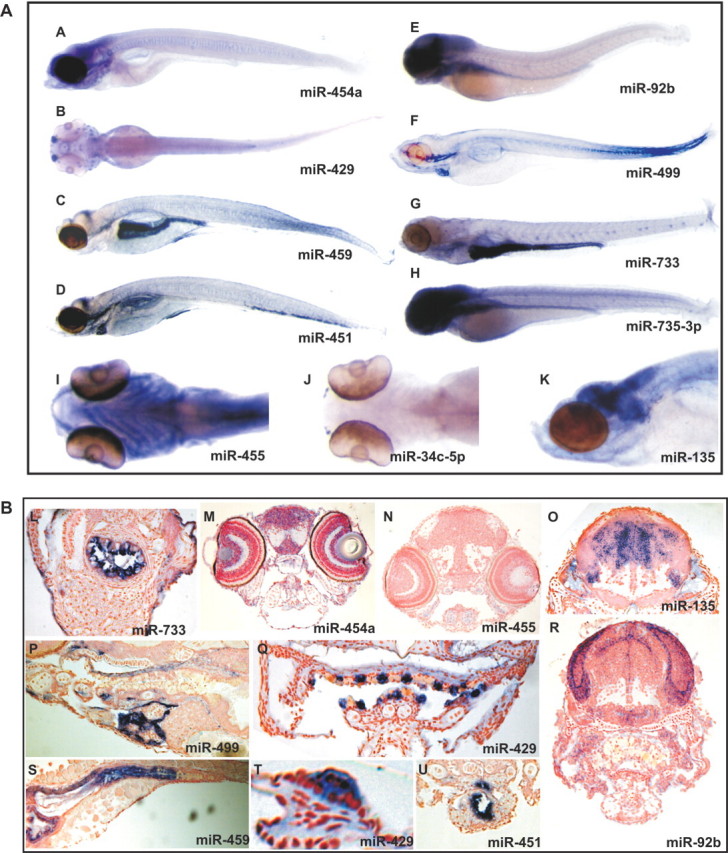
Examples of expression patterns of miRNAs in the zebrafish embryo as revealed by whole mount in situ hybridization. (A) Whole mount pictures of 72-h-old and 5-day-old larvae and (B) pictures of sections from 5-day-old larvae. (A and M) miR-454a is expressed in the brain, the pharyngeal arches and the jaw and the eye; (B, Q and T) miR-429 is expressed in the hair and supporting cells of the lateral line organ (T), the taste buds (Q), the nose and the epithelium of the lips; (C and S) miR-459 is expressed in the anterior gut; (D and U) miR-451 is expressed in the blood cells; (E and R) miR-92b is expressed in the proliferating zones of the preoptic region, optic tectum, tegmentum, telencephalon and octaval area; (F and P) miR-499 is expressed in the ventricle and atrium, the muscles of the head and the somitic muscles; (G and L) miR-733 is expressed ubiquitously but primarily in the intestine; (H) miR-735-3p is expressed ubiquitously, but primarily in the central nervous system; (I and N) miR-455 is expressed in the cartilage of the pharyngeal arches and head skeleton; (J) miR-34c-5p is expressed in the nose; (K and O) miR-135 is expressed in the pallium, optic ganglion, optic tectum, ventral telencephalon and at the beginning of the medulla oblongata.
Figure 3
Figure 3
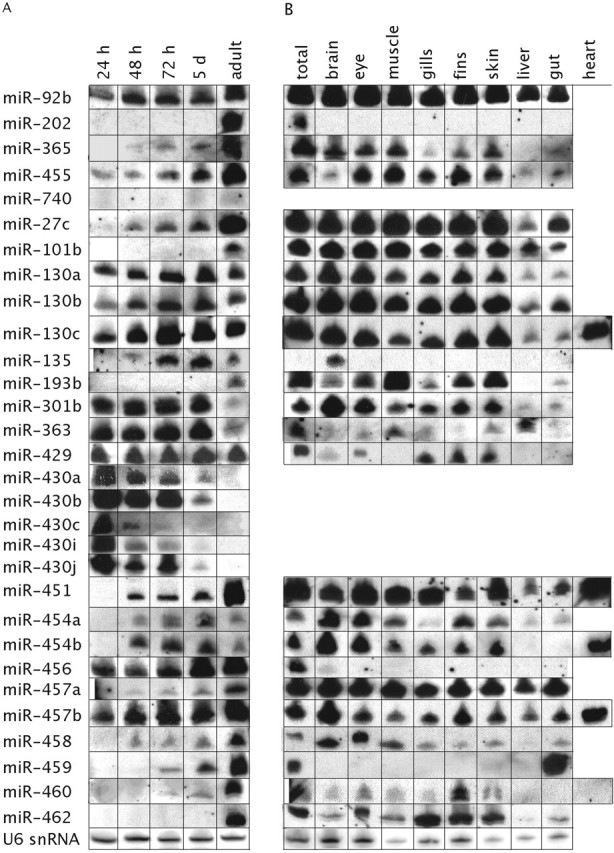
Northern blot analysis of the expression of known miRNAs from zebrafish. (A) Expression of miRNAs in five developmental stages: 24 h, 48 h, 72 h, 5 days and adult zebrafish. (B) Expression of miRNAs in RNA derived from 10 adult zebrafish tissues: total, brain, eye, muscle, gills, fins, skin, liver, gut and heart. For some miRNAs we did not analyze the expression in the heart, because we could not obtain enough heart tissue for analyzing all the miRNAs by northern blotting. U6 snRNA serves as a loading control.
Figure 4
Figure 4
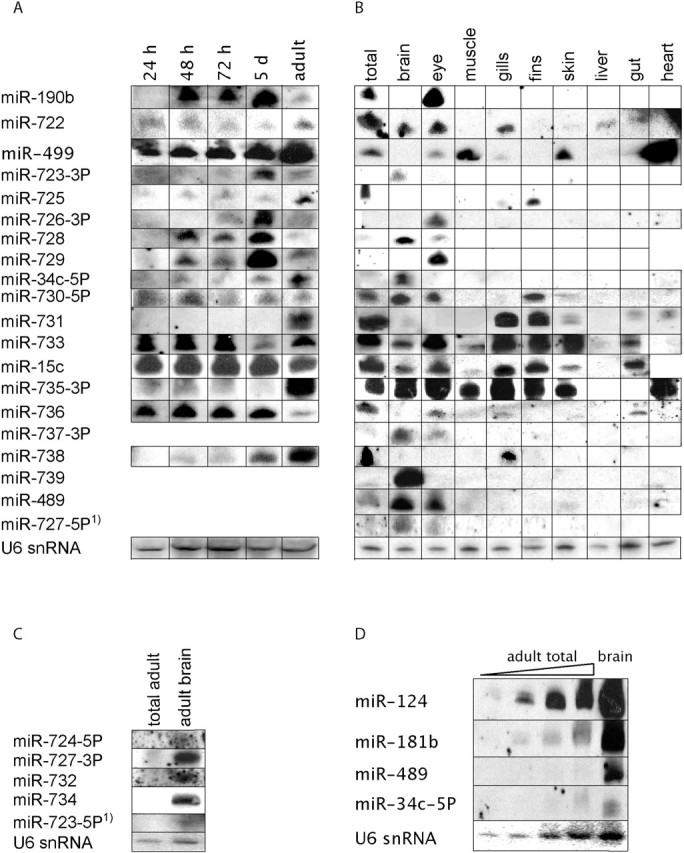
Northern blot analysis of newly cloned miRNAs from zebrafish. (A) Expression of miRNAs detected in five developmental stages: 24 h, 48 h, 72 h, 5 days and adult zebrafish. (B) Expression of miRNAs in 10 different tissues from adult zebrafish: total, brain, eye, muscle, gills, fins, skin, liver, gut and heart. (C) miRNAs detected by specifically probing RNA from adult fish brain. (D) Dilution series of adult fish RNA and one adult brain RNA sample. Blots were probed for two abundant and brain-specific miRNAs (miR-124 and miR-181b) and two new and brain specific miRNAs cloned in this study (miR-489 and miR-34c-5p). U6 snRNA serves as a loading control. 1, regarded as the miRNA star sequence.

References

    1. Ambros, V. 2004. The functions of animal microRNAs Nature 431350–355 - PubMed
    1. Bartel, D.P. and Chen, C.Z. 2004. Micromanagers of gene expression: the potentially widespread influence of metazoan microRNAs Nature Rev. Genet. 5396–400 - PubMed
    1. Lee, R.C., Feinbaum, R.L., Ambros, V. 1993. The C.elegans heterochronic gene lin-4 encodes small RNAs with antisense complementarity to lin-14 Cell 75843–854 - PubMed
    1. Wightman, B., Ha, I., Ruvkun, G. 1993. Posttranscriptional regulation of the heterochronic gene lin-14 by lin-4 mediates temporal pattern formation in C.elegans Cell 75855–862 - PubMed
    1. Griffiths-Jones, S. 2004. The microRNA Registry Nucleic Acids Res. 32D109–D111 - PMC - PubMed

Publication types