The chicken talpid3 gene encodes a novel protein essential for Hedgehog signaling
- PMID: 16702409
- PMCID: PMC1472910
- DOI: 10.1101/gad.369106
The chicken talpid3 gene encodes a novel protein essential for Hedgehog signaling
Abstract
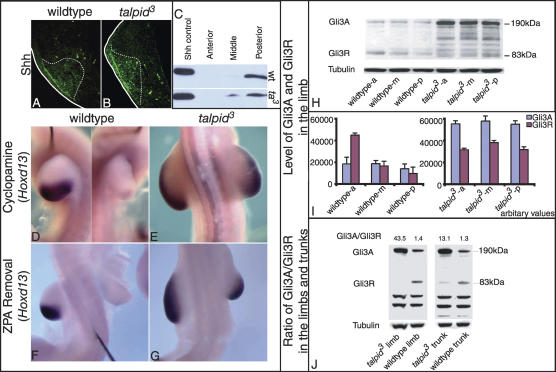
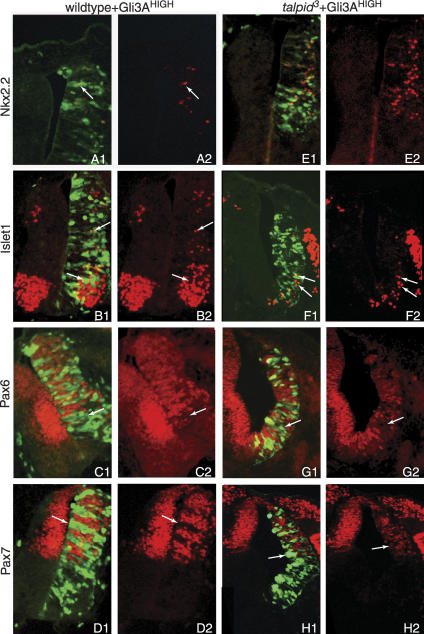
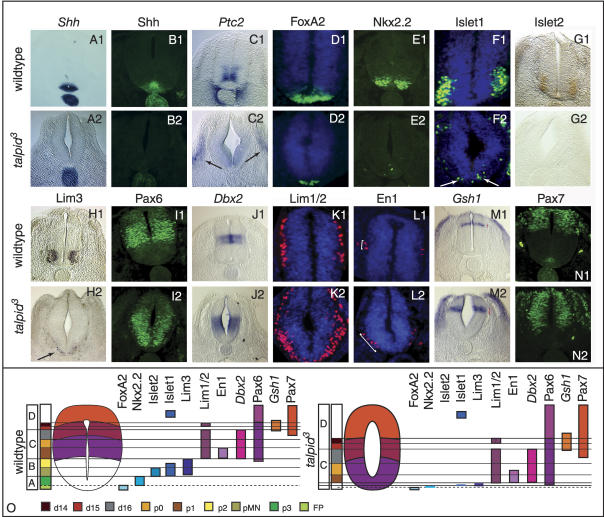
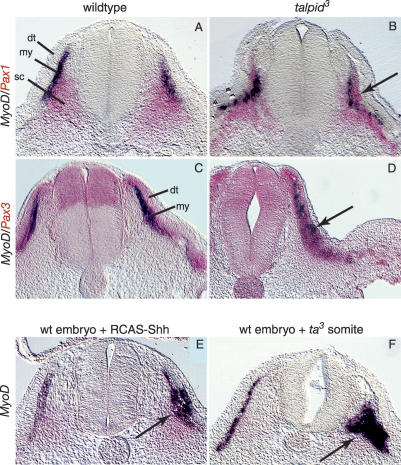
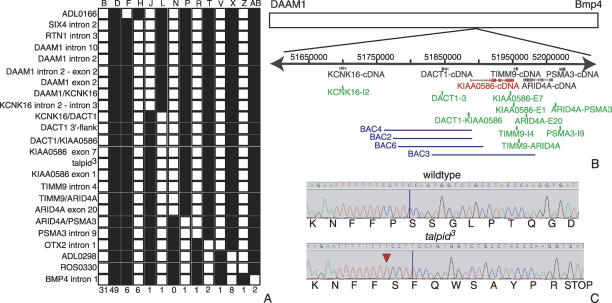
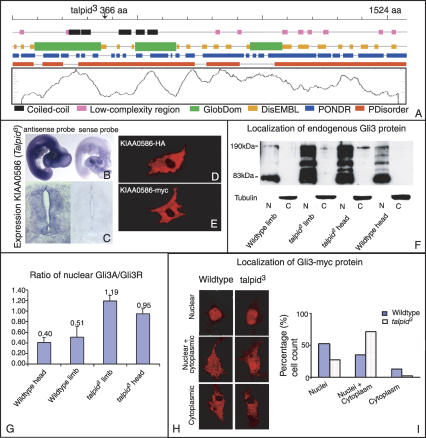
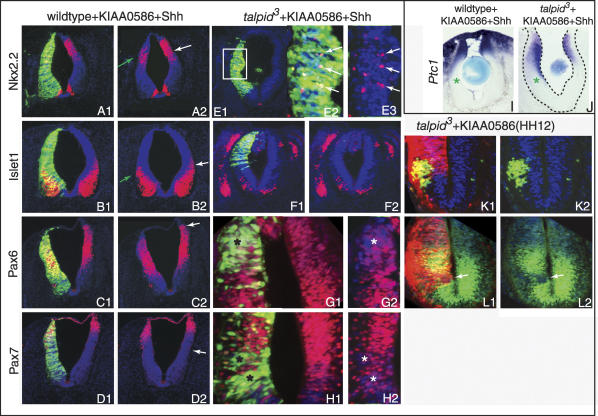
Talpid3 is a classical chicken mutant with abnormal limb patterning and malformations in other regions of the embryo known to depend on Hedgehog signaling. We combined the ease of manipulating chicken embryos with emerging knowledge of the chicken genome to reveal directly the basis of defective Hedgehog signal transduction in talpid3 embryos and to identify the talpid3 gene. We show in several regions of the embryo that the talpid3 phenotype is completely ligand independent and demonstrate for the first time that talpid3 is absolutely required for the function of both Gli repressor and activator in the intracellular Hedgehog pathway. We map the talpid3 locus to chromosome 5 and find a frameshift mutation in a KIAA0586 ortholog (ENSGALG00000012025), a gene not previously attributed with any known function. We show a direct causal link between KIAA0586 and the mutant phenotype by rescue experiments. KIAA0586 encodes a novel protein, apparently specific to vertebrates, that localizes to the cytoplasm. We show that Gli3 processing is abnormal in talpid3 mutant cells but that Gli3 can still translocate to the nucleus. These results suggest that the talpid3 protein operates in the cytoplasm to regulate the activity of both Gli repressor and activator proteins.
Figures
References
-
- Bai C.B., Auerbach W., Lee J.S., Stephen D., Joyner A.L. Gli2, but not Gli1, is required for initial Shh signaling and ectopic activation of the Shh pathway. Development. 2002;129:4753–4761. - PubMed
-
- Borycki A.G., Brunk B., Tajbakhsh S., Buckingham M., Chiang C., Emerson C.P.J. Sonic hedgehog controls epaxial muscle determination through Myf5 activation. Development. 1999;126:4053–4063. - PubMed
-
- Burt D.W., Morrice D.R., Lester D.H., Robertson G.W., Mohammed M.D., Simmons J., Downey L.M., Thuang C., Bridges L.R., Paton I.R., et al. Analysis of rdd locus in chicken: A model for human retinitis pigmentosa. Mol. Vis. 2003;9:164–170. - PubMed
-
- Buxton P., Davey M.G., Paton I.R., Morrice D.R., Francis-West P.H., Burt D.W., Tickle C. Craniofacial development in the talpid3 chicken mutant. Differentiation. 2004;72:348–362. - PubMed
Publication types
MeSH terms
Substances
Associated data
- Actions
- Actions
- Actions
- Actions
- Actions
- Actions
- Actions
- Actions
- Actions
- Actions
- Actions
- Actions
- Actions
- Actions
- Actions
- Actions
- Actions
- Actions
- Actions
- Actions
- Actions
- Actions
- Actions
Grants and funding
LinkOut - more resources
Full Text Sources
Other Literature Sources
Molecular Biology Databases