. 2006 May 23;103(21):8125-30.
doi: 10.1073/pnas.0602581103. Epub 2006 May 15.

Genetic variants of Tgfb1 act as context-dependent modifiers of mouse skin tumor susceptibility

Affiliations

Genetic variants of Tgfb1 act as context-dependent modifiers of mouse skin tumor susceptibility

Jian-Hua Mao et al. Proc Natl Acad Sci U S A. .

Abstract

The human TGFB1 gene is polymorphic, and genetic variants are associated with altered cancer risk. However, human genetic association studies have had variable outcomes because TGFbeta1 action is context-dependent. We used the murine skin model of chemical carcinogenesis in genetic linkage analysis of three independent Mus musculus NIH/Ola x (Mus spretus x M. musculus NIH/Ola)F1 backcrosses, to identify a skin tumor susceptibility locus, Skts14, on proximal chromosome 7. Tgfb1 maps at the peak of linkage. The mouse Tgfb1 gene is polymorphic, resulting in cis-regulated differential allelic mRNA expression between M. spretus and M. musculus in F1 mouse skin. This phenomenon is reflected in differential phospho-SMAD2 levels, downstream of TGFbeta signaling, between these two mouse species. In normal F1 mouse skin, the Tgfb1SPR allele is expressed at higher levels than the Tgfb1NIH allele, and this differential is accentuated by phorbol 12-myristate 13-acetate treatment. In benign F1 papillomas, this imbalance is reversed, possibly by selection against expression of a hyperactive Tgfb1SPR allele in TGFbeta growth-responsive tumors. We demonstrate that skin tumor susceptibility is altered by Tgfb1 gene dosage, but that manifestation of Tgfb1-linked skin tumor susceptibility in M. musculus NIH/Ola x (M. spretus x M. musculus NIH/Ola)F1 backcross mice depends on interactions with another unlinked tumor modifying locus, Skts15, that overlaps Tgfbm3 on chromosome 12. These findings illustrate the power of complex genetic interactions in determining disease outcome and have major implications to the assessment of disease risk in individuals harboring variant TGFB1 alleles.


Conflict of interest statement

Conflict of interest statement: No conflicts declared.

Figures

Fig. 1.
Fig. 1.
Skts14, a skin tumor susceptibility locus on proximal mouse chromosome 7. LOD scores for genetic linkage on chromosome 7 in the F1 NSP backcross (n = 206; ♦), and in that subset of the NSP backcross sharing Haplotype 4 (n = 44; ○). Also shown is a linkage analysis in the N4 backcross (n = 76; ▵).
Fig. 2.
Fig. 2.
Haploinsufficiency for Tgfb1 increases papilloma incidence. Twenty-three WT and 30 Tgfb1+/− age-matched adult female mice were subjected to a standard chemical carcinogenesis protocol, and papilloma numbers were counted weekly. Tgfb1+/− developed significantly more papillomas than Tgfb1+/+ mice (P = 0.025 at 20 weeks; Student’s t test).
Fig. 3.
Fig. 3.
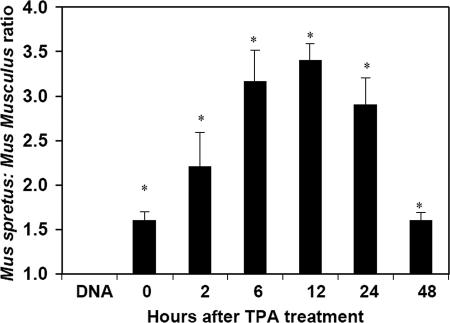
Differential allelic expression of Tgfb1 in normal mouse skin. RNA was prepared from normal skins of (NIH/Ola × SPRET/Gla)F1 mice, untreated (0) or at various times (2, 6, 12, 24, or 48 h) after topical application of PMA. The M. spretus to M. musculus Tgfb1 transcript ratio was determined by TaqMan analysis of cDNA by using allele-specific probes. All samples overexpressed the M. spretus Tgfb1 allele, and this effect was accentuated 12 h after PMA treatment. For comparison, we also determined the M. spretus/M. musculus ratio in genomic DNA. As expected, this ratio is close to 1 for normal F1 mice. Asterisks indicate significant differences between genomic DNA and cDNA samples. The means and standard deviations of three independent experiments are shown.
Fig. 4.
Fig. 4.
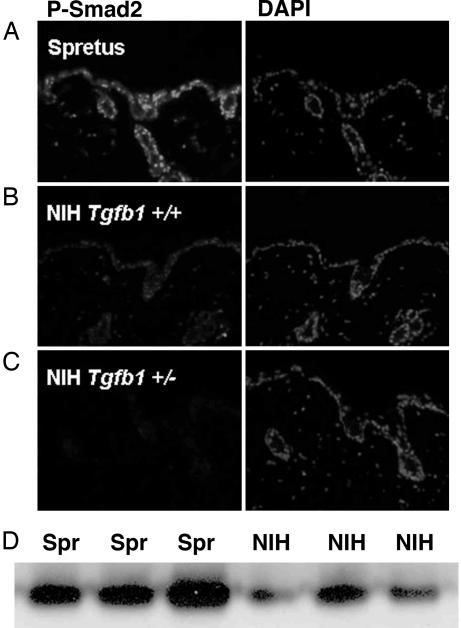
Basal phospho-Smad2 levels are elevated in the skin of M. spretus compared with M. musculus. (AC) Immunohistochemistry using an anti-phospho-SMAD2 antibody (that recognizes both phospho-Smad2 and phospho-Smad3) on untreated skins from M. spretus (A), M. musculus Tgfb1+/+ (B), and Tgfb1+/− (C) mice. (D) Different levels of phospho-SMAD2 were also observed by Western blot analysis. Cell lysates from three different M. spretus and three different M. musculus mice were immunoprecipitated with an anti-phospho-SMAD2-specific antibody, followed by Western blot analysis using the same antibody.
Fig. 5.
Fig. 5.
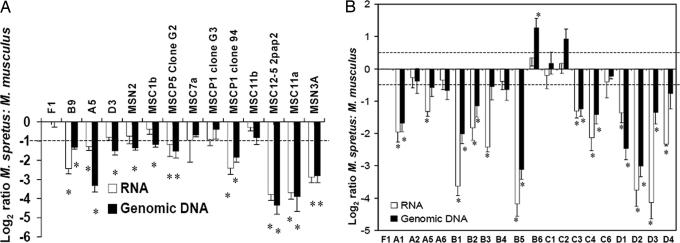
Genomic imbalance and differential allelic expression of Tgfb1 in tumors. (A) cDNA was prepared from skin tumor-derived M. spretus/M. musculus F1 hybrid cell lines. Seven of these lines showed significant overexpression of the M. musculus allele, which is indicated by asterisks. Genomic DNA was isolated from the same samples, and TaqMan analysis was carried out to measure the relative copy number of different Tgfb1 alleles. Ten of the samples (denoted by asterisks) showed significant amplification of the M. musculus allele of Tgfb1. (B) cDNA and genomic DNA was generated from primary papillomas of M. musculus NIH mice, congenic for M. spretus on proximal chromosome 7. TaqMan analysis was carried out as above. Nine tumors showed significant genomic imbalance at Tgfb1 in favor of the M. musculus allele. These nine, together with an additional three had significant overexpression of Tgfb1NIH, indicated by asterisks. Two tumors had genomic imbalance in favor of the M. spretus allele, but in both cases the Tgfb1SPR/Tgfb1NIH expression ratio was not significantly different from 1.0. The dashed line in A and B denote the significance level for differential expression/genomic imbalance determined by Student’s t test.

References

    1. Akhurst R. J. J. Clin. Invest. 2002;109:1533–1536. - PMC - PubMed
    1. Muraoka R. S., Dumont N., Ritter C. A., Dugger T. C., Brantley D. M., Chen J., Easterly E., Roebuck L. R., Ryan S., Gotwals P. J., et al. J. Clin. Invest. 2002;109:1551–1559. - PMC - PubMed
    1. Yang Y. A., Dukhanina O., Tang B., Mamura M., Letterio J. J., MacGregor J., Patel S. C., Khozin S., Liu Z. Y., Green J., et al. J. Clin. Invest. 2002;109:1607–1615. - PMC - PubMed
    1. Cui W., Fowlis D. J., Bryson S., Duffie E., Ireland H., Balmain A., Akhurst R. J. Cell. 1996;86:531–542. - PubMed
    1. Derynck R., Akhurst R. J., Balmain A. Nat. Genet. 2001;29:117–129. - PubMed

Publication types

Substances