. 2006 May 23;103(21):7994-9.
doi: 10.1073/pnas.0507492103. Epub 2006 May 15.

Complex genetic networks underlying the defensive system of rice (Oryza sativa L.) to Xanthomonas oryzae pv. oryzae

Affiliations

Complex genetic networks underlying the defensive system of rice (Oryza sativa L.) to Xanthomonas oryzae pv. oryzae

Z K Li et al. Proc Natl Acad Sci U S A. .

Abstract

Complete resistance (CR) and partial resistance (PR) of rice (Oryza sativa L.) to its bacterial pathogen, Xanthomonas oryzae pv. oryzae (Xoo), was genetically dissected by using 2 mapping populations and 10 Xoo races. Two CR genes, 50 quantitative resistance loci, and 60 digenic interactions were identified, which showed various degrees of race specificity to the Xoo races. The complex epistasis between these loci led us to the discovery of complex genetic networks underlying the rice defensive system to Xoo. The networks consisted of two major components: one representing interactions between alleles at the R loci of rice and alleles at the corresponding avirulence loci of Xoo for CR and the other comprising interactions between quantitative resistance loci in rice and their corresponding aggressiveness loci in Xoo for PR. The race specificity of PR and its strong genetic overlap with CR indicate that PR is essentially "weaker" CR. The genetic networks discovered are expected to maintain a high level of the allelic diversity at avirulent loci in the pathogen by stabilizing selection, which may maintain a high allelic diversity at R loci in the host by the frequency-dependent selection.


Conflict of interest statement

Conflict of interest statement: No conflicts declared.

Figures
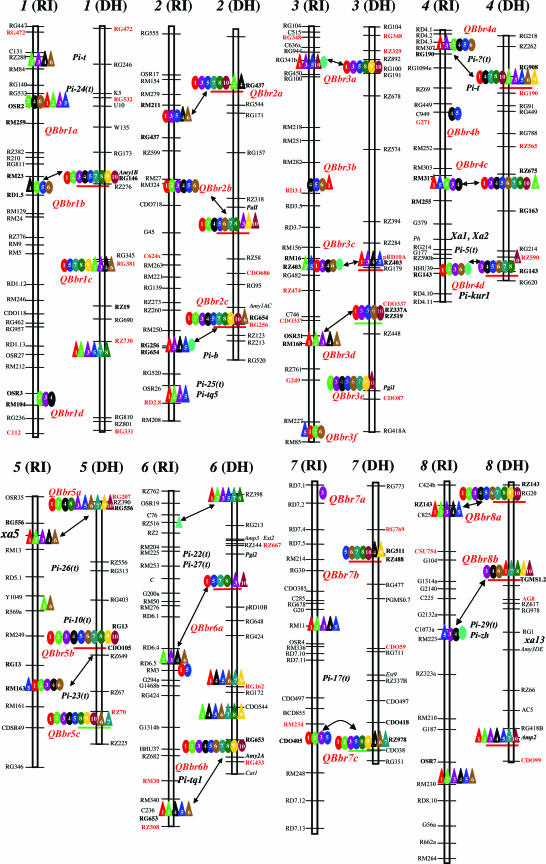
Fig. 1.
Fig. 1.
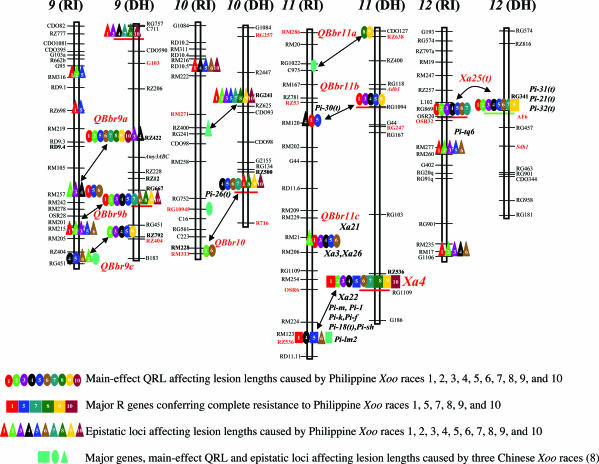
Genomic locations of Xa4, Xa25(t), QRL (in red italics), and epistatic loci (triangles) associated with complete and partial resistance to 10 Philippine and 3 Chinese Xoo races detected in the Lemont/Teqing RILs (RI) and IR64/Azucena DHLs (DH). Xa, Pi, and the red-colored markers are major R genes or markers associated with CR to Xoo and rice blast caused by M. grisea detected in the same populations (refs. – and unpublished data). QRL underlined by red and green lines are closely linked to disease-resistance-gene homologs and defense response genes (16). The double-headed arrows connecting pairwise QRL detected in the RIL and DHL populations indicate cases for which those QRL locate at approximately the same positions based on the common markers in the two populations and the consensus rice linkage map at the Gramene web site (9).
Fig. 1.
Fig. 1.
Genomic locations of Xa4, Xa25(t), QRL (in red italics), and epistatic loci (triangles) associated with complete and partial resistance to 10 Philippine and 3 Chinese Xoo races detected in the Lemont/Teqing RILs (RI) and IR64/Azucena DHLs (DH). Xa, Pi, and the red-colored markers are major R genes or markers associated with CR to Xoo and rice blast caused by M. grisea detected in the same populations (refs. – and unpublished data). QRL underlined by red and green lines are closely linked to disease-resistance-gene homologs and defense response genes (16). The double-headed arrows connecting pairwise QRL detected in the RIL and DHL populations indicate cases for which those QRL locate at approximately the same positions based on the common markers in the two populations and the consensus rice linkage map at the Gramene web site (9).
Fig. 2.
Fig. 2.
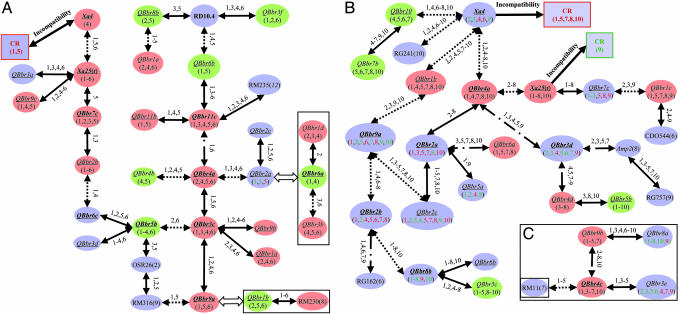
Putative genetic networks underlying the defensive system of rice based on the epistatic relationships between R genes and QRL detected. (A) The putative genetic networks underlying CR and PR to six Philippine Xoo races detected in the Lemont/Teqing RILs. (B) The putative genetic networks underlying CR and PR to 10 Philippine Xoo races detected in the IR64/Azucena DHLs. QRL in orange and green represent loci at which the indica (Teqing or IR64) and japonica (Lemont or Azucena) alleles, respectively, resulted in resistance, whereas those in light blue present cases for which resistance resulted from alleles of either parent, depending on Xoo races. Underlined QRL are those detected in both populations and are inferred based on the common markers using the comparative mapping approach (9). The numbers under each QRL represent the Xoo races against which the QRL was effective (Fig. 1). Lines connecting two QRL indicate that significant epistasis was detected between them, and the numbers above the lines are Xoo races against which the epistasis was detected (Tables 3 and 4). Cases for which two interacting loci are connected by solid lines represent the parental type of interaction (the parental genotypes were associated with resistance), those connected by dotted lines represent the recombinant type of interaction (the recombinant genotypes were associated with resistance), and those connected by dotted–dashed lines represent cases for which either the parental or recombinant type interaction was associated with resistance, depending on Xoo races. Rectangular boxes in A and C represent cases for which groups of interacting loci could be included into the networks based on the comparative mapping results in Fig. 1.

References

    1. Nelson R. R. J. Environ. Qual. 1972;1:220–227.
    1. Leonard K. J., Czochor R. J. Ann. Rev. Phytopathol. 1980;18:237–258.
    1. Crute I. R. In: Mechanisms of Resistance in Plant Diseases. Fraser R. S. S., editor. Dordrecht, The Netherlands: Nijhoff and Junk; 1986. pp. 80–142.
    1. Hulbert S. H., Webb C. A., Smith S. M., Sun Q. Ann. Rev. Phytopathol. 2001;39:285–312. - PubMed
    1. Keen N. T. Annu. Rev. Genet. 1990;24:447–463. - PubMed

Publication types