


Web-based surveillance and global Salmonella distribution, 2000-2002
- PMID: 16704773
- PMCID: PMC3291443
- DOI: 10.3201/eid1205.050854
Web-based surveillance and global Salmonella distribution, 2000-2002
Abstract
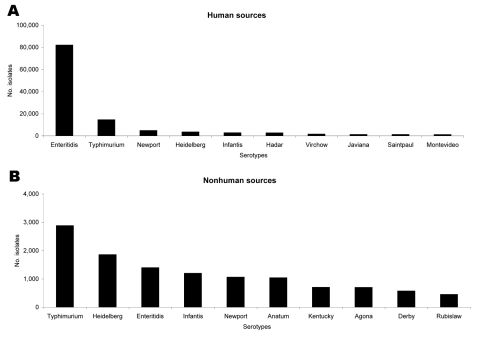
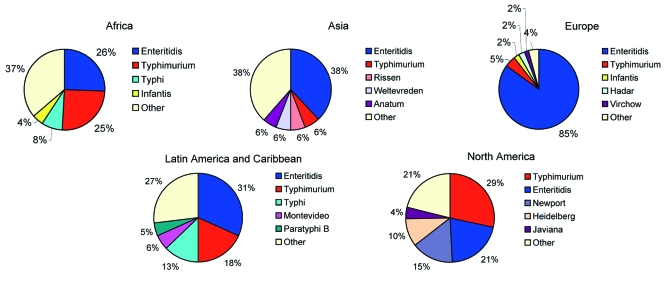
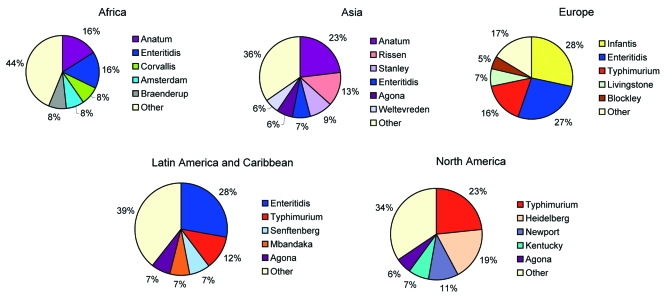
Salmonellae are a common cause of foodborne disease worldwide. The World Health Organization (WHO) supports international foodborne disease surveillance through WHO Global Salm-Surv and other activities. WHO Global Salm-Surv members annually report the 15 most frequently isolated Salmonella serotypes to a Web-based country databank. We describe the global distribution of reported Salmonella serotypes from human and nonhuman sources from 2000 to 2002. Among human isolates, S. Enteritidis was the most common serotype, accounting for 65% of all isolates. Among nonhuman isolates, although no serotype predominated, Salmonella enterica serovar Typhimurium was reported most frequently. Several serotypes were reported from only 1 region of the world. The WHO Global Salm-Surv country databank is a valuable public health resource; it is a publicly accessible, Web-based tool that can be used by health professionals to explore hypotheses related to the sources and distribution of salmonellae worldwide.
Figures
References
-
- World Health Organization. The role of food safety in health and development: report of a joint FAO/WHO expert committee on food safety. WHO Technical Report Series, no. 705. Geneva: The Organization; 1984. - PubMed
-
- Gomez TM, Motarjemi Y, Miyagawa S, Kaferstein FK, Stohr K. Foodborne salmonellosis. World Health Stat Q. 1997;50:81–9. - PubMed
-
- Todd ECD. Epidemiology of foodborne diseases: a worldwide review. World Health Stat Q. 1997;50:30–50. - PubMed
MeSH terms
LinkOut - more resources
Full Text Sources
Other Literature Sources
Medical