


doi: 10.3201/eid1205.051487.
Hantavirus in African wood mouse, Guinea
Affiliations
- PMID: 16704849
- PMCID: PMC3374458
- DOI: 10.3201/eid1205.051487
Item in Clipboard
Hantavirus in African wood mouse, Guinea
Emerg Infect Dis.
2006 May.
Abstract
Hantaviruses are rodent-borne, emerging viruses that cause life-threatening human diseases in Eurasia and the Americas. We detected hantavirus genome sequences in an African wood mouse (Hylomyscus simus) captured in Sangassou, Guinea. Sequence and phylogenetic analyses of the genetic material demonstrate a novel hantavirus species, which we propose to name "Sangassou virus."
Figures
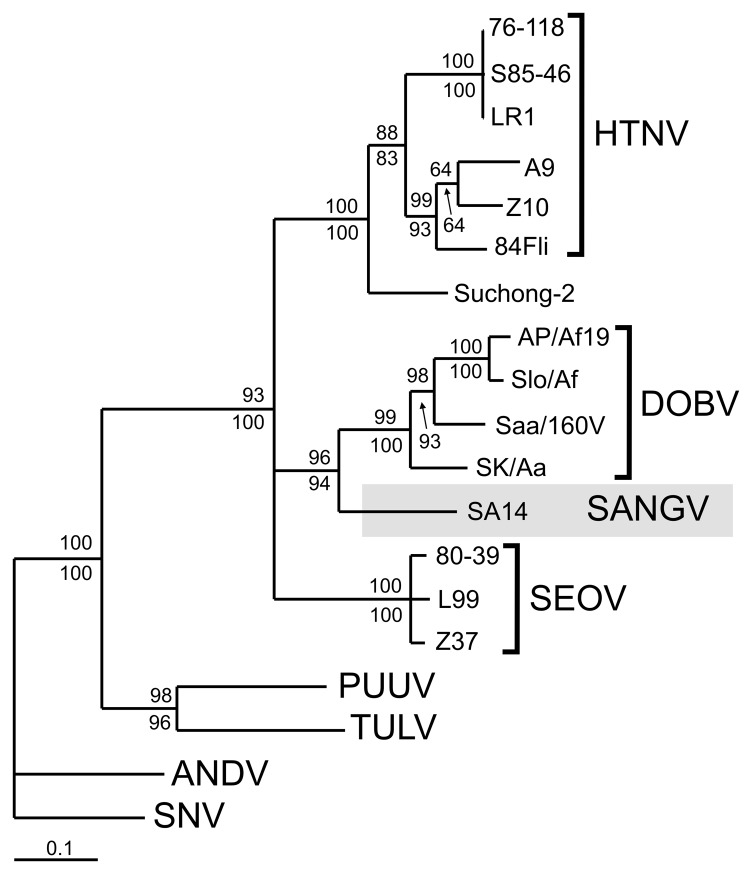
Maximum likelihood phylogenetic tree of hantaviruses showing the placement of SA14 (Sangassou virus [SANGV], indicated by gray shading). Partial S segment genome sequences (837 nucleotides, positions 394–1230) were used to calculate the tree with TREE-PUZZLE program (8). The Tamura-Nei evolutionary model was used; the values above the branches represent PUZZLE support values. The values below the branches represent bootstrap values of the corresponding neighbor-joining tree computed with PAUP* program (9) using 10,000 bootstrap replicates. The scale bar indicates an evolutionary distance of 0.1 nucleotide substitutions per position in the sequence. HTNV, Hantaan virus; DOBV, Dobrava virus; SEOV, Seoul virus; PUUV, Puumala virus; TULV, Tula virus; ANDV, Andes virus; SNV, Sin Nombre virus.
References
-
- Schmaljohn CS, Nichol ST, eds. Hantaviruses. Berlin: Springer-Verlag; 2001.
Publication types
MeSH terms
Substances
LinkOut - more resources
Full Text Sources
Medical
Molecular Biology Databases