


doi: 10.3201/eid1206.051564.
Hantaviruses in Serbia and Montenegro
Affiliations
- PMID: 16707066
- PMCID: PMC3373030
- DOI: 10.3201/eid1206.051564
Item in Clipboard
Hantaviruses in Serbia and Montenegro
Emerg Infect Dis.
2006 Jun.
Abstract
Hantaviruses are endemic in the Balkan Peninsula. An outbreak of hemorrhagic fever with renal syndrome occurred in 2002 in Serbia and Montenegro. The epidemiologic characteristics and genetic relatedness of Dobrava/Belgrade virus strains responsible for most cases are described.
Figures
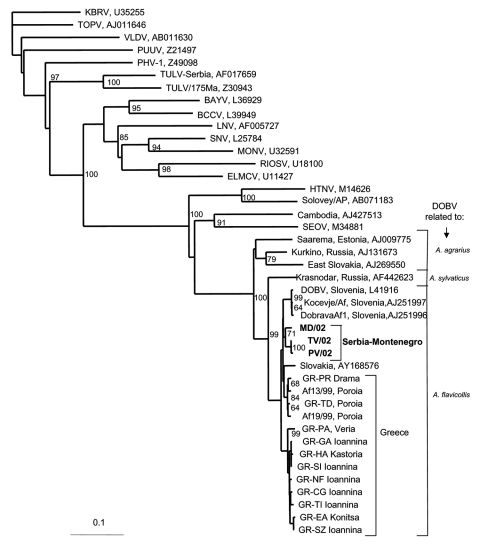
Phylogenetic tree based on partial S segment fragment showing the clustering of the sequence obtained from this study and respective representative hantavirus strains from GenBank database. The numbers indicate percentage bootstrap replicates (of 100); values <60% are not shown. Horizontal distances are proportional to the nucleotide differences. The scale bar indicates 10% nucleotide sequence divergence. Vertical distances are for clarity only. BAYV, Bayou virus; BCCV, Black Creek Canal virus; ELMCV, El Moro Canyon virus; HTNV, Hantaan virus; KBRV, Khabarovsk virus; LNV, Laguna Negra; MONV, Monongahela virus; NYV, New York virus; PHV, Prospect Hill virus; PUUV, Puumala virus; RIOSV, Rio Segundo virus; SEOV, Seoul virus; SNV, Sin Nombre virus; TOPV, Topografov virus; TULV, Tula virus; VLDV, Vladivostok virus. Accession numbers of Greek DOBV strains are AF060014–AF060024 for sequences from human cases and AJ410615 and AJ410619 from Apodemus flavicollis (Afl) sequences. Sequences in this study are indicated in boldface.
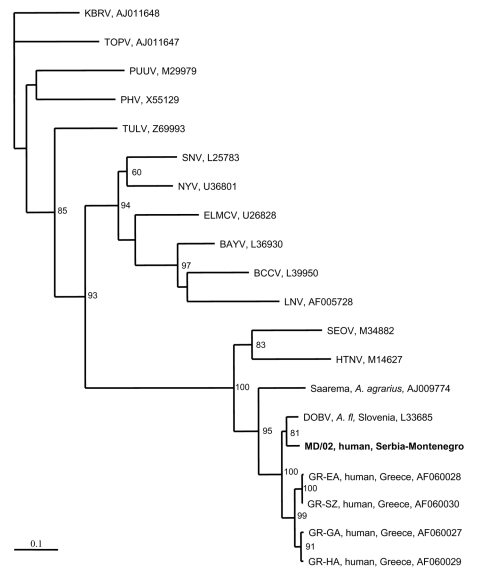
Phylogenetic tree based on partial M segment fragment showing the clustering of the sequence obtained from this study and respective representative hantavirus strains from GenBank database. The numbers indicate percentage bootstrap replicates (of 100); values <60% are not shown. Horizontal distances are proportional to the nucleotide differences. The scale bar indicates 10% nucleotide sequence divergence. Vertical distances are for clarity only. Sequences in this study are indicated in boldface. BAYV, Bayou virus; BCCV, Black Creek Canal virus; ELMCV, El Moro Canyon virus; HTNV, Hantaan virus; KBRV, Khabarovsk virus; LNV, Laguna Negra; MONV, Monongahela virus; NYV, New York virus; PHV, Prospect Hill virus; PUUV, Puumala virus; RIOSV, Rio Segundo virus; SEOV, Seoul virus; SNV, Sin Nombre virus; TOPV, Topografov virus; TULV, Tula virus; VLDV, Vladivostok virus.
References
-
- Nichol ST, Ksiazek TG, Rollin PE, Peters CJ. Hantavirus pulmonary syndrome and newly described hantaviruses in the United States. In: Elliott RM, editor. The Bunyaviridae. New York: Plenum Press; 1996. p. 269–80.
-
- Avšič-Županc T. Hantaviruses and hemorrhagic fever with renal syndrome in the Balkans. In: Saluzzo JF, Dodet B, editors. Factors in the emergence and control of rodent-borne viral diseases. Paris: Elsevier SAS; 1999. p. 93–8.
MeSH terms
Substances
LinkOut - more resources
Full Text Sources
Molecular Biology Databases