. 2006 May 23;103(21):8107-12.
doi: 10.1073/pnas.0510740103. Epub 2006 May 17.

Comprehensive mutation identification in an evolved bacterial cooperator and its cheating ancestor

Affiliations

Comprehensive mutation identification in an evolved bacterial cooperator and its cheating ancestor

Gregory J Velicer et al. Proc Natl Acad Sci U S A. .

Abstract

Precise characterization of the mutation histories of evolutionary lineages is crucial for understanding the evolutionary process, yet mutation identification has been constrained by traditional techniques. We sought to identify all accumulated mutations in an experimentally evolved lineage of the cooperative bacterium Myxococcus xanthus, which constructs fruiting bodies by a process of social multicellular development in response to starvation. This lineage had undergone two major transitions in social phenotype: from an ancestral cooperator to a socially defective cheater, and from the cheater to a competitively dominant cooperator that re-evolved social and developmental proficiency. The 9.14-Mb genome of the evolved, dominant cooperator (strain "PX") was sequenced to approximately 19-fold coverage by using recent "sequencing-by-synthesis" technology and partially sequenced (approximately 45%) by using capillary technology. The resulting data revealed 15 single-nucleotide mutations relative to the laboratory ancestor of PX after the two phases of experimental evolution but no evidence of duplications, transpositions, or multiple-base deletions. No mutations were identified by capillary sequencing beyond those found by pyrosequencing, resulting in a high probability that all mutations were discovered. Seven errors in the reference strain previously sequenced by the Sanger approach were revealed, as were five mutational differences between two distinct laboratory stocks of the reference strain. A single mutation responsible for the restoration of development in strain PX was identified, whereas 14 mutations occurred during the prior phase of experimental evolution. These results provide insight into the genetic basis of two large adaptive transitions in a social bacterium.


Conflict of interest statement

Conflict of interest statement: No conflicts declared.

Figures
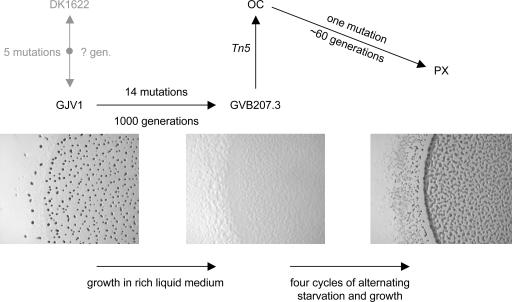
Fig. 1.
Fig. 1.
The previously sequenced strain DK1622 and its derivative clone GJV1 are separated by five mutations and an unknown number of generations of lab stock cultivation. The lineage from GJV1 to GVB207.3 incurred 14 mutations over 1,000 generations of growth in liquid medium, one or more of which eliminated the ability to undergo multicellular development (6). OC was generated by integration of a Tn5 transposon (which confers resistance to kanamycin) into the GVB207.3 genome (8). OC evolved into PX by regaining the ability to sporulate via social development during an extended developmental competition against a marked variant of GJV1 (9, 10). Only one mutation was found to distinguish PX from OC, and this mutation was subsequently shown to cause the restoration of developmental proficiency in PX (10).
Fig. 2.
Fig. 2.
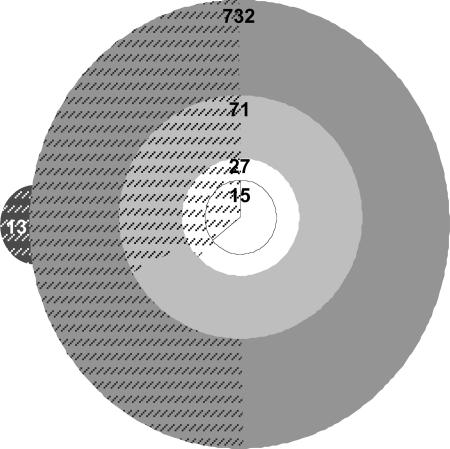
Assembly of pyrosequencing reads of strain PX resulted in 104 contigs bearing 732 discrepancy units relative to the DK1622 GenBank sequence (large gray circle). Seventy-one (71) of these were selected (by exclusion of putative single base pair deletions within homopolymer runs four bases or longer and discrepancies ≤5 bp from contig ends) and tested independently by PCR (light gray circle). Twenty-seven (27) of these discrepancies were real (open circle), with 15 of them being evolutionary mutations separating PX from GJV1 (bordered open circle) and the remaining 12 being differences between GJV1 and the DK1622 reference sequence. Of these latter 12 discrepancies, 5 are real mutational differences between GJV1 and the sequenced clone of DK1622, whereas the other 7 represented errors in the original GenBank sequence. Hatched regions indicate the proportion of putative discrepancies within each category that were covered by high-quality capillary sequence. Capillary sequencing generated 13 putative discrepancies (gray, hatched protrusion) not present among the 732 putative contig discrepancies. All 13 were shown to be false positives by subsequent PCR-sequencing analysis. Relative total circle areas are not proportionally accurate, whereas the proportions of hatched vs. unhatched areas within the four concentric circles are proportionally accurate.

References

    1. Elena S. F., Lenski R. E. Nat. Rev. Genet. 2003;4:457–469. - PubMed
    1. Sachs J. L., Bull J. J. Proc. Natl. Acad. Sci. USA. 2005;102:390–395. - PMC - PubMed
    1. Lenski R. E., Ofria C., Pennock R. T., Adami C. Nature. 2003;423:139–144. - PubMed
    1. Lenski R. E., Winkworth C. L., Riley M. A. J. Mol. Evol. 2003;56:498–508. - PubMed
    1. Kaiser D. Proc. Natl. Acad. Sci. USA. 1979;76:5952–5956. - PMC - PubMed

LinkOut - more resources