. 2006 Jun;188(11):3826-36.
doi: 10.1128/JB.01740-05.

Ectopic overexpression of wild-type and mutant hipA genes in Escherichia coli: effects on macromolecular synthesis and persister formation

Affiliations

Ectopic overexpression of wild-type and mutant hipA genes in Escherichia coli: effects on macromolecular synthesis and persister formation

Shaleen B Korch et al. J Bacteriol. 2006 Jun.

Abstract

Persistence is an epigenetic trait that allows a small fraction of bacteria, approximately one in a million, to survive prolonged exposure to antibiotics. In Escherichia coli an increased frequency of persisters, called "high persistence," is conferred by mutations in the hipA gene, which encodes the toxin entity of the toxin-antitoxin module hipBA. The high-persistence allele hipA7 was originally identified because of its ability to confer high persistence, but little is known about the physiological role of the wild-type hipA gene. We report here that the expression of wild-type hipA in excess of hipB inhibits protein, RNA, and DNA synthesis in vivo. However, unlike the RelE and MazF toxins, HipA had no effect on protein synthesis in an in vitro translation system. Moreover, the expression of wild-type hipA conferred a transient dormant state (persistence) to a sizable fraction of cells, whereas the rest of the cells remained in a prolonged dormant state that, under appropriate conditions, could be fully reversed by expression of the cognate antitoxin gene hipB. In contrast, expression of the mutant hipA7 gene in excess of hipB did not markedly inhibit protein synthesis as did wild-type hipA and yet still conferred persistence to ca. 10% of cells. We propose that wild-type HipA, upon release from HipB, is able to inhibit macromolecular synthesis and induces a bacteriostatic state that can be reversed by expression of the hipB gene. However, the ability of the wild-type hipA gene to generate a high frequency of persisters, equal to that conferred by the hipA7 allele, may be distinct from the ability to block macromolecular synthesis.


Figures
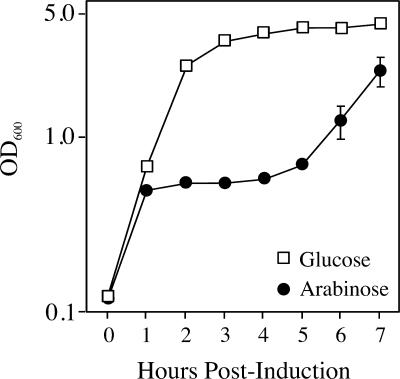
FIG. 1.
FIG. 1.
Ectopic expression of hipA causes a transient inhibition of culture growth. TH1273 (hipA::Kan) cells transformed with pBAD33hipA were grown overnight in LB with chloramph-enicol and glucose and subcultured the following morning in the same medium at an OD600 of 0.025. At an OD600 of 0.1, the culture was washed and split into LB-chloramphenicol medium containing glucose or arabinose. The values presented are the average of three independent experiments; error bars represent the standard deviations.
FIG. 2.
FIG. 2.
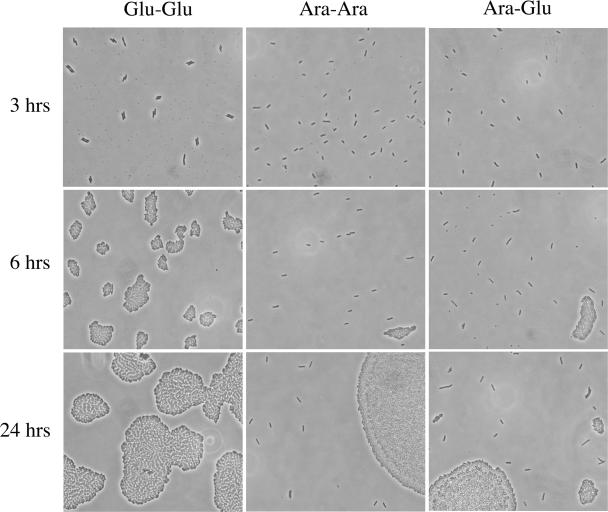
A limited number of cells form colonies after expression of hipA. TH1273 (hipA::kan) cells transformed with pBAD33hipA were grown overnight in LB- with chloramph enicol and -glucose and subcultured the following morning in the same medium at an OD600 of 0.025. At an OD600 of 0.1, the culture was washed and split into LB-chloramph enicol medium containing glucose (Glu) or arabinose (Ara). After 180 min of hipA induction, aliquots were transferred to slides coated with LB-arabinose agar (center) or LB-glucose agar (right). The left panels show cells grown only in LB-chloramph enicol-glucose and spread on slides coated with LB-glucose agar.
FIG. 3.
FIG. 3.
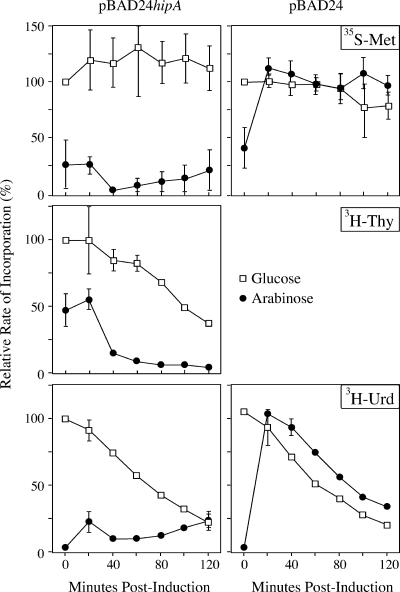
Ectopic expression of wild-type hipA inhibits macromolecular synthesis. TH1273 (hipA::kan) was transformed with either pBAD24hipA or pBAD24 without an insert. Overnight cultures grown in MOPS-minimal plus ampicillin and glucose were diluted into the same medium to an OD600 of 0.01. At an OD600 of 0.1, the culture was washed and split into MOPS minimal medium with glucose (squares) or arabinose (circles), and pulse-chase experiments were conducted to monitor the incorporation of radiolabeled precursors into protein (top), DNA (center), or RNA (bottom). The incorporation rates are expressed as the percent relative to the incorporation of precursor into the glucose culture at time zero. The values presented are the averages of three independent experiments; error bars represent the standard deviations.
FIG. 4.
FIG. 4.
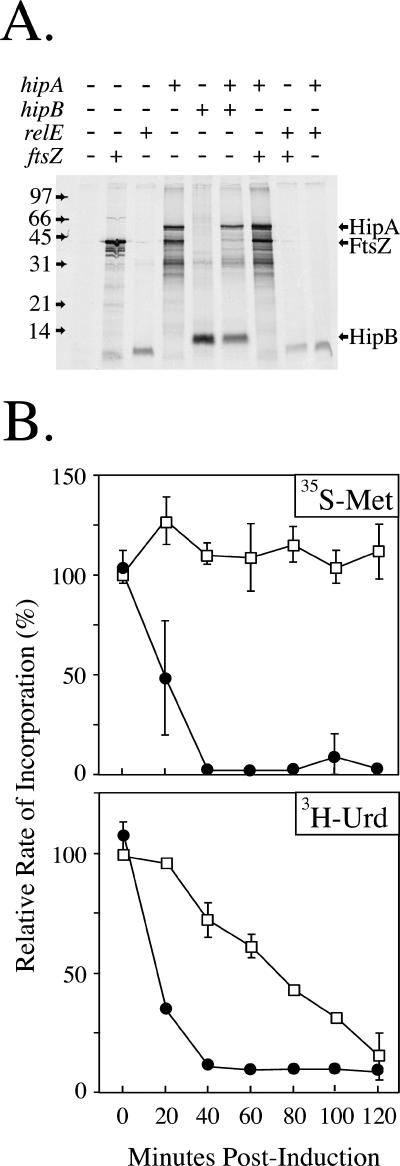
HipA does not block translation in vitro. (A) T7 S30 in vitro translation system programmed with the DNA templates pET11ftsZ, pET11hipA, pEThipB, or pET11relE. The positions of the individual proteins after SDS-15% PAGE are indicated. (B) BL21(DE3)/pLysS was transformed with pET11hipA, and pulse-chase experiments were conducted in MOPS minimal medium plus glucose as described in Materials and Methods. The incorporation of [35S]methionine and [3H]uridine was measured in the absence (squares) or presence (circles) of 0.05 mM IPTG. The incorporation rate is expressed as the percent relative to the incorporation of precursor into the glucose culture at time zero.
FIG. 5.
FIG. 5.
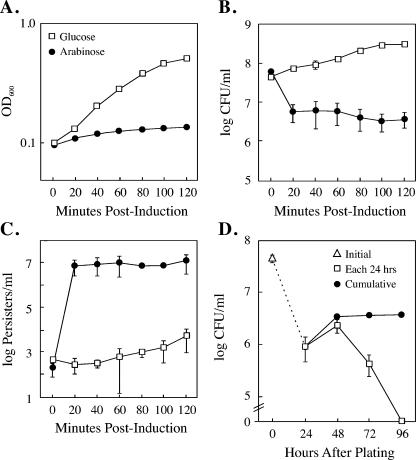
Expression of wild-type hipA in excess of hipB confers persistence. (A) TH1273 (hipA::kan) cells were transformed with pBAD33hipA. Fresh transformants were grown in MOPS minimal medium containing either glucose (squares) or arabinose (circles). (B and C) Aliquots were diluted and plated on LB to determine the CFU per ml after 24 h (B) or spread on LB-ampicillin plates for 24 h prior to treatment with penicillinase to allow outgrowth of persisters (C). (D) Time course of CFU appearance after a 60-min hipA induction. Symbols: □, number of CFU appearing in each 24-h period; •, total accumulated CFU; ▵, initial CFU present at the time arabinose was added to medium. For all panels, the values presented are the average of three independent experiments; the error bars represent the standard deviations.
FIG. 6.
FIG. 6.
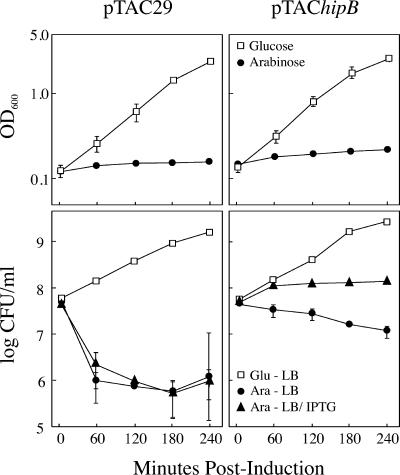
Expression of hipB after hipA overexpression restores cell growth. TH1273 cells carrying pBAD33hipA and either pTAC29 (left panels) or pTAC29hipB (right panels) were grown in MOPS minimal medium in the presence of glucose (□) or arabinose (•) to induce or suppress hipA transcription. At the indicated time points, the cells were removed and plated on LB or LB-IPTG (to induce hipB [▴]), and the numbers of CFU were determined. The values presented are the averages of three independent experiments; error bars represent the standard deviations.
FIG. 7.
FIG. 7.
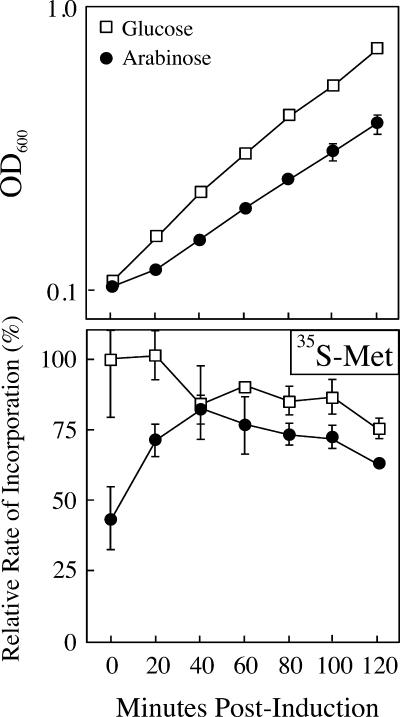
Ectopic expression of the hipA7 allele does not markedly inhibit protein synthesis. TH1273 (hipA::Kan) cells were transformed with pBAD24hipA7. Fresh transformants were cultured in MOPS minimal medium in with glucose (□) or arabinose (•) and monitored for growth (upper panel) and [35S]methionine incorporation (lower panel) as described in Materials and Methods. The incorporation rates are expressed as the percent relative to the incorporation of precursor into the glucose culture at time zero. The values presented are the averages of five independent experiments; error bars represent the standard deviations.
FIG. 8.
FIG. 8.
Expression of hipA7 confers persistence regardless of the level of induction. TH1273 cells transformed with either pBAD33hipA or pBAD33hipA7 were grown in LB broth in the presence of glucose (squares) or arabinose (circles). Cells were plated on LB to determine CFU (open symbols) or on LB-ampicillin plates to determine persister CFU (closed symbols). The values presented are the averages of three independent experiments; error bars represent the standard deviations.

References

    1. Aizenman, E., H. Engelberg-Kulka, and G. Glaser. 1996. An Escherichia coli chromosomal “addiction module” regulated by guanosine-3′5′-bispyrophosphate: a model for programmed cell death. Proc. Natl. Acad. Sci. USA 93:6059-6063. - PMC - PubMed
    1. Amitai, A., Y. Yassin, and H. Engelberg-Kulka. 2004. MazF-mediated cell death in Escherichia coli: a point of no return. J. Bacteriol. 186:8295-8300. - PMC - PubMed
    1. Balaban, N. Q., J. Merrin, R. Chait, L. Kowalik, and S. Leibler. 2004. Bacterial persistence as a phenotypic switch. Science 305:1622-1625. - PubMed
    1. Bernard, P., and Couturier. 1992. Cell killing by the F plasmid CcdB protein involves poisioning of DNA-topoisomerase II complexes. J. Mol. Biol. 226:735-745. - PubMed
    1. Bigger, J. W. 1944. Treatment of staphylococcal infections with penicillin by intermittent treatment. Lancet ii:497-500.

Publication types

MeSH terms

LinkOut - more resources