


Context fear learning in the absence of the hippocampus
- PMID: 16707800
- PMCID: PMC6675287
- DOI: 10.1523/JNEUROSCI.2685-05.2006
Context fear learning in the absence of the hippocampus
Abstract
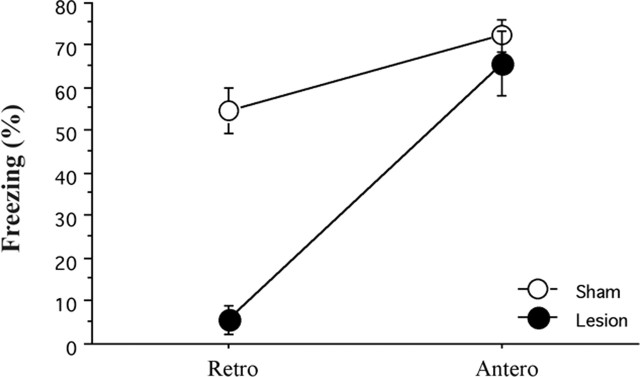
Lesions of the rodent hippocampus invariably abolish context fear memories formed in the recent past but do not always prevent new learning. To better understand this discrepancy, we thoroughly examined the acquisition of context fear in rats with pretraining excitotoxic lesions of the dorsal hippocampus. In the first experiment, animals received a shock immediately after placement in the context or after variable delays. Immediate shock produced no context fear learning in lesioned rats or controls. In contrast, delayed shock produced robust context fear learning in both groups. The absence of fear with immediate shock occurs because animals need time to form a representation of the context before shock is presented. The fact that it occurs in both sham and lesioned rats suggests that they learn about the context in a similar manner. However, despite learning about the context in the delay condition, lesioned rats did not acquire as much fear as controls. The second experiment showed that this lesion-induced deficit could be overcome by increasing the number of conditioning trials. Lesioned animals learned normally after multiple shocks, regardless of freezing level or trial spacing. The last experiment showed that animals with complete hippocampus lesions could also learn about the context, although the same lesions produced devastating retrograde amnesia. These results demonstrate that alternative systems can acquire context fear but do so less efficiently than the hippocampus.
Figures


References
-
- Anagnostaras SG, Gale GD, Fanselow MS (2001). Hippocampus and contextual fear conditioning: recent controversies and advances. Hippocampus 11:8–17. - PubMed
-
- Cho YH, Friedman E, Silva AJ (1999). Ibotenate lesions of the hippocampus impair spatial learning but not contextual fear conditioning in mice. Behav Brain Res 98:77–87. - PubMed
-
- de Hoz L, Moser EI, Morris RG (2005). Spatial learning with unilateral and bilateral hippocampal networks. Eur J Neurosci 22:745–754. - PubMed
-
- Fanselow MS (1984). Opiate modulation of the active and inactive components of the postshock reaction: parallels between naloxone pretreatment and shock intensity. Behav Neurosci 98:269–277. - PubMed
Publication types
MeSH terms
Grants and funding
LinkOut - more resources
Full Text Sources
Medical
Miscellaneous
