


Short-term statin treatment improves endothelial function and neurohormonal imbalance in normocholesterolaemic patients with non-ischaemic heart failure
- PMID: 16709697
- PMCID: PMC1861248
- DOI: 10.1136/hrt.2005.082560
Short-term statin treatment improves endothelial function and neurohormonal imbalance in normocholesterolaemic patients with non-ischaemic heart failure
Abstract
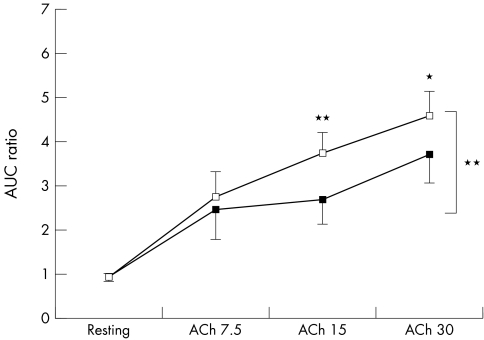
Objectives: To investigate the effect of short-term statin treatment on impaired endothelium-dependent vasodilatation and haemodynamic abnormalities typically occurring in chronic heart failure (CHF).
Methods: In a double-blind, crossover study endothelium-dependent vasodilatation was measured in conduit and resistance vessels of 23 patients with non-ischaemic CHF after 6 weeks of placebo and 40 mg atorvastatin. The haemodynamic impact was assessed by cardioendocrine hormones, echocardiography and clinical indicators of CHF.
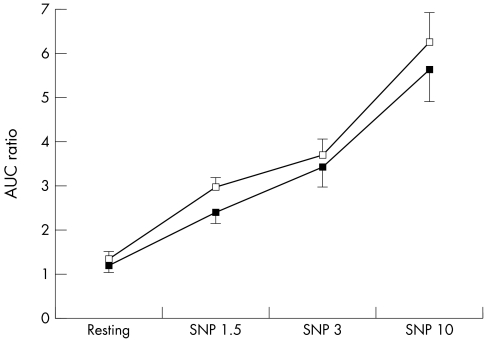
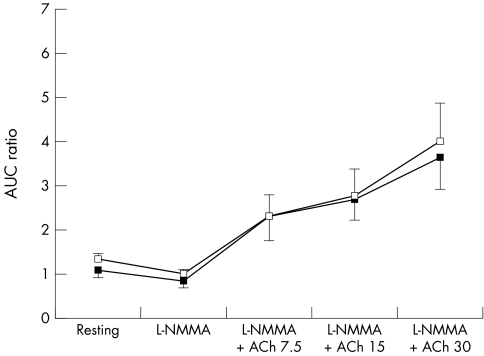
Results: Cholesterol concentrations were population average (low density lipoprotein 3.56 (SEM 0.16) mmol/l, triglycerides 1.70 (0.20) mmol/l and high density lipoprotein 1.17 (0.07) mmol/l). In resistance vessels, the area under the curve ratio during acetylcholine infusion increased from 9.2 (1.9) with placebo to 12.2 (2.1) with statin (p < 0.01). This improvement was reversed during co-infusion with the nitric oxide antagonist N(G)-monomethyl-L-arginine. In conduit arteries, flow-mediated dilatation increased from 5.64 (SEM 0.88)% with placebo to 6.83 (0.97)% with statin (p < 0.05). Endothelium-independent vasodilatation did not change (p = 0.68 for conduit and p = 0.45 for resistance vessels). Endothelin 1 and atrial natriuretic peptide (ANP) decreased from 1.57 (0.08) and 51.3 (1.0) with placebo to 1.42 (0.09) pg/ml (p < 0.05) and 42.1 (7.5) pmol/l (p < 0.05), respectively, with statin.
Conclusions: In patients with non-ischaemic CHF and population-average cholesterol concentrations, short-term statin treatment improves endothelial function in conduit and resistance vessels and lowers plasma endothelin 1 and ANP concentrations.
Conflict of interest statement
Competing interests: None declared.
Comment in
-
Heart failure: statins for all?Heart. 2006 Nov;92(11):1537-8. doi: 10.1136/hrt.2006.089797. Epub 2006 Apr 10. Heart. 2006. PMID: 16606859 Free PMC article.
References
-
- Drexler H. Endothelium as a therapeutic target in heart failure. Circulation 1998982652–2655. - PubMed
-
- Rauchhaus M, Coats A J, Anker S D. The endotoxin‐lipoprotein hypothesis. Lancet 2000356930–933. - PubMed
-
- Krum H, McMurray J J. Statins and chronic heart failure: do we need a large‐scale outcome trial? J Am Coll Cardiol 2002391567–1573. - PubMed
-
- O'Driscoll G, Green D, Taylor R R. Simvastatin, an HMG‐coenzyme A reductase inhibitor, improves endothelial function within 1 month. Circulation 1997951126–1131. - PubMed
Publication types
MeSH terms
Substances
LinkOut - more resources
Full Text Sources
Medical
