


Follow-up on metabolic markers in children treated for obstructive sleep apnea
- PMID: 16709938
- PMCID: PMC2648122
- DOI: 10.1164/rccm.200401-110OC
Follow-up on metabolic markers in children treated for obstructive sleep apnea
Abstract
Rationale: In adults, obstructive sleep apnea (OSA) is associated with metabolic dysfunction that improves with treatment of OSA. No equivalent studies exist in children.
Objective: To examine the relationship between metabolic markers and OSA with time and treatment in children.
Methods: Metabolic markers measured on a fasting morning blood sample at diagnostic polysomnography and follow-up 1.3 +/- 0.6 yr later.
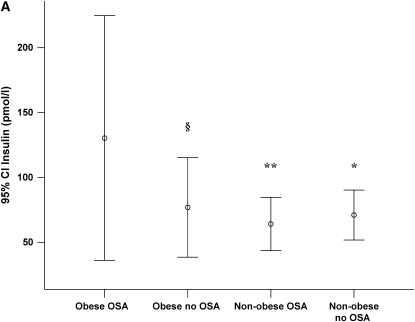
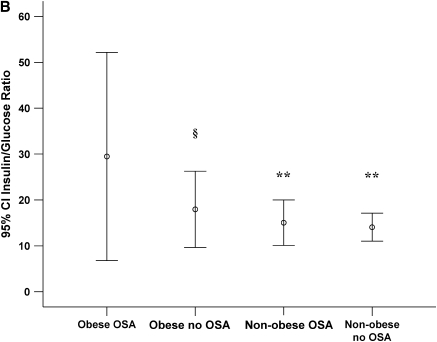
Measurements and main results: Forty-five children (34 males), aged 6.9 +/- 3.5 yr, and including 12 obese subjects, were in the final analysis. There were no differences in metabolic markers between children with and without OSA at initial study; however, obese children had significantly higher insulin (106.1 +/- 72.1 vs. 66.7 +/- 37.6 pmol/L; p = 0.028), insulin/glucose ratio (23.7 +/- 14.3 vs. 14.7 +/- 8.0; p = 0.02), and significantly lower high-density lipoprotein cholesterol (1.3 +/- 0.2 vs. 1.6 +/- 0.4 nmol/L; p = 0.005) than nonobese children. Twenty children underwent surgical removal of adenotonsillar tissue, whereas 12 children with OSA elected not to have treatment. OSA persisted after treatment in five children, and resolved in 27. Thirteen children did not have OSA on initial or follow-up studies. At follow-up, there was a small but significant improvement in total cholesterol in those children whose OSA was resolved (4.8 +/- 0.8 to 4.7 +/- 0.6 nmol/L; p = 0.005) and a trend for obese children with persisting OSA to have elevated insulin levels compared with obese children without OSA (p = 0.07).
Conclusion: Obesity appears to be the major influence on metabolic dysfunction in children with OSA, but these preliminary data also suggest that resolution or persistence of OSA may affect changes in metabolic function over time.
Figures
References
-
- Grunstein RR. Metabolic aspects of sleep apnea. Sleep 1996;19:S218–S220. - PubMed
-
- Dietz WH. Health consequences of obesity in youth: childhood predictors of adult disease. Pediatrics 1998;101:518–525. - PubMed
-
- Elmasry A, Janson C, Lindberg E, Gislason T, Tageldin MA, Boman G. The role of habitual snoring and obesity in the development of diabetes: a 10-year follow-up study in a male population. J Intern Med 2000;248:13–20. - PubMed
-
- Reaven GM. Role of insulin resistance in human disease. Diabetes 1988;37:1595–1607. - PubMed
-
- Phillips BG, Somers VK. Sleep disordered breathing and risk factors for cardiovascular disease. Curr Opin Pulm Med 2002;8:516–520. - PubMed
Publication types
MeSH terms
Substances
Grants and funding
LinkOut - more resources
Full Text Sources
