


Impact of the revision of a nutrient database on the validity of a self-administered food frequency questionnaire (FFQ)
- PMID: 16710079
- PMCID: PMC7603904
- DOI: 10.2188/jea.16.107
Impact of the revision of a nutrient database on the validity of a self-administered food frequency questionnaire (FFQ)
Abstract
Background: Revision of the national nutrient database in 2000 had a strong impact on the absolute level of estimated nutrient intake in dietary assessments. However, whether it influenced the ranking of individuals by estimated intake, a more important function in epidemiologic studies, has not been investigated. Here, we investigated the effect of this revision of the nutrient database on the validity of a food frequency questionnaire (FFQ) used to estimate nutrient intake in the Japan Public Health Center-based prospective Study (JPHC Study).
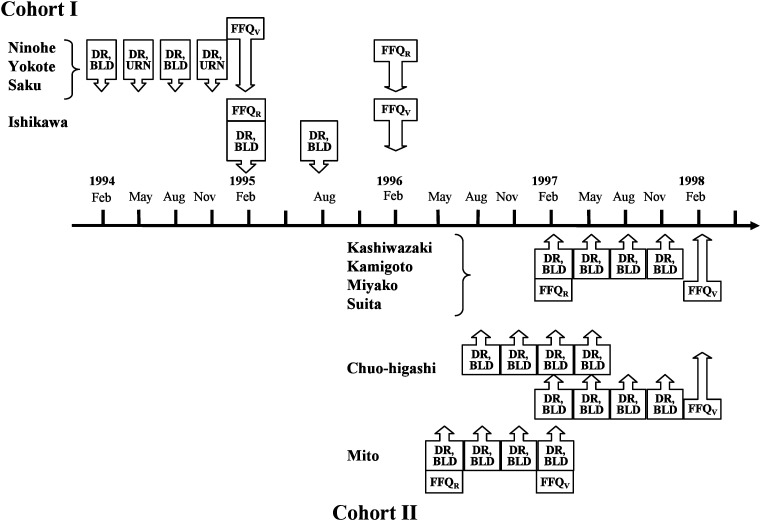
Methods: Subjects were a subsample of the JPHC Study who volunteered to participate in the validation study of the FFQ. Validity of the FFQ was evaluated by reference to the 28-day weighed dietary records as a gold standard. Nutrient intake according to the FFQ was recalculated using the revised database, and the results were compared to those using the previous database. Spearman's rank correlation coefficients (CCs) between intakes estimated by the FFQ and dietary records were computed using the revised database, and were compared to CCs computed using the previous database.
Results: For most of the nutrients, mean intake increased or decreased significantly using the revised database. However, no notable change was seen for the CC between estimated intake according to dietary records and FFQ when the revised database was used for calculation. Differences in the point estimates of the CCs ranged from -0.14 to 0.15. Likewise, CCs between biomarkers and estimated intake according to FFQ were similar for the two databases.
Conclusion: Despite changes in intake levels for many nutrients, the validity of our FFQ using rank correlation by nutrient intake was not influenced by revision of the nutrient database in Japan.
Figures
References
-
- Willett W. Nutrition Epidemiology. 2nd ed. Oxford, UK: Oxford University Press; 1998.
-
- Resource Council; Science and Technology Agency; the Government of Japan. Standard Tables of Food Composition in Japan, the fifth revised edition. Tokyo: Printing Bureau, Ministry of Finance; 2002.
-
- Council for Science and Technology; Ministry of Education, Culture, Sports, Science and Technology; the Government of Japan. Standard Tables of Food Composition in Japan, the fifth revised and enlarged edition. Tokyo: Printing Bureau, Ministry of Finance; 2005.
-
- The Study Circle for Health and Nutrition Information. Kokumin Eiyo no Genjou (Results of National Nutrition Survey in Japan, 2002, Ministry of Health, Labour and Welfare, Japan). Tokyo, Japan: Daiichi Shuppan Publishers; 2004. (in Japanese)
-
- Matsuda-Inoguchi N, Nakatsuka H, Watanabe T, Shimbo S, Higashikawa K, Ikeda M. Estimation of nutrient intake by the new version of Japanese food composition tables in comparison with that by the previous version. Tohoku J Exp Med 2001; 194: 229-39. - PubMed
