Review
. 2006 May;6(3):327-37.
doi: 10.2174/156652406776894572.

Toll-like receptors and corneal innate immunity

Affiliations
Review

Toll-like receptors and corneal innate immunity

Ashok Kumar et al. Curr Mol Med. 2006 May.

Abstract

The ocular surface is constantly exposed to a wide array of microorganisms. The ability of the cornea to recognize pathogens as foreign and eliminate them is critical to retain its transparency, hence preservation of sight. In the eye, as in other parts of the body, the early response against invading pathogens is provided by innate immunity. Corneal innate immune system uses a series of pattern recognition receptors to detect the presence of pathogens thus allowing for rapid host defense responses to invading microbes. A key component of such receptors is the "Toll-like receptors" (TLRs), which have come to occupy the center stage in innate immunity against invading pathogens. An increasing number of studies have shown that TLRs are expressed by a variety of tissues and cells of the eye and play an important role in ocular defense against microbial infection. Here in this review we summarize the current knowledge about TLR expression in human eye with main emphasis on the cornea, and discuss the future directions of the field.


Figures
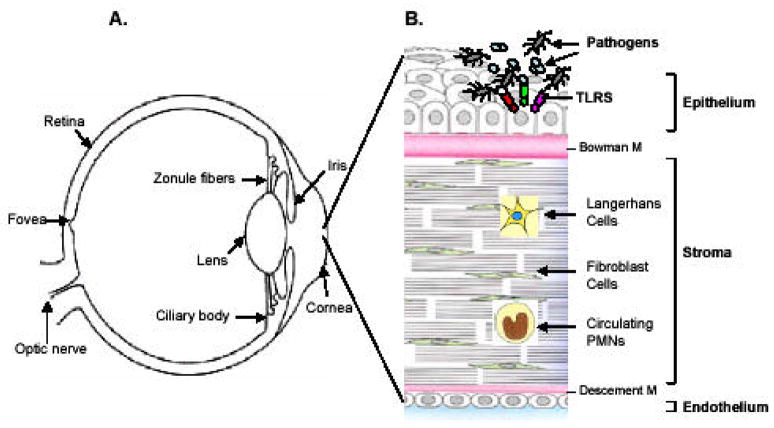
Fig. (1)
Fig. (1). Components of corneal innate response
(A) The cornea is a transparent, avascular, dome surface in front of the eye, in the cross section (B) it consists of an outer epithelial, middle stromal and inner endothelial layers. The epithelial cells being the outermost layer are in constant contact with microbes and their products. These cells recognize the pathogens possibly through various TLRs and secrete proinflammatory cytokines/chemokines such as IL-1β, IL-6, IL-8 and TNF-α. These cytokines either directly or indirectly recruit immune cells such as PMNs or dendritic cells (DCs) to the site of infection. The stromal fibroblast cells also express TLRs and might respond to the pathogen, when they reach the stromal layer after breaking epithelial integrity. Langerhans cells (LC) are abundantly present in peripheral cornea and less in the central cornea. These cells like DCs are powerful antigen presenting cells (APC) and present Ag to T and B cells, therefore they form the adaptive branch of immunity in the cornea. TLR expression patterns for various cell types are presented in Table 1.
Fig. (2)
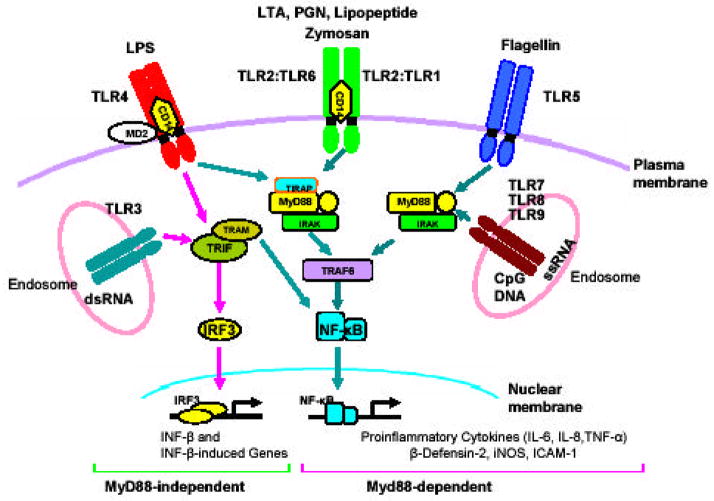
Fig. (2). TLR signaling pathways in corneal epithelium
TLRs such as TLR2, 4, and 5 at the cell surface of HCEC recognize PAMPs such as lipoproteins, LPS, and flagellin, respectively. Similarly nucleic acids released from damaged infected tissues or cells or captured from multiplying bacteria or viruses are recognized by TLRs such (TLR3, 7, 8, and 9) expressed in endosomes. The recognition of PAMPs by specific TLRs leads to the activation of cascade of intracellular signaling pathways in a MyD88 dependent or MyD88-independent manner. The MyD88-dependent pathway (all TLRs except TLR3) utilizes MyD88 which transduces signal through IRAK and TRAF6, leading to the activation of NF-κB pathways and production of proinflammatory cytokines and anti-microbial peptides. On the other hand, The MyD88-independent pathways, uses TRIF as an adaptor and transduces signal through TBK1 and IRF3/7, leading to the expression of IFNs and the IFN-induced genes. TLR2 and TLR4 also utilize non-TLR receptors such as CD14 and MD2 for initial binding of their ligands.

References

    1. Hazlett LD. Prog Retin Eye Res. 2004;23:1–30. - PubMed
    1. Klotz SA, Penn CC, Negvesky GJ, Butrus SI. Clin Microbiol Rev. 2000;13:662–685. - PMC - PubMed
    1. Hazlett LD. DNA Cell Biol. 2002;21:383–390. - PubMed
    1. Ladage PM. Eye Contact Lens. 2004;30:194–197. discussion 205–196. - PubMed
    1. Kurpakus-Wheater M, Kernacki KA, Hazlett LD. Prog Histochem Cytochem. 2001;36:185–259. - PubMed

Publication types

Substances

LinkOut - more resources