. 2006 May 19;34(9):2663-75.
doi: 10.1093/nar/gkl354. Print 2006.

Long homopurine*homopyrimidine sequences are characteristic of genes expressed in brain and the pseudoautosomal region

Affiliations

Long homopurine*homopyrimidine sequences are characteristic of genes expressed in brain and the pseudoautosomal region

Albino Bacolla et al. Nucleic Acids Res. .

Abstract

Homo(purine*pyrimidine) sequences (R*Y tracts) with mirror repeat symmetries form stable triplexes that block replication and transcription and promote genetic rearrangements. A systematic search was conducted to map the location of the longest R*Y tracts in the human genome in order to assess their potential function(s). The 814 R*Y tracts with > or =250 uninterrupted base pairs were preferentially clustered in the pseudoautosomal region of the sex chromosomes and located in the introns of 228 annotated genes whose protein products were associated with functions at the cell membrane. These genes were highly expressed in the brain and particularly in genes associated with susceptibility to mental disorders, such as schizophrenia. The set of 1957 genes harboring the 2886 R*Y tracts with > or =100 uninterrupted base pairs was additionally enriched in proteins associated with phosphorylation, signal transduction, development and morphogenesis. Comparisons of the > or =250 bp R*Y tracts in the mouse and chimpanzee genomes indicated that these sequences have mutated faster than the surrounding regions and are longer in humans than in chimpanzees. These results support a role for long R*Y tracts in promoting recombination and genome diversity during evolution through destabilization of chromosomal DNA, thereby inducing repair and mutation.


Figures
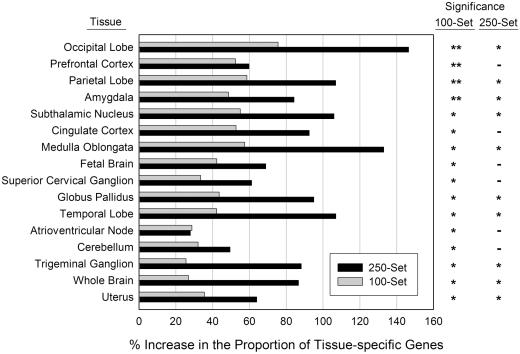
Figure 1
Figure 1
Tissue distribution of R•Y tract-containing genes. The percentage increase in the fraction of R•Y-containing genes (100-set and 250-set) highly expressed (Z-score >1) in a given tissue relative to the fraction of all genes highly expressed in the same tissue is displayed on the x-axis. Asterisks, significantly enriched tissues as determined by binomial probability after a Bonferroni multiple comparison correction. Significance: **, P < 10−7; *, 10−7P < 0.05, -, not significant.
Figure 2
Figure 2
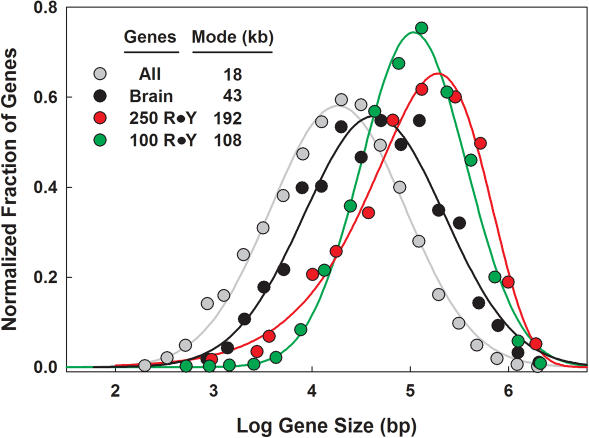
Relationship between gene size and the presence of R•Y tracts. The fractions of genes with log gene size falling within 0.2 (0.25 for ≥100 bp R•Y tract-containing genes and 0.3 for ≥250 bp R•Y tract-containing genes) log-intervals plotted as a function of their mean values. Gray, 22,799 human genes; black, 1377 brain-specific human genes; green, 1891 ≥100 bp R•Y tract-containing human genes; red, 200 ≥250 bp R•Y tract-containing human genes.
Figure 3
Figure 3
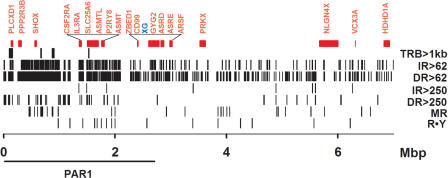
Repetitive elements in the pseudoautosomal region. The vertical lines represent the locations of repetitive elements in the first 7 Mbp of the human X chromosome containing the PAR1 region. R•Y, clustered R•Y repeats from Supplementary Figure 4; MR, mirror repeats ≥62 bp; DR>250, direct repeats ≥250 bp; IR>250, inverted repeats ≥250 bp; DR>62, direct repeats ≥62 bp but <250 bp; IR>62, inverted repeats ≥62 bp but <250 bp; TRB>1kb, sequences containing tandem repeat blocks >94.8% pure with a total length >1kb; red, annotated genes; XG (in blue) gene spanning the PAR1 boundary.
Figure 4
Figure 4
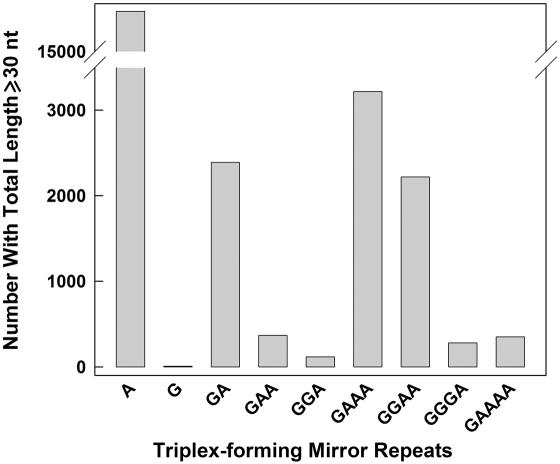
Number of Triplex-forming sequences with mirror symmetry in the human genome. Gray bars, total numbers of uninterrupted R•Y tracts with mirror symmetry ≥30 bp in length.
Figure 5
Figure 5
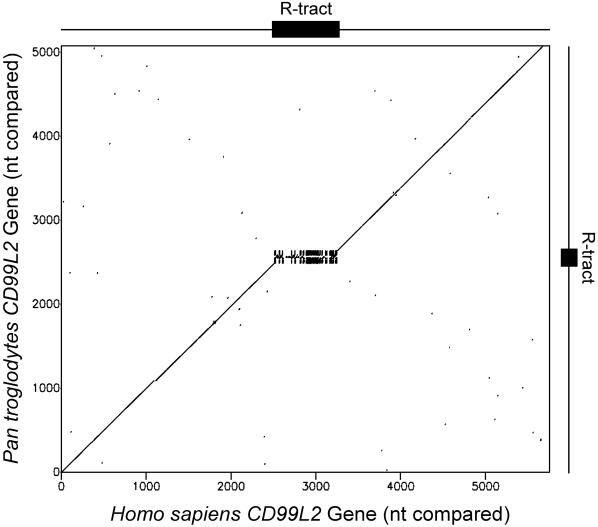
Comparative genomics of R•Y tracts. Dot-plot of the R-tract and 5 kb of flanking sequence in the human CD99L2 gene with the orthologous gene from chimpanzee.
Figure 6
Figure 6
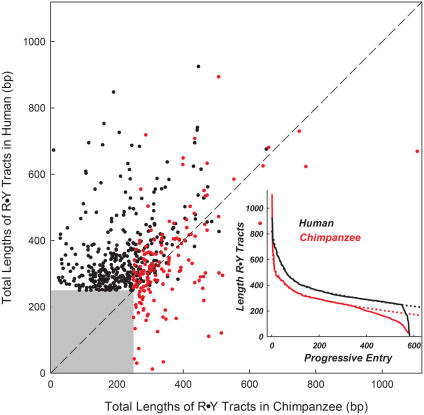
Length comparison of R•Y tracts between human and chimpanzee. The lengths of the tracts in chimpanzee are plotted against the lengths of the orthologous tracts in human. The total R•Y tract lengths are given, including interruptions. Black dots, human pure R•Y tracts ≥250 bp in length versus orthologous tracts in chimpanzee (436 total); red dots, chimpanzee pure R•Y tracts ≥250 bp in length versus orthologous tracts in human (166 total). Inset, the 582 unique human/chimpanzee pairs of R•Y tracts from the main panel were ranked by length. Black line, human R•Y tracts (average length = 359 ± 114 bp); red line, chimpanzee R•Y tracts (average length = 260 ± 127 bp); dotted lines, curves fitted to the distributions of R•Y tracts.

References

    1. Sinden R.R. DNA Structure and Function. San Diego, CA: Academic Press; 1994.
    1. Wells R.D., Dere R., Hebert M.L., Napierala M., Son L.S. Advances in mechanisms of genetic instability related to hereditary neurological diseases. Nucleic Acids Res. 2005;33:3785–3798. - PMC - PubMed
    1. Mirkin S.M., Frank-Kamenetskii M.D. H-DNA and related structures. Annu. Rev. Biophys. Biomol. Struct. 1994;23:541–576. - PubMed
    1. Rich A., Zhang S. Timeline: Z-DNA: the long road to biological function. Nature Rev. Genet. 2003;4:566–572. - PubMed
    1. Neidle S., Parkinson G.N. The structure of telomeric DNA. Curr. Opin. Struct. Biol. 2003;13:275–283. - PubMed

Publication types