. 2006 Jun;74(6):3251-61.
doi: 10.1128/IAI.00245-06.

Environmental signals generate a differential and coordinated expression of the heme receptor gene family of Bartonella quintana

Affiliations

Environmental signals generate a differential and coordinated expression of the heme receptor gene family of Bartonella quintana

James M Battisti et al. Infect Immun. 2006 Jun.

Abstract

Of all bacteria, Bartonella quintana has the highest reported in vitro hemin requirement, yet an explanation for this remains elusive. To produce diseases such as trench fever, endocarditis, and bacillary angiomatosis, B. quintana must survive and replicate in the disparate environments of the Pediculus humanus corporis (body louse) gut and the human vasculature. We previously identified a five-member family of hemin binding proteins (Hbps) synthesized by B. quintana that bind hemin on the outer surface but share no similarity to known bacterial heme receptors. In the present study, we examine the transcription, regulation, and synthesis of this virulence factor family by cultivation of the bacterium in environments that simulate natural heme, oxygen, and temperature conditions encountered in the host and insect vector. First, quantitative real-time PCR data show that hbpC expression is regulated by temperature, where a >100-fold increase in transcript quantity was seen at 30 degrees C relative to 37 degrees C, suggesting that HbpC synthesis would be greatest in the cooler temperature of the louse. Second, cultivation at human bloodstream oxygen concentration (5% relative to 21% atmospheric) significantly decreases the transcript quantity of all hbp genes, indicating that expression is influenced by O2 and/or reactive oxygen species. Third, a differential expression pattern within the hbp family is revealed when B. quintana is grown in a range of hemin concentrations: subgroup I (hbpC and hbpB) predominates in a simulated louse environment (high heme), and subgroup II (hbpA, hbpD, and hbpE) is preferentially expressed in a simulated human background (low heme). By using two-dimensional sodium dodecyl sulfate-polyacrylamide gel electrophoresis, immunoblotting, and matrix-assisted laser desorption ionization-time of flight mass spectrometry fingerprinting, we demonstrate that synthesis of HbpA correlates with hbpA transcript increases observed at low hemin concentrations. Finally, an hbpA promoter-lacZ reporter construct in B. quintana demonstrates that a transcriptional regulator(s) is controlling the expression of hbpA through a cis-acting regulatory element located in the hbpA promoter region.


Figures
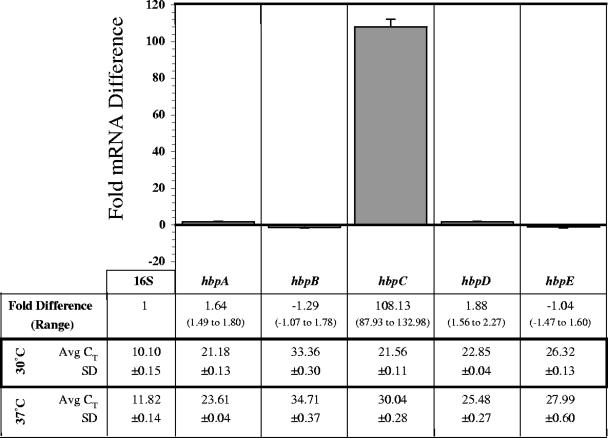
FIG. 1.
FIG. 1.
Fold differences in hbp mRNA following growth at louse-like temperature (30°C) relative to that at human temperature (37°C). At 96 h, the amount of target hbp mRNA transcript in 30°C preparations was normalized to the amount of 16S rRNA and is relative to the quantity of that particular hbp mRNA transcript in 37°C preparations. A representative experiment is shown, where CT values were determined in triplicate. SD bars were generated by comparing fold differences to those obtained from a second independent triplicate determination.
FIG. 2.
FIG. 2.
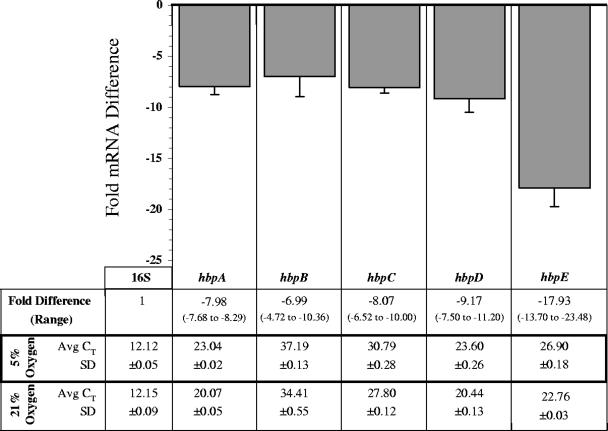
Fold differences in hbp mRNA following growth at human bloodstream oxygen concentration (5% O2) relative to that of the routine in vitro culture environment (21% O2). At 96 h, the amount of target hbp mRNA transcript in 5% O2 preparations was normalized to the amount of 16S rRNA and is relative to the quantity of that particular hbp mRNA transcript from 21% O2 preparations. A representative experiment is shown, where CT values were determined in triplicate. SD bars were generated by comparing fold differences to those obtained from a second independent triplicate determination.
FIG. 3.
FIG. 3.
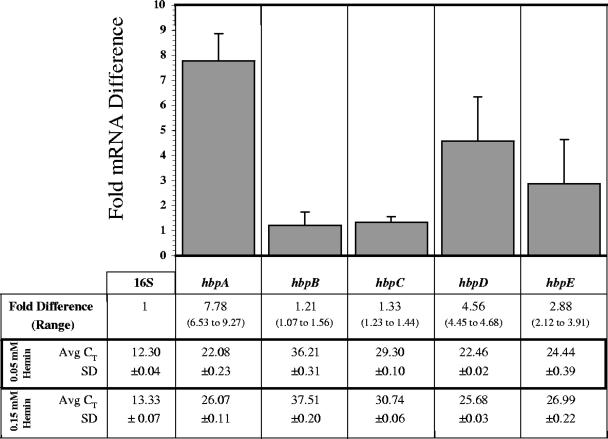
Fold differences in hbp mRNA following growth at a low hemin concentration (0.05 mM) relative to the control concentration (0.15 mM). At mid-log phase, the amount of target hbp mRNA transcript from 0.05 mM preparations was normalized to the amount of 16S rRNA and is relative to the quantity of that particular hbp mRNA transcript from 0.15 mM preparations. A representative experiment is shown, where CT values were determined in triplicate. SD bars were generated by comparing fold differences to those obtained from a second independent triplicate determination.
FIG. 4.
FIG. 4.
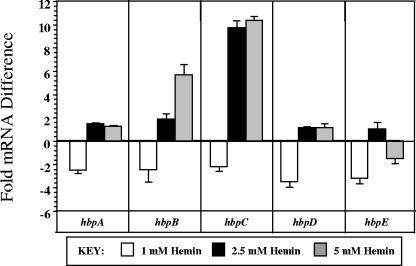
Fold differences in hbp mRNA at high heme levels from mid-log-phase cells. The amount of target hbp mRNA transcript from cultures grown in 1, 2.5, and 5 mM heme was normalized to the amount of 16S rRNA and is relative to the quantity of that particular hbp mRNA transcript from 0.15 mM preparations. A representative experiment is shown, where CT values were determined in triplicate. SD bars were generated by comparing fold differences to those obtained from a second independent triplicate determination.
FIG. 5.
FIG. 5.
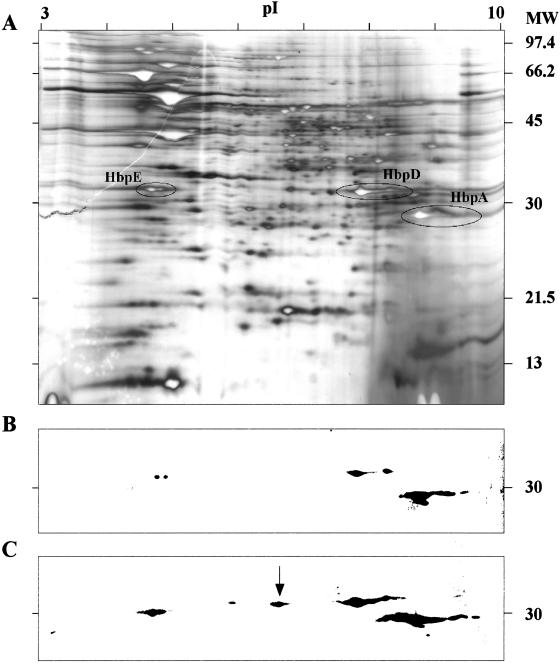
A. Two-dimensional SDS-PAGE gel of a whole-cell lysate of B. quintana grown for 96 h at the control hemin concentration (0.15 mM), with positions of HbpA, HbpD, and HbpE circled. B. Corresponding immunoblot of two-dimensional SDS-PAGE developed with anti-HbpA antiserum reacting with subgroup II Hbps. C. Immunoblot of two-dimensional SDS-PAGE of B. quintana grown to mid-log phase at a low hemin concentration (0.05 mM) developed with anti-HbpA showing significant increases in HbpA, HbpD, and HbpE. Identity of the Hbps was verified by MALDI-TOF MS, and the spot indicated with the arrow is additional HbpD not seen at the 0.15 mM heme level. The pI range of the IEF is shown at the top, and the molecular weight (MW) is given to the right in thousands.
FIG. 6.
FIG. 6.
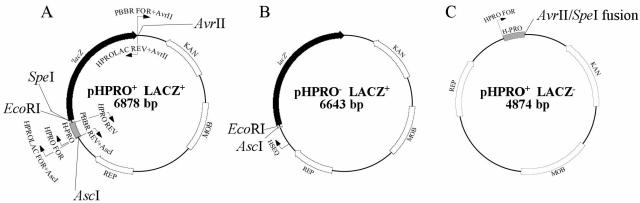
A. Reporter construct (pHPRO+ LACZ+) containing the 240-bp hbpA promoter region, HPRO, fused to ′lacZ. Primers used for inverse PCR cloning and sequence analysis are indicated with small arrows and are described in Table 1. Restriction endonuclease sites and plasmid ORFs (KAN, kanamycin resistance cassette; MOB, mobilization gene; REP, origin of replication) are also illustrated. B. Control plasmid 1 derived from the reporter construct by removing the EcoRI-AscI fragment containing the HPRO. C. Control plasmid 2 derived from the reporter construct by removal of the SpeI-AvrII fragment containing ′lacZ.
FIG. 7.
FIG. 7.
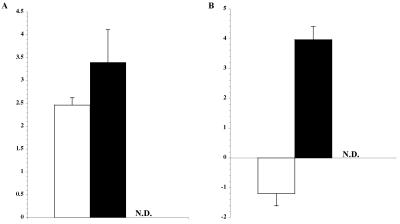
Fold differences in ′lacZ mRNA in B. quintana containing the reporter construct pHPRO+ LACZ+ (white) or the control plasmids pHPRO LACZ+ (black) and pHPRO+ LACZ+ (N.D., not detectable), under conditions of (A) low heme (0.05 mM) or (B) low O2 (5%) relative to normal conditions (0.15 mM heme or 21% O2, respectively). A representative experiment is shown, where CT values were determined in triplicate. SD bars were generated by comparing fold differences to those obtained from a second independent triplicate determination. All strains were grown in the environments indicated, and mRNA preparations were made at mid-log phase.

References

    1. Alsmark, C. M., A. C. Frank, E. O. Karlberg, B. A. Legault, D. H. Ardell, B. Canback, A. S. Eriksson, A. K. Naslund, S. A. Handley, M. Huvet, B. La Scola, M. Holmberg, and S. G. Andersson. 2004. The louse-borne human pathogen Bartonella quintana is a genomic derivative of the zoonotic agent Bartonella henselae. Proc. Natl. Acad. Sci. USA 101:9716-9721. - PMC - PubMed
    1. Andrews, S. C., A. K. Robinson, and F. Rodriguez-Quinones. 2003. Bacterial iron homeostasis. FEMS Microbiol. Rev. 27:215-237. - PubMed
    1. Appleby, C. A. 1984. Leghemoglobin and Rhizobium respiration. Annu. Rev. Plant Physiol. 35:443-478.
    1. Applied Biosystems. 2004. Guide to performing relative quantitation of gene expression using real-time quantitative PCR. [Online.] http://www.appliedbiosystems.com/support/tutorials/pdf/performing_rq_gen.... Accessed 13 February 2006.
    1. Ausubel, F., et al. 1995. Current protocols in molecular biology. John Wiley and Sons, Inc., New York, N.Y.

Publication types

MeSH terms

LinkOut - more resources