Review
. 2006 Apr;13(4):305-10.
doi: 10.1038/nsmb1077.

Determinants of histone H1 mobility and chromatin binding in living cells

Affiliations
Review

Determinants of histone H1 mobility and chromatin binding in living cells

Frédéric Catez et al. Nat Struct Mol Biol. 2006 Apr.

Abstract

The dynamic interaction of chromatin-binding proteins with their nucleosome binding sites is an important element in regulating the structure and function of chromatin in living cells. Here we review the major factors regulating the intranuclear mobility and chromatin binding of the linker histone H1, the most abundant family of nucleosome-binding proteins. The information available reveals that multiple and diverse factors modulate the interaction of H1 with chromatin at both a local and global level. This multifaceted mode of modulating the interaction of H1 with nucleosomes is part of the mechanism that regulates the dynamics of the chromatin fiber in living cells.


Conflict of interest statement

COMPETING INTERESTS STATEMENT

The authors declare that they have no competing financial interests.

Figures
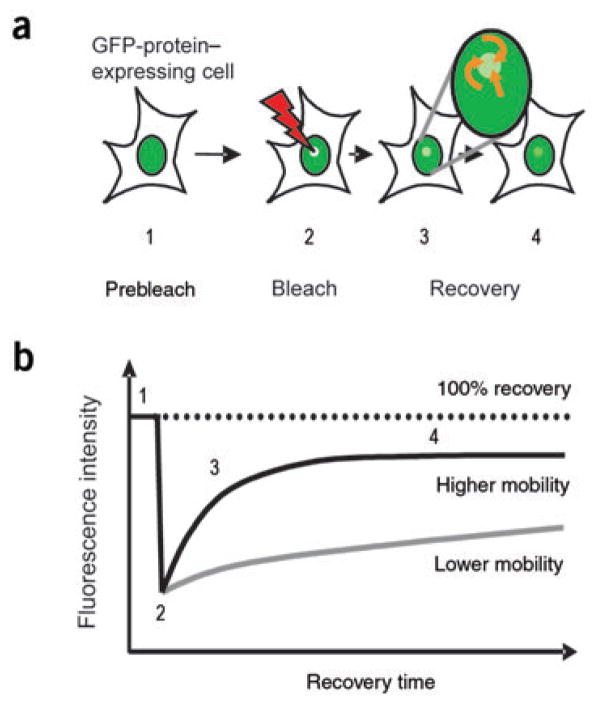
Figure 1
Figure 1
Analysis of protein dynamics in living cells by FRAP. (a) FRAP experiment. A small area in the nucleus of a cell expressing a fluorescent protein (1) is irreversibly photobleached with a laser beam (2), and the recovery of the fluorescence intensity due to entry of non-photobleached molecules (orange arrows) is continuously monitored (3 and 4). (b) Hypothetical plots for fast and slow fluorescence recovery (high and low mobility, respectively). The rate of recovery is inversely related to the time that a protein is bound to chromatin,.
Figure 2
Figure 2
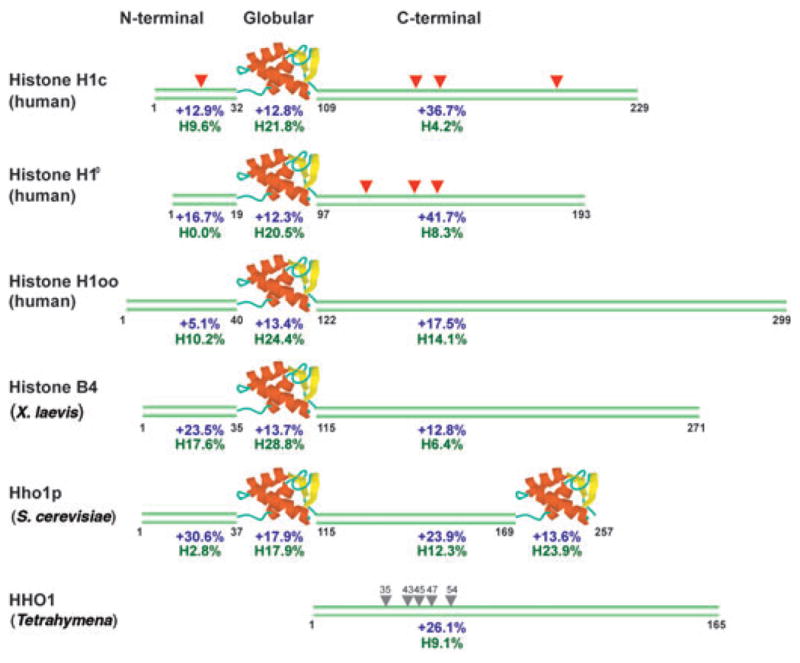
Structural features of H1 variants. Human H1c represents the typical somatic variant found in most cells. The amino acid positions at the boundaries of the domains are indicated under each sequence. For each domain, percentage of net positively charged residues is indicated in blue and percentage of hydrophobic residues (Val, Leu, Ile) in green. Red triangles, conserved SPTXK motifs; gray triangles, serine residues in Tetrahymena HHO1 protein, which have been shown to affect binding.
Figure 3
Figure 3
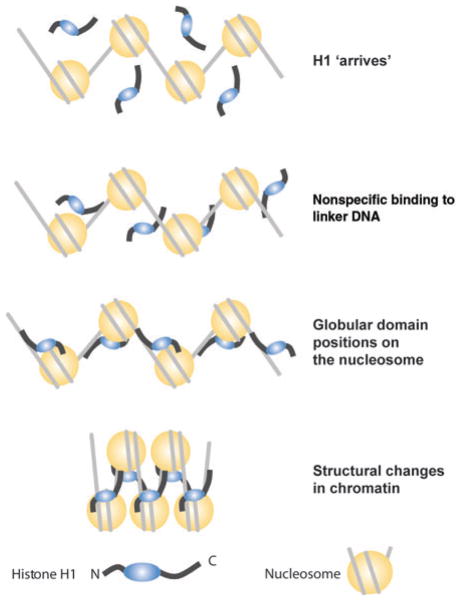
Dynamic binding of H1 to chromatin. According to Brown et al., the binding of H1 to chromatin is a multistep process initiated by a charge-based, low-affinity interaction of the C-terminal domain with the linker DNA, allowing the globular domain to ‘scan’ the nucleosome core for optimum placement. Proper placement of the globular domain induces conformational changes in the H1 flanks and leads to structural changes in chromatin.
Figure 4
Figure 4
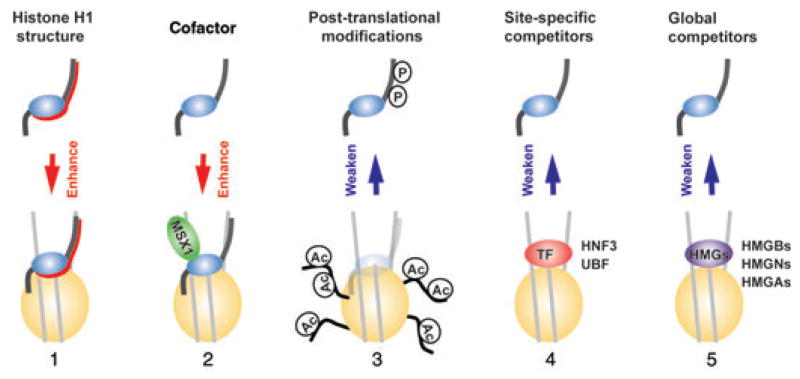
Determinants of H1-nucleosome interactions. From left: the unique structural features of H1 are the major factor promoting its binding to chromatin (1); regulatory cofactors promote the binding of specific H1 variants to unique nucleosomes (2); post-translational modification of either H1 or chromatin generally reduces the binding of H1 to chromatin (3); site-specific transcription factors (TF) and similar regulatory factors compete with and reduce the binding of H1 to specific chromatin sites (4); non–sequence-specific nucleosome-binding proteins such as HMGs act as global competitors that weaken the interaction of H1 with nucleosomes throughout the entire chromatin (5).

References

    1. Luger K, Hansen JC. Nucleosome and chromatin fiber dynamics. Curr Opin Struct Biol. 2005;15:188–196. - PubMed
    1. Bustin M, Catez F, Lim JH. The dynamics of histone H1 function in chromatin. Mol Cell. 2005;17:617–620. - PubMed
    1. Harvey AC, Downs JA. What functions do linker histones provide? Mol Microbiol. 2004;53:771–775. - PubMed
    1. Brown DT. Histone H1 and the dynamic regulation of chromatin function. Biochem Cell Biol. 2003;81:221–227. - PubMed
    1. Parseghian MH, Hamkalo BA. A compendium of the histone H1 family of somatic subtypes: an elusive cast of characters and their characteristics. Biochem Cell Biol. 2001;79:289–304. - PubMed

Publication types