


Review
doi: 10.1016/j.critrevonc.2006.02.002.
Epub 2006 May 23.
The growth factor independence-1 transcription factor: new functions and new insights
Affiliations
- PMID: 16716599
- PMCID: PMC2830489
- DOI: 10.1016/j.critrevonc.2006.02.002
Item in Clipboard
Review
The growth factor independence-1 transcription factor: new functions and new insights
Crit Rev Oncol Hematol.
2006 Aug.
Abstract
The growth factor independence-1 (Gfi1) transcription factor is required for proper development of neuroendocrine cells, sensory neurons, and blood. Patients with mutations in Gfi1 exhibit severe congenital neutropenia (SCN) or non-immune chronic idiopathic neutropenia of adults. Gfi1 was initially described as an oncoprotein that mediates tumor progression in a mouse model of leukemia; however, recent data suggest that Gfi1 may act as either an oncogene or an anti-proliferative tumor suppressor gene depending on the cell type. Here we review the latest literature on Gfi1, and emphasize its role in the hematopoietic, sensory and neuroendocrine systems.
Figures
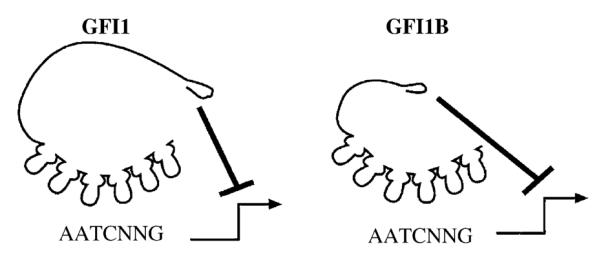
Schematic representation of the transcriptional repressors Gfi1 and Gfi1B. Both Gfi1 and Gfi1B bind to the consensus-DNA binding site 5′-AATCNNG-3′ with C2H2 type zinc-fingers on target genes. Once bound to DNA, Gfi1 and Gfi1B repress transcription through the N-terminal SNAG repressor domain.

Senseless and Gfi1 interaction with proneural basic-helix-loop-helix (bHLH) proteins in fly and human neurogenesis. (1) bHLH transcription factors of the achaete-scute complex (AS-C) regulate the development of the fly peripheral nervous system but are antagonized by Notch signaling. (2) AS-C encoded proteins are tissue specific, but bind the ubiquitous daughterless encoded proteins. These proneural bHLH dimers bind DNA sequences known as an E box (CANNTG) to transactivate the expression of senseless. (3) AS-C factors require Senseless for PNS development, because Senseless is a positive regulator of AS-C/Da function, probably through direct repression of a repressor of AS-C activity. (4) Senseless synergizes with the proneural bHLH factors to transactivate genes (including senseless), resulting in a positive-feed-back loop. Once critical levels of functional proneural bHLH dimers and Senseless are reached, Notch signals are antagonized within the cell. (5) Subsequent to inhibition of Notch signaling, neural cell fate is fixed. A similar sequence of events is proposed in human neurogenesis with orthologous proteins.

Gfi1 may function as either an oncogene or a tumor suppressor. Biological processes corresponding to either function are listed and discussed further in the text.
References
-
- Nolo R, Abbott LA, Bellen HJ. Senseless, a Zn finger transcription factor, is necessary and sufficient for sensory organ development in Drosophila. Cell. 2000;102:349–62. - PubMed
-
- Hock H, Hamblen MJ, Rooke HM, et al. Intrinsic requirement for zinc finger transcription factor gfi-1 in neutrophil differentiation. Immunity. 2003;18:109–20. - PubMed
-
- Karsunky H, Zeng H, Schmidt T, et al. Inflammatory reactions and severe neutropenia in mice lacking the transcriptional repressor Gfi1. Nat Genet. 2002;30:295–300. - PubMed
-
- Hock H, Hamblen MJ, Rooke HM, et al. Gfi-1 restricts proliferation and preserves functional integrity of haematopoietic stem cells. Nature. 2004;431:1002–7. - PubMed
Publication types
MeSH terms
Substances
Grants and funding
LinkOut - more resources
Full Text Sources
