. 2006 Jun 6;103(23):8894-9.
doi: 10.1073/pnas.0602328103. Epub 2006 May 23.

Fragments of ATP synthase mediate plant perception of insect attack

Affiliations

Fragments of ATP synthase mediate plant perception of insect attack

Eric A Schmelz et al. Proc Natl Acad Sci U S A. .

Abstract

Plants can perceive a wide range of biotic attackers and respond with targeted induced defenses. Specificity in plant non-self-recognition occurs either directly by perception of pest-derived elicitors or indirectly through resistance protein recognition of host targets that are inappropriately proteolyzed. Indirect plant perception can occur during interactions with pathogens, yet evidence for analogous events mediating the detection of insect herbivores remains elusive. Here we report indirect perception of herbivory in cowpea (Vigna unguiculata) plants attacked by fall armyworm (Spodoptera frugiperda) larvae. We isolated and identified a disulfide-bridged peptide (+ICDINGVCVDA-), termed inceptin, from S. frugiperda larval oral secretions that promotes cowpea ethylene production at 1 fmol leaf(-1) and triggers increases in the defense-related phytohormones salicylic acid and jasmonic acid. Inceptins are proteolytic fragments of chloroplastic ATP synthase gamma-subunit regulatory regions that mediate plant perception of herbivory through the induction of volatile, phenylpropanoid, and protease inhibitor defenses. Only S. frugiperda larvae that previously ingested chloroplastic ATP synthase gamma-subunit proteins and produced inceptins significantly induced cowpea defenses after herbivory. Digestive fragments of an ancient and essential plant enzyme, inceptin functions as a potent indirect signal initiating specific plant responses to insect attack.


Conflict of interest statement

Conflict of interest statement: No conflicts declared.

Figures
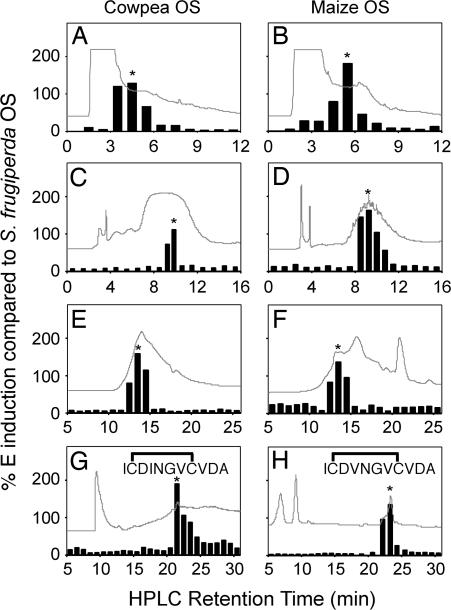
Fig. 1.
Fig. 1.
HPLC purification of inceptins from maize- and cowpea-derived S. frugiperda OS. Fractions inducing E production in cowpea leaves, denoted by an asterisk, were isolated by a series of strong cation exchange (A and B), RP-C18 (C and D), gel filtration (E and F), and normal-phase chromatography (G and H). UV traces (λ = 200 Å) are overlaid on an arbitrary scale. Fractions were sequentially collected, desalted, evaporated, and resolubilized in H2O for leaf bioassays. Final purification resulted in single fractions (∗) used for MS, Edman N-terminal sequencing, and confirmation with synthetic peptides.
Fig. 2.
Fig. 2.
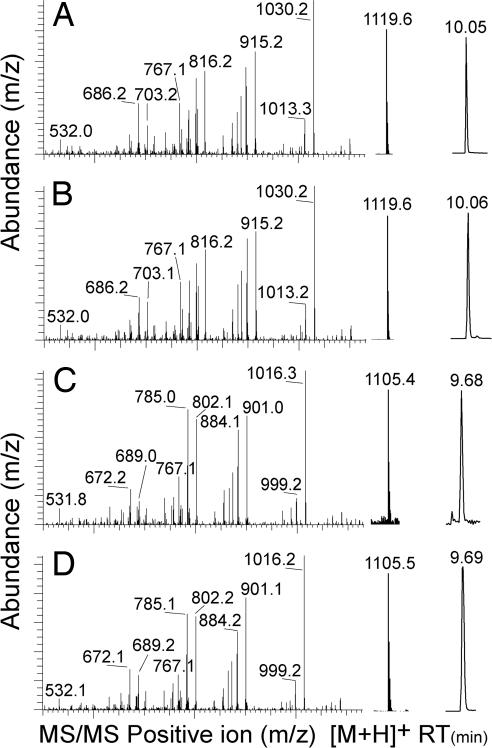
LC-MS confirmation of natural and synthetic inceptins. From left to right, MS fragment ions, predominant positive m/z [M+H]+ ions, and LC retention time (RT) of parent ion peak of isolated natural product inceptin from cowpea-derived S. frugiperda OS (A), synthetic cowpea inceptin (B), isolated natural product inceptin from maize-derived S. frugiperda OS (C), and synthetic maize inceptin (D).
Fig. 3.
Fig. 3.
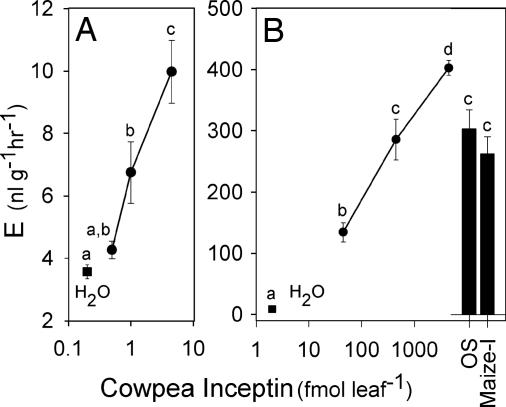
Inceptins are potent inducers of E production in cowpea leaves. Average (n = 6; ±SEM) E production of damaged cowpea leaves treated with synthetic cowpea inceptin ranging from 0.45 to 4.50 fmol (A) and 45 to 4,500 fmol (B). Damaged leaves treated with H2O only (filled squares) were arbitrarily placed at 0.2 and 2.0 on the x axes of A and B, respectively. Filled bars represent leaf responses to 1 μl of cowpea-derived S. frugiperda OS and 450 fmol of maize inceptin (Maize-I). Different letters (a–d) represent significant differences. (All ANOVA P values were <0.0001. Tukey test corrections for multiple comparisons: P < 0.05.)
Fig. 4.
Fig. 4.
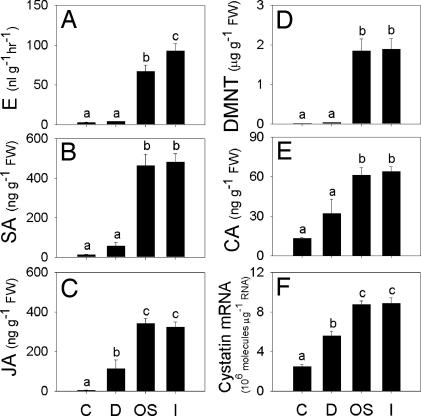
Inceptin and S. frugiperda OS induce similar phytohormone and defense responses. Leaves were either undamaged controls (C) or were damaged with the addition of H2O (D), 1 μl of cowpea-derived OS (OS), or 450 fmol of synthetic cowpea inceptin (I). Shown are average (n = 6, +SEM) E production (A) and leaf concentrations of SA (B), JA (C), DMNT (D), cinnamic acid (E), and cystatin protease inhibitor gene expression (F) 4 h after treatments. Different letters (a–c) represent significant differences. (All ANOVA P values were <0.0001. Tukey test corrections for multiple comparisons: P < 0.05.)
Fig. 5.
Fig. 5.
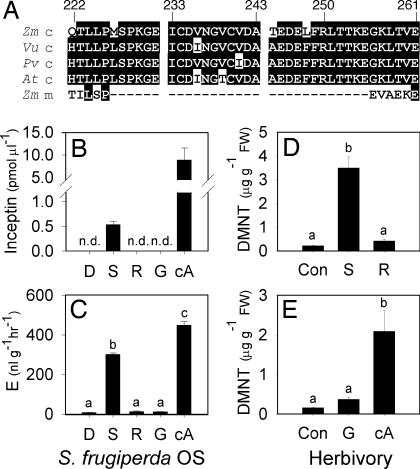
Inceptin is derived from cATPC and regulates perception of S. frugiperda attack. (A) Predicted amino acid sequences from chloroplastic (c) atpC mRNA sequences of Z. mays (Zm_c), V. unguiculata (Vu_c), P. vulgaris var. black bean (Pv_c), A. thaliana (At_c), and Z. mays mitochondrial (m) (Zm_m). Inceptin is located within amino acids 233–243 based on unprocessed full-length Zm_c. Shown are average (n = 4, +SEM) inceptin levels (B) and cowpea E production (C) from 1 μl of S. frugiperda OS from larvae fed artificial diet (D), cowpea shoots (S), or roots (R) containing H2O or E. coli-expressed proteins GST (G) and cATPC-GST (cA). n.d., not detectable (<10 fmol). (D and E) Average (n = 6, +SEM) cowpea DMNT concentrations 4 h after leaves were untreated (Con) or fed upon by larvae that had previously consumed shoots or roots (D) or artificial diet containing G or cA (E). Different letters (a–c) represent significant differences. (All ANOVA P values were <0.001. Tukey test corrections for multiple comparisons: P < 0.05.)

References

    1. Kessler A., Baldwin I. T. Annu. Rev. Plant Biol. 2002;53:299–328. - PubMed
    1. Zhao J., Davis L. C., Verpoorte R. Biotechnol. Adv. 2005;23:283–333. - PubMed
    1. Dangl J. L., Jones J. D. G. Nature. 2001;411:826–833. - PubMed
    1. Mackey D., Belkhadir Y., Alonso J. M., Ecker J. R., Dangl J. L. Cell. 2003;112:379–389. - PubMed
    1. Shao F., Golstein C., Ade J., Stoutemyer M., Dixon J. E., Innes R. W. Science. 2003;301:1230–1233. - PubMed

Publication types

Substances