Comparative Study
. 2006 Jun;50(6):2000-8.
doi: 10.1128/AAC.01598-05.

Inhibition of human coronavirus NL63 infection at early stages of the replication cycle

Affiliations
Comparative Study

Inhibition of human coronavirus NL63 infection at early stages of the replication cycle

Krzysztof Pyrc et al. Antimicrob Agents Chemother. 2006 Jun.

Abstract

Human coronavirus NL63 (HCoV-NL63), a recently discovered member of the Coronaviridae family, has spread worldwide and is associated with acute respiratory illness in young children and elderly and immunocompromised persons. Further analysis of HCoV-NL63 pathogenicity seems warranted, in particular because the virus uses the same cellular receptor as severe acute respiratory syndrome-associated coronavirus. As there is currently no HCoV-NL63-specific and effective vaccine or drug therapy available, we evaluated several existing antiviral drugs and new synthetic compounds as inhibitors of HCoV-NL63, targeting multiple stages of the replication cycle. Of the 28 compounds that we tested, 6 potently inhibited HCoV-NL63 at early steps of the replication cycle. Intravenous immunoglobulins, heptad repeat 2 peptide, small interfering RNA1 (siRNA1), siRNA2, beta-D-N(4)-hydroxycytidine, and 6-azauridine showed 50% inhibitory concentrations of 125 microg/ml, 2 microM, 5 nM, 3 nM, 400 nM, and 32 nM, respectively, and low 50% cytotoxicity concentrations (>10 mg/ml, >40 microM, >200 nM, >200 nM, >100 microM, and 80 microM, respectively). These agents may be investigated further for the treatment of coronavirus infections.


Figures
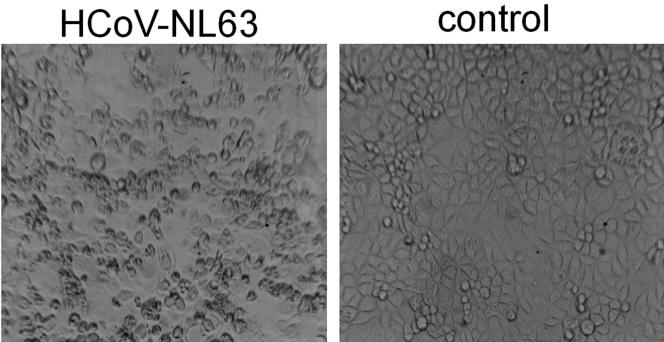
FIG. 1.
FIG. 1.
CPE induced by HCoV-NL63 on LLC-MK2 cells.
FIG. 2.
FIG. 2.
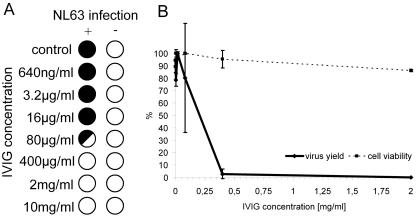
Inhibition of HCoV-NL63 by IVIG. (A) CPE reduction mediated by IVIG. Filled circles indicate CPE development, empty circles indicate the absence of CPE, and the half-filled circle represents the development of CPE in 50% of wells. (B) Decrease in HCoV-NL63 virus yield after IVIG treatment and cell viability assay. Numbers on the y axis represent the percentages of produced virus and percentages of viable cells.
FIG. 3.
FIG. 3.
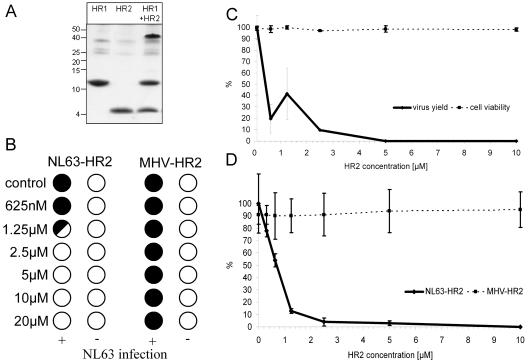
Inhibition of HCoV-NL63 by the HR2 peptide. (A) SDS-polyacrylamide gel electrophoresis analysis of HR peptides separately and the HR1/HR2 complex formation. The molecular mass of the complex corresponds to the predicted heterohexamer. (B) CPE reduction mediated by HR2 peptide. Filled circles indicate CPE development, empty circles indicate the absence of CPE, and the half-filled circle represents the development of CPE in 50% of wells. (C) Decrease in HCoV-NL63 virus yield after HR2 treatment and cell viability assay. Numbers on the y axis represent the percentages of produced virus and percentages of viable cells. (D) Immunostaining-based HCoV-NL63 infection inhibition assay. Values on the y axis represent the percentages of infected cells.
FIG. 4.
FIG. 4.
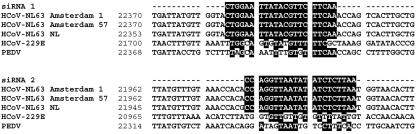
Sequence alignment illustrating conservation and specificity of siRNA target sequences in different HCoV-NL63 isolates. PEDV, porcine epidemic diarrhea virus.
FIG. 5.
FIG. 5.
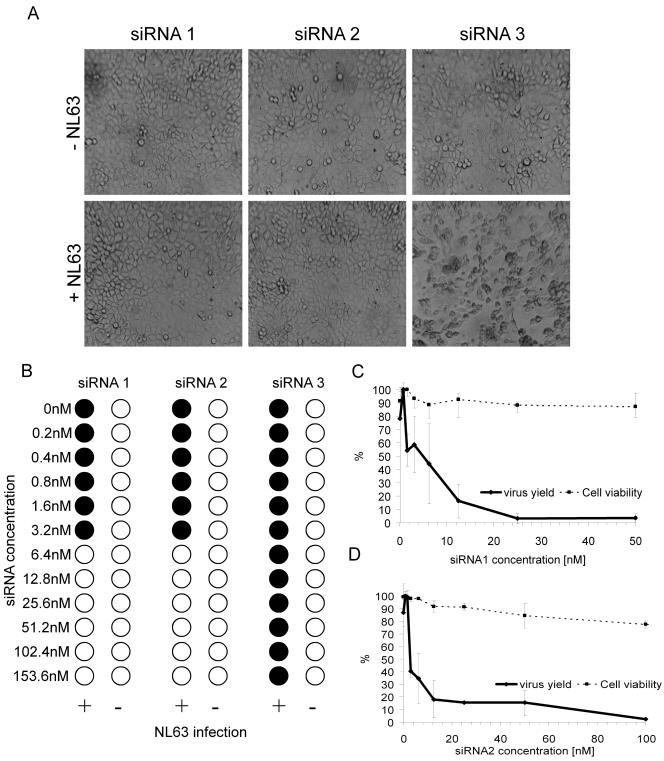
Inhibition of HCoV-NL63 with two specific siRNAs. (A) LLC-MK2 cells transfected with 25 nM siRNA1 and siRNA2 and 50 nM siRNA3 and infected with HCoV-NL63. CPE was observed only in the culture transfected with control siRNA3. The images were taken 6 days postinfection. (B) CPE reduction mediated by siRNA1 and siRNA2. Filled circles indicate CPE development, and empty circles indicate the absence of CPE. (C) Decrease in HCoV-NL63 virus yield after siRNA1 treatment and cell viability assay. Numbers on the y axis represent the percentages of produced virus and percentages of viable cells. (D) Decrease in HCoV-NL63 virus yield after siRNA2 treatment and cell viability assay. Numbers on the y axis represent the percentages of produced virus and percentages of viable cells.
FIG. 6.
FIG. 6.
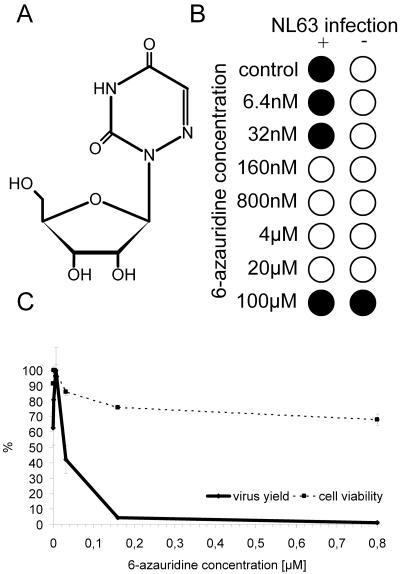
Inhibition of HCoV-NL63 with 6-azauridine. (A) Structure of 6-azauridine. (B) CPE reduction mediated by 6-azauridine. Filled circles indicate CPE development, and empty circles indicate the absence of CPE. (C) Decrease in HCoV-NL63 virus yield after treatment with 6-azauridine and cell viability assay. Numbers on the y axis represent the percentages of produced virus and percentages of viable cells.
FIG. 7.
FIG. 7.
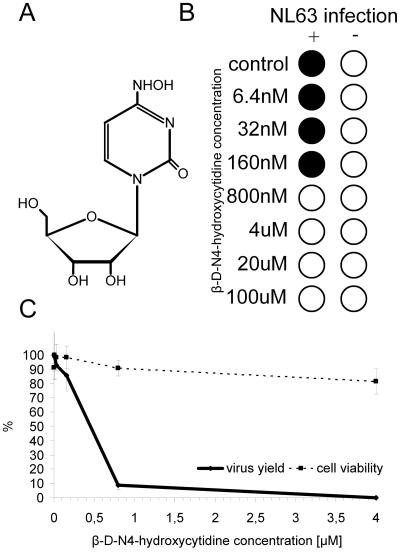
Inhibition of HCoV-NL63 by β-d-N4-hydroxycytidine. (A) Structure of β-d-N4-hydroxycytidine. (B) CPE reduction mediated by β-d-N4-hydroxycytidine. Filled circles indicate CPE development, and empty circles indicate the absence of CPE. (C) Decrease in HCoV-NL63 virus yield after treatment with β-d-N4-hydroxycytidine and cell viability assay. Numbers on the y axis represent the percentages of produced virus and percentages of viable cells.

References

    1. Anderson, J. P., R. Daifuku, and L. A. Loeb. 2004. Viral error catastrophe by mutagenic nucleosides. Annu. Rev. Microbiol. 58:183-205. - PubMed
    1. Arden, K. E., M. D. Nissen, T. P. Sloots, and I. M. Mackay. 2005. New human coronavirus, HCoV-NL63, associated with severe lower respiratory tract disease in Australia. J. Med. Virol. 75:455-462. - PMC - PubMed
    1. Barlough, J. E., and B. L. Shacklett. 1994. Antiviral studies of feline infectious peritonitis virus in vitro. Vet. Rec. 135:177-179. - PubMed
    1. Barnard, D. L., V. D. Hubbard, J. Burton, D. F. Smee, J. D. Morrey, M. J. Otto, and R. W. Sidwell. 2004. Inhibition of severe acute respiratory syndrome-associated coronavirus (SARSCoV) by calpain inhibitors and beta-D-N4-hydroxycytidine. Antivir. Chem. Chemother. 15:15-22. - PubMed
    1. Barreiro, P., T. Garcia-Benayas, A. Rendon, S. Rodriguez-Novoa, and V. Soriano. 2004. Combinations of nucleoside/nucleotide analogues for HIV therapy. AIDS Rev. 6:234-243. - PubMed

Publication types

MeSH terms