


Genetic changes that correlate with reduced susceptibility to daptomycin in Staphylococcus aureus
- PMID: 16723576
- PMCID: PMC1479123
- DOI: 10.1128/AAC.00039-06
Genetic changes that correlate with reduced susceptibility to daptomycin in Staphylococcus aureus
Abstract
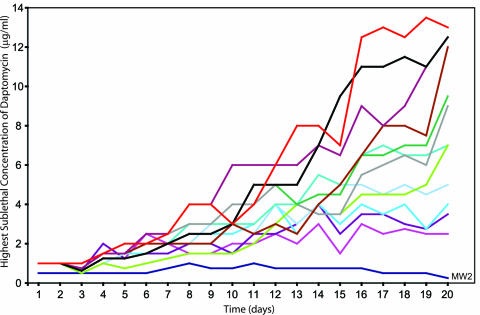
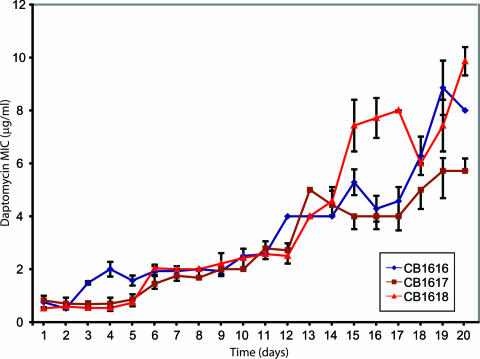
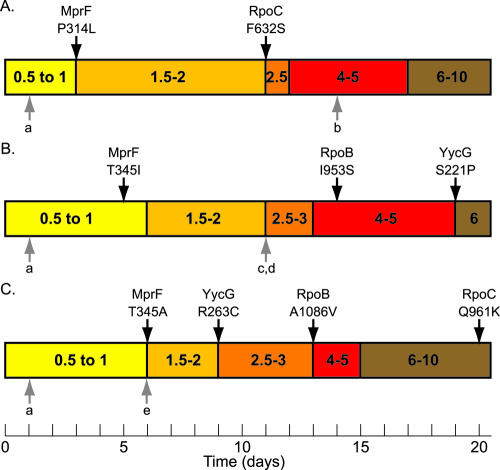
Daptomycin is a lipopeptide antibiotic with potent activity against gram-positive bacteria. Complete-genome comparisons of laboratory-derived Staphylococcus aureus with decreased susceptibility to daptomycin and their susceptible parent were used to identify genes that contribute to reduced susceptibility to daptomycin. Selective pressure of growth in sublethal concentrations of daptomycin resulted in the accumulation of mutations over time correlating with incremental decreases in susceptibility. Single point mutations resulting in amino acid substitutions occurred in three distinct proteins: MprF, a lysylphosphatidylglycerol synthetase; YycG, a histidine kinase; and RpoB and RpoC, the beta and beta' subunits of RNA polymerase. Sequence analysis of mprF, yycF, yycG, rpoB, and rpoC in clinical isolates that showed treatment-emergent increases in daptomycin MICs revealed point mutations in mprF and a nucleotide insertion in yycG, suggesting a role for these genes in decreased susceptibility to daptomycin in the hospital setting.
Figures
References
-
- Albert, T. J., D. Dailidiene, G. Dailide, J. E. Norton, A. Kalia, T. A. Richmond, M. Molla, J. Singh, R. D. Green, and D. E. Berg. 2005. Mutation discovery in bacterial genomes: metronidazole resistance in Helicobacter pylori. Nat. Methods 2:951-953. - PubMed
-
- Alder, J. D. 2005. Daptomycin: a new drug class for the treatment of gram-positive infections. Drugs Today 41:81-90. - PubMed
-
- Baba, T., F. Takeuchi, M. Kuroda, H. Yuzawa, K. Aoki, A. Oguchi, Y. Nagai, N. Iwama, K. Asano, T. Naimi, H. Kuroda, L. Cui, K. Yamamoto, and K. Hiramatsu. 2002. Genome and virulence determinants of high virulence community-acquired MRSA. Lancet 359:1819-1827. - PubMed
-
- Clausen, V. A., W. Bae, J. Throup, M. K. Burnham, M. Rosenberg, and N. G. Wallis. 2003. Biochemical characterization of the first essential two-component signal transduction system from Staphylococcus aureus and Streptococcus pneumoniae. J. Mol. Microbiol. Biotechnol. 5:252-260. - PubMed
-
- Critchley, I. A., D. C. Draghi, D. F. Sahm, C. Thornsberry, M. E. Jones, and J. A. Karlowsky. 2003. Activity of daptomycin against susceptible and multidrug-resistant gram-positive pathogens collected in the SECURE study (Europe) during 2000-2001. J. Antimicrob. Chemother. 51:639-649. - PubMed
Publication types
MeSH terms
Substances
LinkOut - more resources
Full Text Sources
Other Literature Sources
Medical
