. 2006 Jun 21;25(12):2837-46.
doi: 10.1038/sj.emboj.7601158. Epub 2006 May 25.

Mrc1 and Srs2 are major actors in the regulation of spontaneous crossover

Affiliations

Mrc1 and Srs2 are major actors in the regulation of spontaneous crossover

Thomas Robert et al. EMBO J. .

Abstract

In vegetative cells, most recombination intermediates are metabolized without an association with a crossover (CO). The avoidance of COs allows for repair and prevents genomic rearrangements, potentially deleterious if the sequences involved are at ectopic locations. We have designed a system that permits to screen spontaneous intragenic recombination events in Saccharomyces cerevisiae and to investigate the CO outcome in different genetic contexts. We have analyzed the CO outcome in the absence of the Srs2 and Sgs1 helicases, DNA damage checkpoint proteins as well as in a mutant proliferating cell nuclear antigen (PCNA) and found that they all contribute to genome stability. Remarkably high effects on COs are mediated by srs2Delta, mrc1Delta and a pol30-RR mutation in PCNA. Our results support the view that Mrc1 plays a specific role in DNA replication, promoting the Srs2 recruitment to PCNA independently of checkpoint signaling. Srs2 would prevent formation of double Holliday junctions (dHJs) and thus CO formation. Sgs1 also negatively regulates CO formation but through a different process that resolves dHJs to yield non-CO products.


Figures
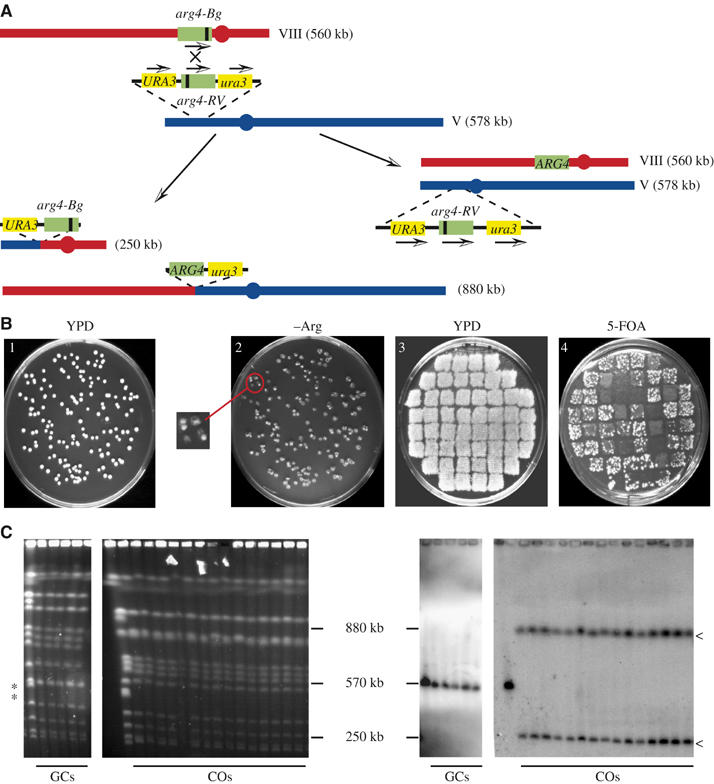
Figure 1
Figure 1
Description of the assay. (A) arg4 heteroalleles are located at its endogenous locus on chromosome VIII and between duplicated alleles of URA3 on chromosome V, in the same orientation with respect to the centromere. A recombination event between these ectopically located arg4 alleles can generate a functional copy of the ARG4 gene by gene conversion associated (left arrow) or not (right arrow) with a CO. (B) Determination of conversion events associated with a CO event. (1) Cells are plated on rich medium, (2) replicated onto arginine-free synthetic medium (a magnified region of the plate shows individual recombinants forming a papillae on a lawn of ghost cells), (3) individual recombinants are patched on rich medium (4) before being replica-plated onto a medium containing 5-FOA. (C) DNA from colonies yielding either papillae (putative GCs) or no papillae (putative COs) was prepared and subjected to clamped homogenous electrical field (CHEF) electrophoresis. Ethidium bromide staining (left panel) or URA3-hybridized Hybond N+ transferred DNA (right panel) confirms the results of the genetic screen. Asterisks (*) identify the mobility of chromosomes VIII (560 kb) and V (578 kb), whereas arrowheads (<) point at the reciprocally translocated products at 880 and 250 kb.
Figure 2
Figure 2
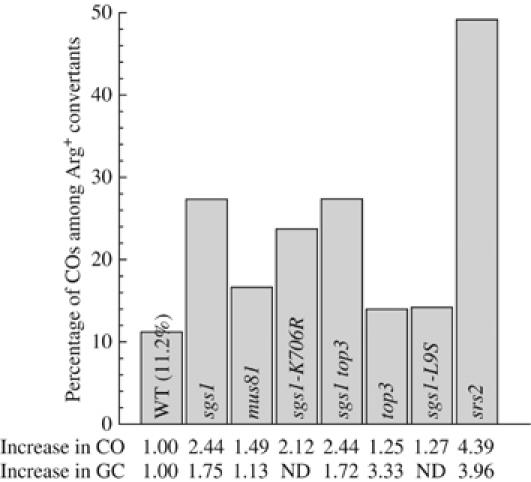
CO bias observed in single mutants. The percentage of CO was determined on a minimum of three individual segregants for each genotype. Homogeneity among each genotype was ascertained first through an ɛ test, and the mean value corresponding to the number of COs divided by the total number of convertants is represented (no s.d.). When percentages were compared to one another, we used the same ɛ test to determine the significance (see Materials and methods). Underneath the graph are the fold increase compared to WT of both COs and total conversion rates (COs and non-COs). The total conversion rate is 6.04 10−7 for our WT control.
Figure 3
Figure 3
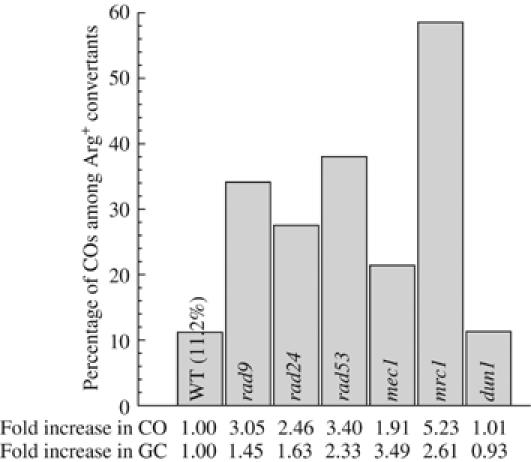
CO bias observed in single checkpoint mutants. Experiments were carried out and compared as in Figure 2.
Figure 4
Figure 4
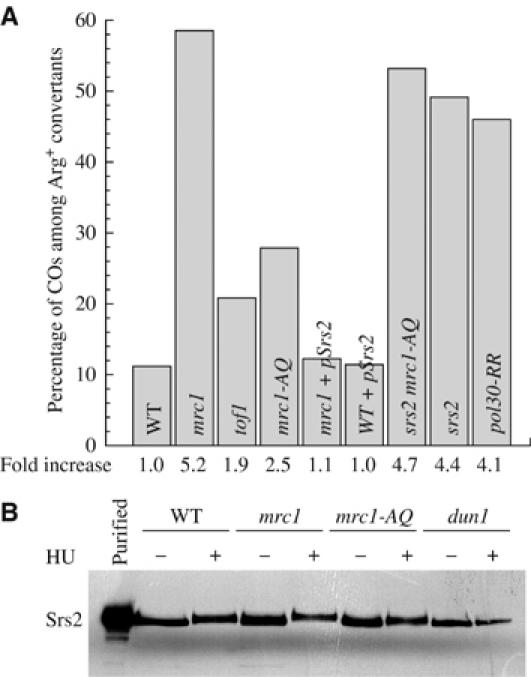
CO control by Mrc1 and Srs2. (A) CO bias in various backgrounds was determined and analyzed as in Figure 2. (B) Phosphorylation status of Srs2 in various backgrounds in the presence or absence of 0.2 M of HU. A 5 ng portion of purified Srs2 was loaded in the control lane.
Figure 5
Figure 5
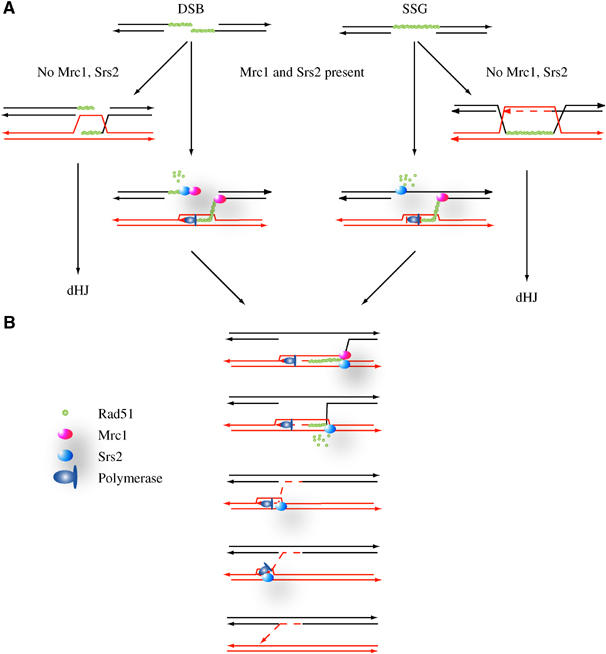
Model for CO inhibition by Srs2 and Mrc1. The initiating lesions are either DSBs (left) or single-strand gap (right) that can arise spontaneously in the course of DNA replication. (A) Early steps: When a DSB is created, the ends of the break are resected and covered with Rad51 before initiating strand invasion. In the presence of Mrc1 and Srs2, dismantling of the nucleofilaments may either prevent one of the ends of a break to become invasive or prevent the second end to be captured and therefore form a dHJ. In the case of a single-strand gap (SSG), Srs2 could prevent the formation of a dHJ by removing Rad51 from the gapped single-stranded DNA, therefore favoring a one-ended event. (B) Later steps: The invading strand pairs with its homologue and establishes a D-loop that becomes stabilized through reverse branch migration. This process brings Mrc1 present at the stalled fork in close contact with the donor DNA and may offer an entryway for Srs2 to the copied strand (3′ to 5′). The helicase activity of Srs2 will melt the newly formed duplex DNA, therefore rejecting the invading strand. Additionally, if the tracking speed of Srs2 is faster than that of the polymerase, the two machineries will collide and result in the complete rejection of the invading strand. In this model, the late steps do not depend on the type of initiating lesions (only SSG is shown), except that in the case of a DSB, a second event of DNA synthesis is necessary to seal the single-strand break present on the recipient molecule.

References

    1. Aylon Y, Kupiec M (2004) New insights into the mechanism of homologous recombination in yeast. Mutat Res 566: 231–248 - PubMed
    1. Aylon Y, Liefshitz B, Bitan-Banin G, Kupiec M (2003) Molecular dissection of mitotic recombination in the yeast Saccharomyces cerevisiae. Mol Cell Biol 23: 1403–1417 - PMC - PubMed
    1. Bailis AM, Arthur L, Rothstein R (1992) Genome rearrangement in top3 mutants of Saccharomyces cerevisiae requires a functional RAD1 excision repair gene. Mol Cell Biol 12: 4988–4993 - PMC - PubMed
    1. Bartrand AJ, Iyasu D, Brush GS (2004) DNA stimulates Mec1-mediated phosphorylation of replication protein A. J Biol Chem 279: 26762–26767 - PubMed
    1. Bashkirov VI, King JS, Bashkirova EV, Schmuckli-Maurer J, Heyer WD (2000) DNA repair protein Rad55 is a terminal substrate of the DNA damage checkpoints. Mol Cell Biol 20: 4393–4404 - PMC - PubMed

Publication types

MeSH terms