. 2005:1:2005.0018.
doi: 10.1038/msb4100025. Epub 2005 Sep 13.

Refactoring bacteriophage T7

Affiliations

Refactoring bacteriophage T7

Leon Y Chan et al. Mol Syst Biol. 2005.

Abstract

Natural biological systems are selected by evolution to continue to exist and evolve. Evolution likely gives rise to complicated systems that are difficult to understand and manipulate. Here, we redesign the genome of a natural biological system, bacteriophage T7, in order to specify an engineered surrogate that, if viable, would be easier to study and extend. Our initial design goals were to physically separate and enable unique manipulation of primary genetic elements. Implicit in our design are the hypotheses that overlapping genetic elements are, in aggregate, nonessential for T7 viability and that our models for the functions encoded by elements are sufficient. To test our initial design, we replaced the left 11,515 base pairs (bp) of the 39,937 bp wild-type genome with 12,179 bp of engineered DNA. The resulting chimeric genome encodes a viable bacteriophage that appears to maintain key features of the original while being simpler to model and easier to manipulate. The viability of our initial design suggests that the genomes encoding natural biological systems can be systematically redesigned and built anew in service of scientific understanding or human intention.


Figures

Figure 1
Figure 1
Element decompression and part design. (A) The coding regions of genes 2.8 and 3 overlap in the wild-type T7 genome. The RBS of gene 3 (underlined) is encoded within gene 2.8. (B) Distinct genetic parts make up the T7.1 genome. The natural RBS and start codon (green) for gene 3 are disrupted by point mutations (capitals); mutations do not change the amino-acid sequence of the 2.8 protein. Parts 28 and 29 are separated by bracketing restriction sites, BamHI (blue) and EagI (orange). Supplementary Figure S3 lists all changes in the DNA sequence of T7.1 relative to wild-type T7.
Figure 2
Figure 2
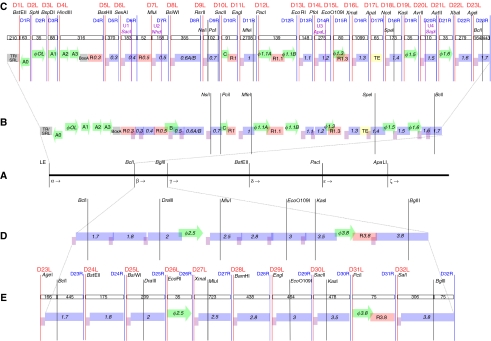
Genome design. (A) We split the wild-type T7 genome into six sections, alpha through zêta, using five restriction sites unique across the natural sequence. (B) Wild-type section alpha genetic elements: protein coding regions (blue), RBSs (purple), promoters (green), RNaseIII recognition sites (pink), a transcription terminator (yellow), and others (gray). Elements are labeled by convention (Dunn and Studier, 1983). Images are not to scale, but overlapping boundaries indicate elements with shared sequence. The five useful natural restriction sites across section alpha are shown (black lines). (C) T7.1 section alpha parts. Parts are given integer numbers, 1–73, starting at the left end of the genome. Unique restriction site pairs bracket each part (red/blue lines, labeled D[part #]L/R). Added unique restriction sites (purple lines, U[part #]) and part length (# base pairs, open boxes) are shown. We do not know if sequence changes in and around parts 6 and 7 destroy the minor E. coli promoter, B. (D) Wild-type section beta genetic elements. (E) T7.1 section beta parts. Supplementary Figure S2 depicts the six sections, alpha through zêta, which make up the T7.1 genome.
Figure 3
Figure 3
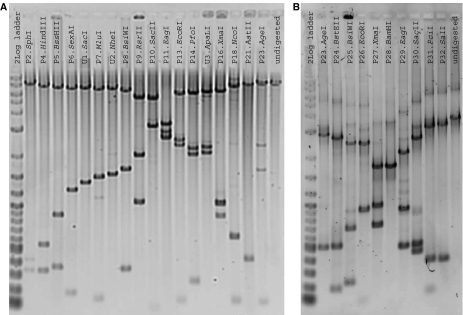
Cutting parts from T7.1. (A) Restriction enzymes specific to the sites that bracket parts (P#.Enzyme) and added unique restriction sites (U#.Enzyme) were used to cut section alpha (Supplementary information). A subset of the digests is shown. As built, part 1 cannot be removed. (B) Restriction digests cutting out all parts in section beta. As built, part 28 cannot be removed.
Figure 4
Figure 4
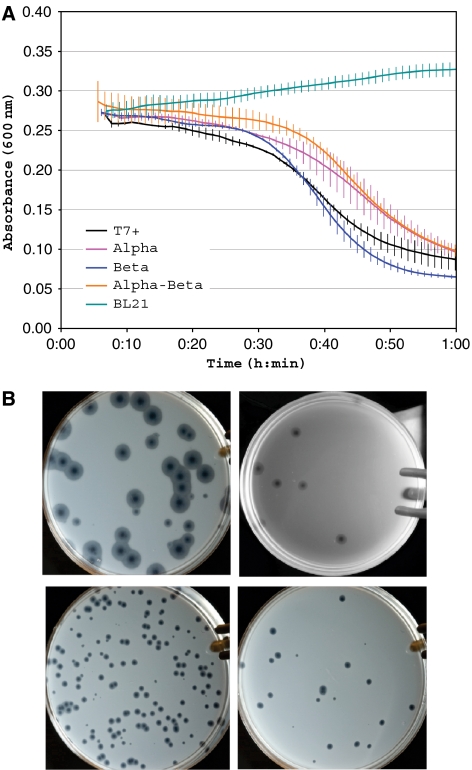
Characterization of T7.1 (A) Lysis of log-phase liquid cultures of E. coli BL21 (30°C) by wild-type T7 (black), alpha-WT chimera (red), WT-beta-WT chimera (blue), alpha-beta-WT chimera (orange); absorbance of 0.275 is ∼2E8 cells/ml. Vertical bars show standard deviation at each time point (based on four replicates) (Supplementary information). (B) T7 plaques on E. coli BL21 (24 h, 37°C, 10 cm Petri dish). Clockwise from top left: wild-type (WT) T7, alpha-WT chimera, WT-beta-WT chimera, alpha-beta-WT chimera (Supplementary information).

Comment in

  • Engineering novel life.
    Knight TF. Knight TF. Mol Syst Biol. 2005;1:2005.0020. doi: 10.1038/msb4100028. Epub 2005 Sep 13. Mol Syst Biol. 2005. PMID: 16729055 Free PMC article. No abstract available.

References

    1. Abelson H, Sussman GJ, Sussman J (1996) Structure and Interpretation of Computer Programs, 2nd edn. Cambridge, MA, USA: MIT Press
    1. Aho A-C, Donner K, Hyden C, Larsen LO, Reuter T (1988) Low retinal noise in animals with low body temperature allows high visual sensitivity. Nature 334: 348–350 - PubMed
    1. Block SM, Segall JE, Berg HC (1982) Impulse responses in bacterial chemotaxis. Cell 31: 215–226 - PubMed
    1. Boothroyd JC, Hayward RS (1979) New genes and promoters suggested by the DNA sequence near the end of the coliphage T7 early operon. Nucleic Acids Res 7: 1931–1943 - PMC - PubMed
    1. Carlson R (2003) The pace and proliferation of biological technologies. Biosecur Bioterror 1: 203–214 - PubMed

Publication types

MeSH terms

Associated data