


Association analyses of CYP19 gene polymorphisms with height variation in a large sample of Caucasian nuclear families
- PMID: 16733710
- PMCID: PMC1829483
- DOI: 10.1007/s00439-006-0199-9
Association analyses of CYP19 gene polymorphisms with height variation in a large sample of Caucasian nuclear families
Abstract
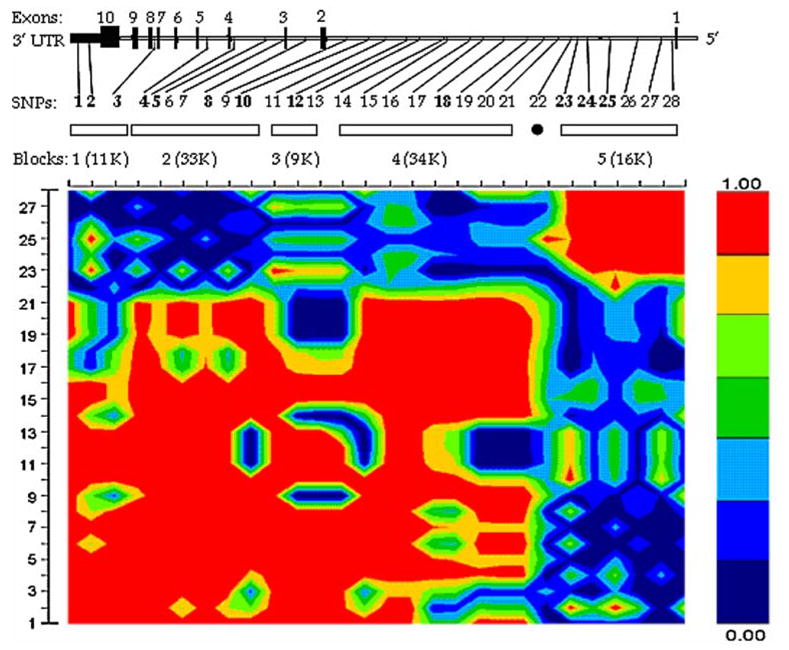
Human height is a complex trait regulated by multiple genetic and environmental factors. CYP19 (cytochrome P450 19) encodes aromatase, which catalyses the rate-limiting step in the conversion of androgens to estrogens. Deleterious mutations in CYP19 can result in estrogen deficiency that will influence adult height to certain extent. In the present study, we aimed to test the associations between the CYP19 gene polymorphisms with adult height variation, using family-based association methods, such as QTDT (quantitative transmission disequilibrium test) and FBAT (family-based association test) in 1,873 subjects from 405 Caucasian nuclear families. We found one SNP (rs730154) significantly associated with height by both QTDT (P=0.0030) and FBAT (P=0.0016) analyses. Haplotype analyses corroborated our single-marker results by showing that the haplotypes in block 4 containing rs730154 were significantly associated with height variation. We thus concluded that CYP19 could be one of the genetic factors influencing adult height in Caucasians. Further studies are required to identify the causal functional variants responsible for Caucasian height within the CYP19 gene.
Figures
References
-
- Abecasis GR, Cookson WO. GOLD—graphical overview of linkage disequilibrium. Bioinformatics. 2000;16:182–183. - PubMed
-
- Abecasis GR, Cherny SS, Cookson WO, Cardon LR. Merlin—rapid analysis of dense genetic maps using sparse gene flow trees. Nat Genet. 2002;30:97–101. - PubMed
-
- Carmichael CM, McGue M. A cross-sectional examination of height, weight, and body mass index in adult twins. J Gerontol A Biol Sci Med Sci. 1995;50:B237–B244. - PubMed
-
- Forriol F, Shapiro F. Bone development: interaction of molecular components and biophysical forces. Clin Orthop Relat Res. 2005;(432):14–33. - PubMed
Publication types
MeSH terms
Substances
Grants and funding
LinkOut - more resources
Full Text Sources
