


Non-alcoholic fatty liver disease may not be a severe disease at presentation among Asian Indians
- PMID: 16733858
- PMCID: PMC4087872
- DOI: 10.3748/wjg.v12.i21.3400
Non-alcoholic fatty liver disease may not be a severe disease at presentation among Asian Indians
Abstract
Aim: To evaluate the clinical and biochemical profile of patients with non alcoholic fatty liver disease (NAFLD) and to assess their histological severity at presentation.
Methods: Consecutive patients presenting to the liver clinic of All India Institute of Medical Sciences (AIIMS) with raised transaminases to at least 1.5 times upper limit of normal, and histologically confirmed non-alcoholic fatty liver disease were included. Patients who had significant alcohol intake or positive markers of other liver diseases or who were taking drugs known to produce fatty liver were excluded. The clinical, biochemical and histological profile of this group was studied.
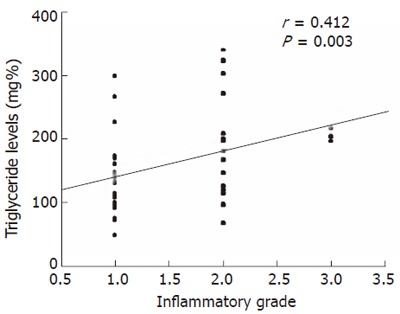
Results: Fifty-one patients with NAFLD formed the study population. Their median age and BMI were 34(17-58) years and 26.7(21.3-32.5) kg/m(2) respectively and 46 (90.1%) were males. The majority of the patients had mild inflammation, either grade 1 [32 (63%)] or grade 2 [16 (31%)] and only 3 (6%) patients had severe (grade 3) inflammation. Twenty-three (45%), 19 (37%), 8(16%) and 1(2%) patient had stage 0, 1, 2 and 3 fibrosis respectively on index biopsy and none had cirrhosis. On univariate analysis, triglyceride levels more than 150 mg % (OR = 7.1; 95% CI: 1.6-31.5, P = 0.002) and AST/ALT ratio>1 (OR = 14.3; 95% CI: 1.4-678.5, P = 0.008) were associated with high grades of inflammation and none was associated with advanced fibrosis. On multivariate logistic regression analysis, hypertriglyceridemia >150 mg% was the only factor independently associated with presence of high grade of inflammation (OR = 1.6; 95% CI: 1.3-22.7, P = 0.02), while none was associated with advanced fibrosis. Triglyceride levels correlated positively with inflammatory grade (r = 0.412; P = 0.003).
Conclusion: NAFLD in North Indian patients is a disease of young over-weight males, most of whom are insulin resistant and they tend to have a mild histological disease at presentation.
Figures
Comment in
-
Indian patients with nonalcoholic fatty liver disease presenting with raised transaminases are different at presentation.World J Gastroenterol. 2007 Jan 28;13(4):649-50. doi: 10.3748/wjg.v13.i4.649. World J Gastroenterol. 2007. PMID: 17278239 Free PMC article. No abstract available.
References
-
- Adams LA, Sanderson S, Lindor KD, Angulo P. The histological course of nonalcoholic fatty liver disease: a longitudinal study of 103 patients with sequential liver biopsies. J Hepatol. 2005;42:132–138. - PubMed
-
- Matteoni CA, Younossi ZM, Gramlich T, Boparai N, Liu YC, McCullough AJ. Nonalcoholic fatty liver disease: a spectrum of clinical and pathological severity. Gastroenterology. 1999;116:1413–1419. - PubMed
-
- Lee RG. Nonalcoholic steatohepatitis: a study of 49 patients. Hum Pathol. 1989;20:594–598. - PubMed
-
- Bugianesi E, Leone N, Vanni E, Marchesini G, Brunello F, Carucci P, Musso A, De Paolis P, Capussotti L, Salizzoni M, et al. Expanding the natural history of nonalcoholic steatohepatitis: from cryptogenic cirrhosis to hepatocellular carcinoma. Gastroenterology. 2002;123:134–140. - PubMed
-
- Yoshioka Y, Hashimoto E, Yatsuji S, Kaneda H, Taniai M, Tokushige K, Shiratori K. Nonalcoholic steatohepatitis: cirrhosis, hepatocellular carcinoma, and burnt-out NASH. J Gastroenterol. 2004;39:1215–1218. - PubMed
MeSH terms
Substances
LinkOut - more resources
Full Text Sources
Medical
